

How to Study a Miracle? (On the Turin Shroud)
American chemist Raymond Rogers has cast doubt on the radiocarbon dating of one of the most famous Christian relics—the Shroud of Turin. To understand the significance of this claim, it is worth saying a few words about the object of study itself. In the mid-14th century, a cloth bearing the image of a human body was put on public display in France. Even then, there were two diametrically opposed views on what this infamous piece of fabric actually was. According to one version, it is the shroud with which Joseph of Arimathea wrapped the executed Savior, while according to another (supported by some historical data)—it is merely a later forgery. The Orthodox Church adheres to the first view. Thus, Patriarch Alexy consecrated a copy of the Shroud of Turin, kept at the Sretensky Monastery in Moscow, as an image of the Savior not made by human hands. The Catholic Church (which owns the original) has taken a cautious stance. It considers the shroud not a relic, but an object that fosters faith (that is, it places it in the same category as icons). The Pope, however, suggests drawing conclusions about the nature of this object based on scientific data. Alas, scientific data on the Shroud remains scarce.
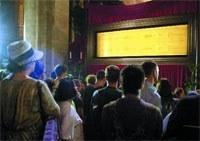
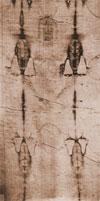
One thing is clear: it is not a crude forgery. There are no traces of paint on the fabric, and the proportions of the figure imprinted on it are such that a medieval artist could not have painted them. The latter would certainly have adhered to the canons of human figure representation of the time, yet the image on the shroud does not contradict anatomy, with the exception of a few significant anomalies. For example, one arm of the figure depicted on it is 10 cm longer than the other, and the feet appear to be an extension of the shins, lying on the same axis. Furthermore, the man’s body bears the same wounds that were supposedly on the body of Jesus Christ, and the blood has not congealed. Supporters of the shroud’s miraculous origin believe that the marks on the fabric were left by light emanating from the resurrected Christ. There is, of course, no convincing scientific evidence to support this view.
It is clear that the image is more of a “negative,” from which the features of the face imprinted on it can be reconstructed. It appears that the face, the shape of the beard, and the mustache are more characteristic of a late medieval European than of a Jew from the beginning of our era. The posture of the deceased (with hands modestly covering the groin) also corresponds to the Middle Ages. Finally, according to Jewish tradition (and the text of the Gospel), Christ’s body should have been wrapped differently than the body of the man who left the imprint on the shroud. In fact, the Shroud of Turin did not even fit snugly around the body.
If the fabric had covered the face, its imprint would have been wider and would have shown traces of folds, whereas what we see is more like a projection of the face onto a flat surface. Another oddity is that in a lying position, a person’s hair should fall toward the back of the head, not frame the face as in a portrait. Apparently, the process of forming the image resembled photography. The parts of the body that were closer to the plane of the cloth were imprinted more clearly, which allowed for a three-dimensional reconstruction. The bloodstains were likely applied to the cloth artificially. The image is close in style to 14th-century religious painting, but it reflects knowledge that had been lost by that time: during crucifixion, the nails were driven not into the palms, but into the wrists… So how old is the shroud after all? It would seem that the answer is provided by a radiocarbon dating study conducted in 1988 (which examined the fabric’s C-14 isotope content). Three laboratories, working independently of one another, obtained very similar results. It can be stated with a high degree of certainty that the examined fragment was created between 1260 and 1390.
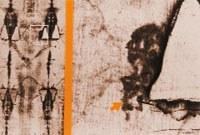
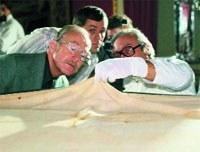
But a fragment is not the entire Shroud! Alas, when samples were taken (at the Church’s insistence), deviations from strict protocol were allowed: for example, scientists were not present during this procedure. Rogers, who worked with one of the fragments in late 2003, asserts that a piece of a patch sewn onto the original fabric was taken for radiocarbon dating. In the 16th century, the Shroud was damaged in a fire, and the monks had to restore it, dyeing the new fabric to match the old one. So, the American chemist allegedly discovered traces of this dyeing. Using other fragments of the shroud, which he considers the oldest, Rogers attempted to estimate their age based on the rate of chemical changes occurring in the linen fabric. In his opinion, the main part of the shroud is between 1,300 and 3,000 years old. The inaccuracy of the estimate and the tendency of human memory to retain the larger of the two figures led to reports by some news agencies that the shroud is older than Christ. Scientific progress gives rise to ever-new methods that can be applied to the study of the relic. Debates continue over the interpretation of pollen samples taken from the shroud. To date, the most promising approach appears to be the analysis of DNA contained in the fabric. Alas, it will not be easy to distinguish the DNA of the man depicted on the shroud from the DNA of the believers who have venerated this relic. And besides—how can one identify the DNA of the Son of God? So, there are still no irrefutable facts that would allow for a final verdict. Even if we consider the results of radiocarbon dating to be erroneous, explaining many of the shroud’s other peculiarities is no easy task. Accepting the second version, however, implies that 14th-century forgers developed some original technique for creating an image on fabric. Was this really necessary to deceive believers who were already not particularly critical? Whose face do we see in the photographs reproduced here: Jesus of Nazareth or a participant in medieval forgeries of antiquities? Despite Rogers’ claims, the second option seems more plausible. However, scientific data will not convince those who believe in miracles. And can science confirm a miracle? Since a miracle defies the laws of nature, it cannot be proven by methods based on the assumption that these laws operate consistently. So what remains? All that remains is to wait for new data. In the meantime, some will believe despite facts that contradict their faith, while others will seek a rational explanation. D. Shabanov. How to Study a Miracle? // Kompyuterra, Moscow, 2005. – No. 5 (577). – pp. 18–19