
Probable History of the Emergence of Orthograde Locomotion
Probable history of the emergence of orthograde locomotion
I set out to describe the phenomenon of bipedalism. At first it seemed relatively simple, but when considered in historical formation, I could not find a single definitive answer; instead, there are many hypotheses.
The first attempts at upright walking are dated by researchers to about 6 million years ago (Drobyshevsky, 2012). These were only attempts, since tree climbing and forelimb-knuckle support were still highly important.
After analyzing a range of literature, I concluded that in the problem of bipedalism—as in many other questions addressed by evolutionists and anthropologists—there is no full consensus, only logically connected assumptions. On this basis, I interpret bipedalism as a forced adaptation: the need for it emerged in connection with the development of labor activity and increasing use of open habitats. If the first reason is fairly well grounded, the second has substantial objections among researchers. Bipedalism is also explained by bioenergetic and thermoregulatory advantages. [1]
According to the geochronological scale, apes referred to as Hominoidea appeared in the Cenozoic Era, Paleogene Period, Oligocene Epoch. As the name implies, their body plan had traits similar to humans. They lived mainly in trees. Their locomotion is characterized by brachiation (from Latin brachium, shoulder): movement by swinging with the arms. Although this is not human bipedal movement, two limbs were predominant in movement (whereas the neighboring superfamily Cercopithecoidea uses all four limbs in locomotion). Some researchers consider Parapithecus a possible ancestor, but fossil remains are scarce. Therefore, I begin the evolutionary line with the superfamily of great apes.
Neogene period: australopithecines.
S. V. Drobyshevsky (PhD in Biology, Associate Professor, Department of Anthropology, Faculty of Biology, Lomonosov Moscow State University) suggests that early australopithecines may be considered an intermediate link between ape and human, including in relation to upright locomotion. In their way of life, some progress is also evident: from predominantly arboreal life to broader wandering across savannas, forests, and waterbody shores.
Table 1. Traits of bipedal locomotion (after S. V. Drobyshevsky).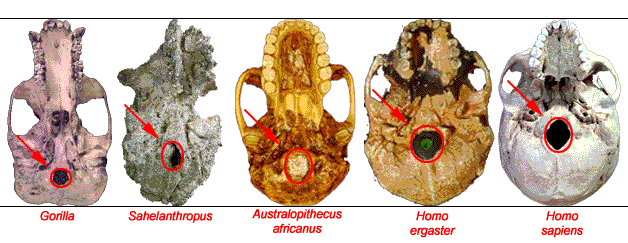
In later hominins, the set of bipedal traits became increasingly pronounced: an anterior position of the foramen magnum, changes in pelvic structure, lower-limb elongation, and foot arch formation. At the same time, some climbing-related features persisted for a long time.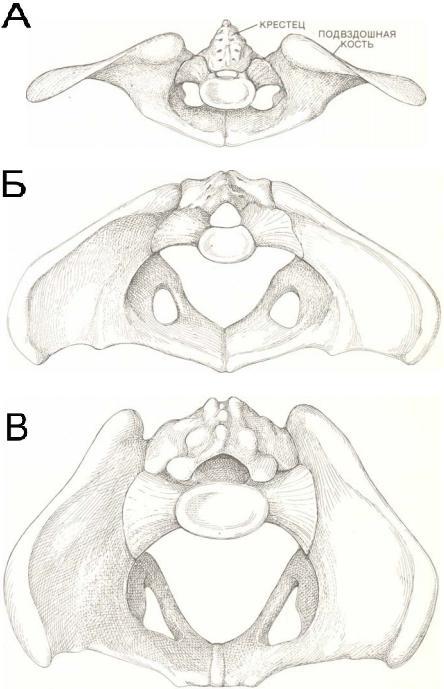
The emergence of stable orthograde locomotion can therefore be seen as a mosaic process: selection acted on different anatomical systems at different rates. Energy economy during long-distance movement, improved thermoregulation in open landscapes, and behavioral changes linked to manipulation and carrying could all have contributed.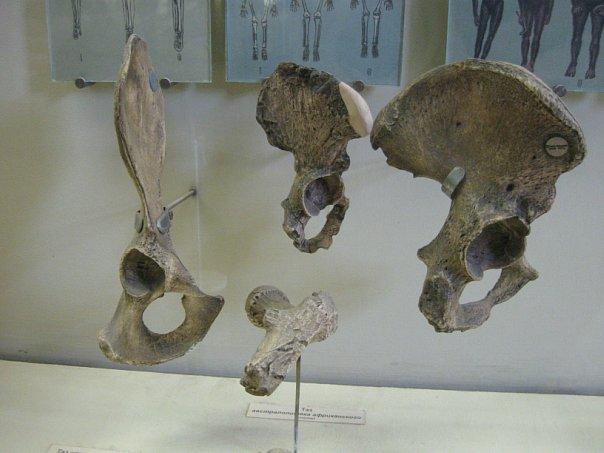
In summary, bipedalism was likely not a one-time event but a prolonged trajectory of adaptive compromises. Its history combines ecological shifts, biomechanical constraints, and social-behavioral innovations.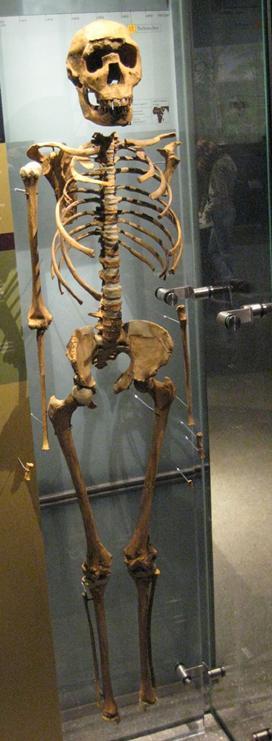
|
In later hominins, the set of bipedal traits became increasingly pronounced: an anterior position of the foramen magnum, changes in pelvic structure, lower-limb elongation, and foot arch formation. At the same time, some climbing-related features persisted for a long time. |
|
|
| The emergence of stable orthograde locomotion can therefore be seen as a mosaic process: selection acted on different anatomical systems at different rates. Energy economy during long-distance movement, improved thermoregulation in open landscapes, and behavioral changes linked to manipulation and carrying could all have contributed. | |
| In summary, bipedalism was likely not a one-time event but a prolonged trajectory of adaptive compromises. Its history combines ecological shifts, biomechanical constraints, and social-behavioral innovations. | |
|
Narrow and tall |
| Structure of the long bones of the legs | |
| The legs are long, the hip joints are widely spread apart owing to the great width of the pelvis, and the knees are brought together | The arms are longer than the legs, the knees are splayed outward 'bow-legged' and are always half-bent, the feet are set apart, so that when walking on two legs the ape moves with a rolling gait, compensating for instability with strong lateral swaying of the trunk |
| Structure of the foot | |
| The arch of the foot is pronounced, the big toe is not turned to the side and is barely mobile | The foot is flat, the toes are long, curved, mobile; the big toe has a grasping function and can be strongly abducted to the side |
| Structure of the arms | |
| The arms are short, the phalanges of the fingers are straight | Morphological adaptations for climbing trees and for support on the phalanges of bent fingers when walking |
| Structure of the spine | |
| The spine is oriented vertically and has characteristic curves - lordoses and kyphoses; the sizes of the vertebrae increase regularly from top to bottom; the sacrum is broad and short | There are no cervical or lumbar lordoses, and the sizes of the vertebrae differ less regularly; the sacrum is narrow and long. |
Fig. 1. Position of the foramen magnum. [2] The above-listed features of upright-walking forms were precisely characteristic of various australopith representatives: the skull of Sahelanthropus tchadensis; the femurs of Orrorin tugenensis ; the skull fragments, limb bones and pelvic remains of Ardipithecus ramidus kadabba and Ardipithecus ramidus ramidus .
|
|
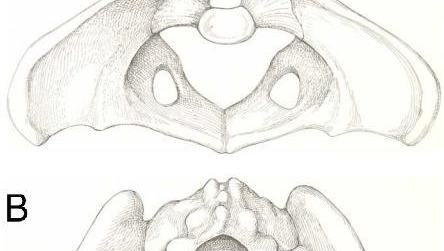
| Fig. 2. Rotation of the iliac bones [3] |
Fig. 3. From left to right: the pelvis of a chimpanzee, Australopithecus africanus, of the human. Palaeontologicallyand museum, Moscow. [2] |
Probable history of the emergence of orthograde locomotion
I set out to describe the phenomenon of bipedalism. At first it seemed relatively simple, but when considered in historical formation, I could not find a single definitive answer; instead, there are many hypotheses.
The first attempts at upright walking are dated by researchers to about 6 million years ago (Drobyshevsky, 2012). These were only attempts, since tree climbing and forelimb-knuckle support were still highly important.
After analyzing a range of literature, I concluded that in the problem of bipedalism—as in many other questions addressed by evolutionists and anthropologists—there is no full consensus, only logically connected assumptions. On this basis, I interpret bipedalism as a forced adaptation: the need for it emerged in connection with the development of labor activity and increasing use of open habitats. If the first reason is fairly well grounded, the second has substantial objections among researchers. Bipedalism is also explained by bioenergetic and thermoregulatory advantages. [1]
According to the geochronological scale, apes referred to as Hominoidea appeared in the Cenozoic Era, Paleogene Period, Oligocene Epoch. As the name implies, their body plan had traits similar to humans. They lived mainly in trees. Their locomotion is characterized by brachiation (from Latin brachium, shoulder): movement by swinging with the arms. Although this is not human bipedal movement, two limbs were predominant in movement (whereas the neighboring superfamily Cercopithecoidea uses all four limbs in locomotion). Some researchers consider Parapithecus a possible ancestor, but fossil remains are scarce. Therefore, I begin the evolutionary line with the superfamily of great apes.
Neogene period: australopithecines.
S. V. Drobyshevsky (PhD in Biology, Associate Professor, Department of Anthropology, Faculty of Biology, Lomonosov Moscow State University) suggests that early australopithecines may be considered an intermediate link between ape and human, including in relation to upright locomotion. In their way of life, some progress is also evident: from predominantly arboreal life to broader wandering across savannas, forests, and waterbody shores.
Table 1. Traits of bipedal locomotion (after S. V. Drobyshevsky).
In later hominins, the set of bipedal traits became increasingly pronounced: an anterior position of the foramen magnum, changes in pelvic structure, lower-limb elongation, and foot arch formation. At the same time, some climbing-related features persisted for a long time.
The emergence of stable orthograde locomotion can therefore be seen as a mosaic process: selection acted on different anatomical systems at different rates. Energy economy during long-distance movement, improved thermoregulation in open landscapes, and behavioral changes linked to manipulation and carrying could all have contributed.
In summary, bipedalism was likely not a one-time event but a prolonged trajectory of adaptive compromises. Its history combines ecological shifts, biomechanical constraints, and social-behavioral innovations.