
The internal is more important than the external. Column in ComputerreOnline #86
A successful organismal construction turns out to be a trap from which it is practically impossible to escape without reorganizing the nature of selection. A biospheric crisis can release it.
I have already written that the Faculty of Biology at Kharkiv University holds annual biological conferences for young scientists. For the opening we invite established specialists, whom we ask to tell something interesting for a large audience. Usually some of the plenary reports are given by "our own", and for others we invite guests from afar. The most interesting guests conduct a round table the next day, where one can calmly talk with them.
In this role, four guests from Russia have already appeared: Alexander Alexandrovich Nikolsky, a renowned specialist in the preservation field, Alexander Vladimirovich Markov, a paleontologist and a brilliant popularizer of biology in the post‑Soviet space, Anatoliy Ilyich Protopopov, a generator of original ideas about human mating behavior, and, finally, this week, Alexander Pavlovich Rasnitsyn.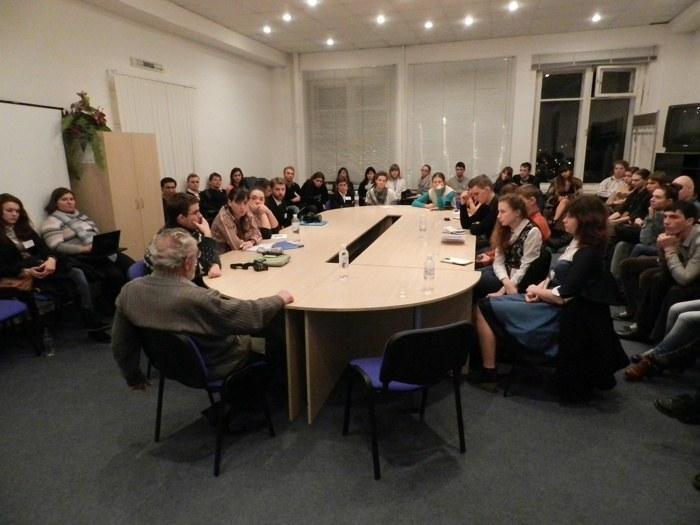
Alexander Pavlovich is known as a paleoentomologist (specialist in fossil insects) and as a theorist of evolutionary biology and systematics. "Wikipedia" reports that he is the author of descriptions of 250 genera and 800 species, especially among his favourite group – the Pterygota. He is an internationally recognized specialist who was once elected President of the International Paleontological Society. A field researcher who has worked in many countries. A theorist whose ideas entered Ukrainian school textbooks more than ten years ago. Creator of the adaptive compromise concept, one of the authors of the epigenetic theory of evolution. Some of his ideas were discussed in one of the previous columns. Well, this is one layer that can be described by listing various achievements.
Another layer manifested in the reaction of my colleagues and me, the impression left by communication with Alexander Pavlovich. We were simply enchanted. Judging by the fact that, when answering a question or reacting to a remark in conversation, Alexander Pavlovich immediately grasps the essence and says what is needed, his thoughts work swiftly. This is somehow unusually combined with unhurriedness and clear speech control, expressive articulation.
What else? Ease of communication, absence of a professorial fee. Experience of personal acquaintance and friendship with many people who have become the pride of biology (and not only biology). An elderly man (has passed three‑quarters of a century), whose backpack cannot be taken away to help him carry, and who looks quite natural with that backpack. In general, a person pleasant to be around.
One of the purposes of inviting masters to a youth scientific conference is to show students what specialists are like. I am very glad that Rasnitsyn visited us – a professional of the highest calibre.
And if he is a professional, then we should focus on what he works on, what he thinks about, and what he tells.
The plenary lecture was devoted to the impact of the Permian‑Triassic crisis on insect diversity. This is not speculative construction, but the result of many years of research on a series of faunas (each from a specific place and time), allowing us to judge what happened to this most numerous group of terrestrial animals at the boundary of the Paleozoic and Mesozoic eras.
Here I must say what this is about. The geological history of Earth is divided into eras and periods largely on the basis of changes in characteristic floras and faunas preserved in sedimentary rocks. We are all familiar with the faunal turnover at the Mesozoic‑Cenozoic boundary (the Meso‑Paleogene crisis). Around that time the dinosaurs and many other animal groups went extinct. The Permian‑Triassic crisis, which has attracted Alexander Pavlovich's attention in recent years, was even deeper.
If you watch Western popular science films, you have long been told why the dinosaurs died out: a big asteroid hit – bam! – and ecological space on Earth was freed for mammals. The fact that the formation of new dinosaur species had ceased long before the impact, and that at the moment of impact their fauna was extremely impoverished, and that in some parts of the globe dinosaurs survived the asteroid fall, is often overlooked.
Geologists have found explanations for almost all mass extinctions in Earth’s history. Permo‑Triassic events, for example, are commonly explained by catastrophic eruptions in Siberia. That such eruptions occurred is undeniable. Whether they played a decisive role in evolution is harder to say; now it seems the conclusion is that mass extinctions occurred before geological perturbations.
Geologists (and other non‑biologists) find it easier to view changes in diversity over time as a process dependent on external conditions. The geological environment of the planet changed – and life, having nowhere else to go, was forced to adapt to the new conditions. It is much more difficult to discern the internal logic and the surprisingly high degree of independence of biological evolution from various catastrophes. The title of this column is a kind of metaphorical summary of Alexander Pavlovich’s lecture, the presentation of which he allowed to be made publicly available – thanks to him for that!
Returning to what insects experienced at the Paleozoic‑Mesozoic boundary. Rasnitsyn and his team carried out a thorough analysis of a huge amount of material. Data were obtained on the dynamics of appearance and extinction of insect species, genera and families – sufficiently comprehensive measures of the evolutionary speed of groups. These data were compared with the estimates of the dynamics of all other organism groups, including marine ones, held by paleontologists worldwide. An unexpected conclusion was reached.
For most of the Paleozoic era, animal diversity stabilized at roughly one level. Mass extinctions occasionally reduced the number of organism groups inhabiting Earth, but it quickly recovered to the previous level. Then (shortly before the Siberian eruptions, but apparently unrelated to them) something happened that first led to a sharp drop in diversity and then to the beginning of its continuous increase. This growth (despite some fluctuations) continues to the present day – see the graphs in the presentation to the lecture.
Thus, the cause of the studied events is most likely internal to the biosphere. What could it be? Something changed in biological communities. If previously they had a constant capacity (which can be expressed as the number of ecological niches representing the possibilities for a certain number of species), after the described events this capacity began to grow. Unfortunately, as Alexander Pavlovich said, we know too little about even the current organization of biological communities, and we simply have no basis for assumptions about what changed in them at the Permian‑Triassic boundary.
But although we do not know what restrained evolution before the crisis, we can, in the most general form, hypothesize what opened new pathways for it after all the changes. Alexander Pavlovich invokes his own adaptive compromise concept to explain this phenomenon.
Organisms are complex systems with many internal interconnections. An ecologically stable environment tests their organization by many parameters, weeding out individuals that carry certain deficiencies. It is clear to us that optimization of a system can be effective when it is carried out on a single parameter.
Optimization on two unrelated, and sometimes mutually exclusive, parameters is almost hopeless. In the real world there are many such parameters. An organism must develop sustainably, resist adverse factors, feed efficiently, escape predators, defend against parasites, not be outcompeted, successfully find a partner and leave enough offspring.
Finding a solution optimal with respect to all these requirements is impossible. The only way out is compromise. Unfortunately, once a compromise found in evolution becomes a trap. It is not enough for selection to improve some characteristic of a species; it is important that the improvement does not lead to the breakdown of other functions. Alexander Pavlovich compares such restructurings to trying to change a car’s design while it is moving (using a metaphor similar to the one I used in the previous column). However, if selection control over some system functions can be weakened, other functions can be dramatically improved.
Something similar happens with agricultural plants and animals: freeing them from the need to survive in a hostile environment allows us to hypertrophically develop some of their functions (running speed in racehorses, egg‑laying rate in layers, sugar accumulation in the root of sugar beet, or leaf head development in cabbage).
From this it follows that a successful organism design becomes a trap from which it is practically impossible to escape without a radical change in conditions and a reorganization of selection pressures. According to Rasnitsyn, to release diverse organism groups from such a trap, a crisis is needed. And the crisis at the Permian‑Triassic boundary was able to overcome the "ossification" of the biota, opening new horizons of complexity for it.
So, have evolving species since then avoided the trap that limits their diversity? They do fall into it. But for some reason, since the described events, the whole fauna and flora no longer fall into such a trap as a whole. This can be described roughly as follows.
In the second half of the Paleozoic, the evolution of the structure of biological communities reached a state of stable equilibrium. Some groups went extinct, others appeared, but the set of roles performed by living beings in the biosphere remained relatively constant. Then, not so much because of external influences as because of the fragility of the "ossified" communities, the whole structure collapsed. Ecosystems became more diverse, and the number of possible roles – and consequently the number of different "actors" – began to increase. Since then the biosphere has not been able to reach a new stable state. Our appearance, by the way, is a consequence of this instability.
...What has been said is based on many assumptions. It is, of course, not a description of established facts but a hypothesis, and a very vague one at that. Yet it can become a basis for testing, refinement and development or for refutation and the search for new explanations. I am very glad that at our Faculty of Biology of V.N. Karazin Kharkiv National University such problems were discussed. We had the pleasure of listening to a person who, processing truly massive data sets, feels out ways for further growth of our understanding of evolutionary patterns.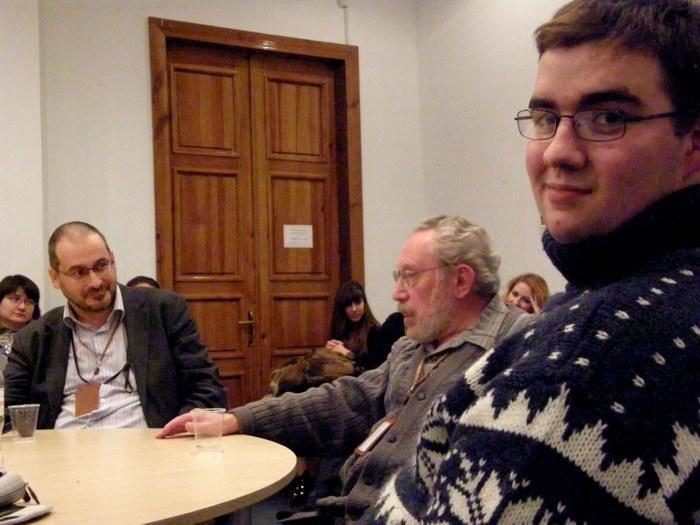
But that is not all. Alexander Pavlovich held a round table in Kharkiv dedicated to problems of the development of evolutionary theory and phylogenetics (the photos in this column were taken there; thanks to Valentyna Inshyna for the second one). The round table mainly discussed the epigenetic theory of evolution, since Alexander Pavlovich is one of the people involved in its emergence and development. I have long planned to talk about the epigenetic theory in more detail and even prepared a suitable "lead‑in", but it did not work out. Well, in that case – next time.