

Frog poison, an unsuccessful experience of going into business, and doubt about the innovative prospects of university science. Column for Kompyutera #101
Under those circumstances, we had to do not what we were good at, but what real customers were willing to pay for.
← Dmytro Shabanov → The hundredth column: an attempt to catch my breath, look back and understand what I am doing and why Toad venom, an unsuccessful experience of going into business, and doubts about the innovative prospects of university science The evolution of evolution: from genetic heredity to the intratechnical replication of t-memes Column for Computerra #100 Column for Computerra #101 Column for Computerra #102 As the spawning of common toads approached, I began to recall how I started studying their population ecology.
This year will already be the fourteenth in which my colleagues and I will mark toads in our beloved population… You know, I thought that the story of how I took up toads might prove instructive for some potential readers. If you don't mind, I'll plunge into reminiscences. …It was in the summer of 1991, at the collapse of the Soviet Union.
I had graduated from the biology faculty, was assigned as a lecturer to the department I had graduated from, and flew off to the Ili Desert in Kazakhstan, without even staying for the diploma ceremony.
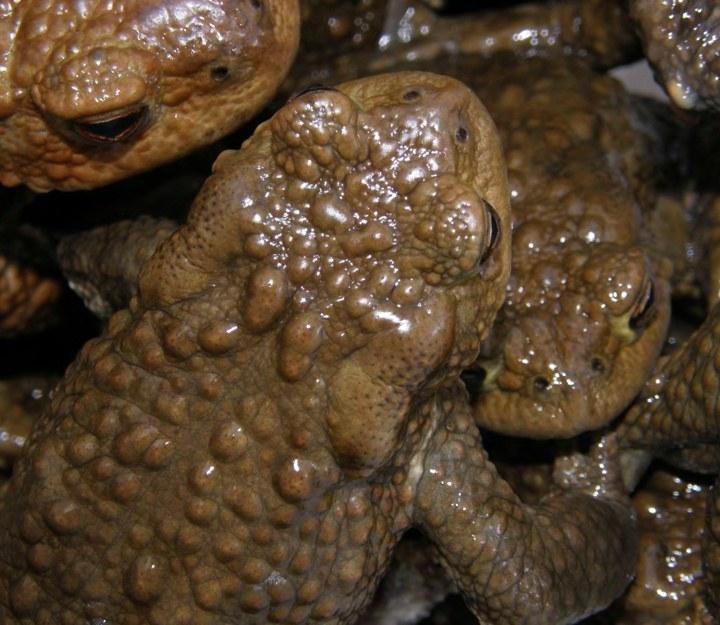
At that time one of the high-ranking government officials passed on to our university a foreign request to develop a technology for obtaining toad venom. In my absence the commission was given to one of my ornithologist colleagues, and when I returned I too was brought into the work. We went through the literature available at the time, obtained an official (!) car and set off to catch toads. We caught few toads and obtained very little venom, yet somehow we learned the craft. We submitted the report to the client… and he had already lost interest in the topic. My colleague and I felt it would be a shame to abandon what we had started, and we decided to continue it at our own risk. Toad venom is interesting raw material. Its basis is steroidal toxins, bufadienolides. Each toad species' venom has its own sets of bufadienolides, which, moreover, can bind into complex compounds with other molecules. Bufadienolides activate the sodium-potassium pump in the cell membrane and affect the work of excitable tissues. The venom also contains the psychoactive amines bufotenins and much else of interest. The venom's field of application is the production of cardiac stimulants, anticancer drugs, potency-enhancing agents, and restorative, skin-"rejuvenating" ointments. The venom is produced by the toads' large parotoid glands. A predator biting a toad presses on the gland with its teeth and squeezes the venom out of it. By squeezing the glands, a toad can be "milked". The resulting parotoid-gland secretion is valuable pharmacological raw material. Do you see the bean-shaped parotoid glands located behind the toad's eyes? When pressed, the venom will burst from them. In 1991, a commercial fever spread across the withering Soviet Union. A multitude of people traded in animal venoms and precious metals.
From Kharkiv alone, no fewer than a dozen people went to Central Asia and the Transcaucasus for blunt-nosed vipers and saw-scaled vipers for illegal buyers. These people were not stopped even by the threat of the death penalty, which had supposedly been introduced in Azerbaijan at the time for the illegal catching of vipers. I also earned a living as a catcher, but I specialized in non-venomous reptiles that were of interest to Western terrarium-keepers. Even then I was ashamed that I caught wild animals, and now I understand that these actions were deeply immoral. But that is not the point… I went for vipers and saw-scaled vipers once, in the spring of 1991. On that trip, near Iolotan in Turkmenistan, I had the luck to observe in the field one of the most serious leaders of the venom business on the scale of the whole Soviet empire. He was an old man in his eighth decade, the author of many books and scientific works, an academician of one of the national academies. He travelled in an armoured army vehicle, accompanied by a team with Kalashnikov rifles. At scientific conferences the academician boasted that outside catchers who came onto "his" territories all, to a man, perished "from snakebites". By the way, in time the structure created by this academician lost out to other, more aggressive and less predictable teams. Among the dangers to which the catchers were exposed, snakes were far from first place. It was people who were truly dangerous. The competitors were dangerous. The police, who in the backwoods restrained themselves by no limits, were dangerous. Bandits were dangerous. And it was also said that you must not poke into certain districts, because they belonged to slave-holding operations. People who ended up there were turned into slaves, practically deprived of any chance of returning home alive. By the way, when I hear that Yeltsin, Kravchuk and Shushkevich buried a flourishing country in Belovezhskaya Pushcha — a family of friendly peoples where the common man felt protected — this somehow does not square with my own memories of 1990–1991. I did not like the snake-venom business, and I refused to take part in it. My partner on the trip to Iolotan went there once more, lost his catch, fell into debt, went again to pay it off, and never returned. Nevertheless, I gained both experience and contacts, and decided to use them in organizing the production of toad venom. The catchers, who risked their heads in the field, earned a pittance. The middlemen grew rich — but not all of them; some fell into losses and debts. The resale of venoms was strangely intertwined with the resale of metals. One of the vivid stories on this market was connected with "red mercury". The Wikipedia article tells fairly well about this non-existent substance. I just cannot agree that "red mercury" was invented by journalists. I knew a man who earned quite well on it. According to him, the scheme for selling "red mercury" was as follows. A buyer looking for this substance would reach a middleman. Then, supposedly independently, the middleman would learn of a conspiratorial seller of this product. With great difficulty he managed to buy a trial batch, which he resold a hundredfold. The seller would not agree to split the main batch. The middleman would invest all his property, run up debts, buy what he was offered, be left with a portion of useless rubbish in his hands, and look for ways not to wash it but, by rolling it on, to resell it further. My acquaintance saw through this game, earned well on one or two trial batches, and did not buy the main volume. And it was precisely he, a merchant capable of outplaying swindlers, who sold our toad venom. Where to — became clear much later. An Eastern European firm, which itself produced this product for a Western client, could not cope with production and substituted our venom for its own. By that time I had parted ways with the partner with whom we had started. The parting included visits from racketeers and threats to members of my family, but I managed to get through that stretch without losses and without deeds that prick the conscience. New partners and new opportunities appeared. The sales brought in big money for those times. I managed to insist on the decision to run the business not in a gangster way but in a civilized one. Officially, obtaining a legal product of the highest possible quality, investing the profit in developing the technology. Of course, this decision was a mistake. Both I and my partners, who agreed to this option, lost heavily. Under those conditions we should have done not what we could do well, but what real buyers were prepared to pay for. Perhaps, had the most perceptive of the partners — the one who sold the venom — been alive, we would not have made such a mistake. But he was killed, according to the investigation's version (which no one believed), almost by accident. We worked out a technology for exploiting natural toad populations without harming them. During spawning, several cars of collectors gathered the toads at the spawning grounds, delivered them to the milking team, and after processing perfected to the last detail, returned them to the spawning grounds. Each batch of venom was analysed using advanced methods. Medicinal products can be made at different levels of technology. At the first of them, you need to take a secret amount of natural raw material, carefully stir it with moonlight using a little spatula from a meadow bone hung up at full moon by a reddish maiden, and perform other similar actions. Such tinctures must be taken brimming with the expectation of a miracle. At the second level of technology, natural raw material is used that conforms to a certain pharmacological monograph describing the requirements for its composition. This is how, for example, ointments based on bee venom are made. To standardize bee venom is much simpler than toad venom. Finally, at the third level, one or several purified components of the natural raw material are used in a medicinal product, in their natural, modified or synthetic form. At the first level, toad venom is used in Asia (and in homeopathy all over the world). At the third level, its toxins are applied in Western Europe. The difficulties arise with the second level, the basic one for our pharmacy. The composition of this raw material is too variable! However, we learned to analyse and separate it. The steroidal toxins of toad venom are separated by high-performance liquid chromatography. A mixture of substances is pumped under high pressure through a column with a filler that interacts selectively with the substances under study. At the time, the world's best laboratories used two-dimensional chromatography to analyse toad venom. Each portion of substance washed out of the column was separately run on a medium with different properties. Our scientific team managed to develop a medium with nanoparticles, on which the full picture of the toxins was obtained in a single run. We refined the technology so that we needed only a small part of the venom of a single individual for analysis. We discovered that the composition of the venom was individual in each toad! Serious differences were found for different sexes and for toads from different (even closely located) local populations. We offered buyers both high-quality raw material and its individual components. And what came of it? We suffered a complete failure. We tried to act by the rules. I even submitted our business plan to a competition run by the French embassy, won free training and the chance to work with an excellent business consultant. Unfortunately, what the French taught us was of little use in our realities. They taught how to run a business in the hothouse environment of a state that helps entrepreneurs. To my idea of bringing in representatives of the mafia, who would share their experience of working in a state of war with all official structures, the French for some reason did not listen. We registered the enterprise after concluding a memorandum of intent with a large pharmaceutical company from Southeast Asia. This company opened a representative office with us, registered a number of its drugs (one — from toad venom), and planned to organize their production locally. We were full of hope when our clients' activity froze. After a certain pause they left the country, conveying their apologies to us. According to them, they were prepared to pay bribes once, when opening the business and registering the drugs. But it turned out that, in our officials' view, they were supposed to pay constantly. The leadership of the international company found this unacceptable, and it halted the whole project. We also had promising negotiations with one of the world leaders — a Western European company whose name everyone knows. We were offered the chance to organize production with a guaranteed, fairly large volume. When we realized we were ready to do it, our partners refused to cooperate. For their drug development they bought raw material on one of the exchanges in Moscow. After a series of small purchases they bought a large batch of counterfeit. The deal was insured. The insurance company recommended by the exchange explained that the insurance had been filled out incorrectly, and paid nothing. The company's leadership decided that they would have no dealings with the post-Soviet space and would organize production on their own farm: more expensive, but more reliable. What hurt most was when, through a brief personal acquaintance, we managed to reach the owner of a company in the USA who used a product analogous to ours. This worthy man praised our venom, noted its low price and exceptional quality. However, according to him, the cost of the raw material made up only a small part of the cost of his product, and he could not substantially cheapen production by switching to our raw material. Moreover, the image losses connected with using raw material from post-Chernobyl Ukraine could, by his account, wreck his entire business. From a certain moment on I stopped making any effort to produce and promote toad venom. I defended a dissertation on the population diversity of toads, in which I used our venom developments too, and moved on to questions of scientific rather than commercial interest. As long as we sold our product illegally, it was needed by someone, money was paid for it. The attempt to sell it officially, with good scientific support, turned out to be inadequate to the realities of our country and the role assigned to it in international business. And this is not a conspiracy of our enemies; it is the natural reaction to the character of the actions of a substantial part of our entrepreneurs (at least in the 1990s). And now a few words about something else.
Nowadays our leadership reproaches university science for being itself to blame for its lack of money.
Who is stopping us from producing an intellectual product for which business (whether domestic or foreign) will gladly pay real money? Only our laziness, nothing more!
So we are told. ← Dmytro Shabanov → The hundredth column: an attempt to catch my breath, look back and understand what I am doing and why Toad venom, an unsuccessful experience of going into business, and doubts about the innovative prospects of university science The evolution of evolution: from genetic heredity to the intratechnical replication of t-memes Column for Computerra #100 Column for Computerra #101 Column for Computerra #102