
IV. Amphibia sensu lato-03. Life Cycle and Spawning of Lissamphibia
The key to understanding the lifestyle peculiarities of extant lissamphibians is their life cycle. Here it is illustrated using select amphibians of the Kharkiv region as examples. Unfortunately, the distinctive features of the lissamphibian life cycle also render them particularly vulnerable. Among other things, these features are important for...
Life Cycle and Spawning of Lissamphibia (primarily using amphibians of the Kharkiv Region as examples)
Many amphibians lead a rather secretive existence. The apogee of their annual cycle is reproduction. This page is devoted to reproduction itself and to the extraordinary phenomena associated with it.
The first photograph on this page shows common toads (Bufo bufo) in amplexus, taken by O. V. Korshunov. This photograph was taken in the course of a long-term study of the common toad population inhabiting Iskov Pond in the vicinity of the Biological Station of V. N. Karazin Kharkiv National University. The authors of this textbook began monitoring the size of this population by mark-recapture methods in 2000. The year 2020 (the 21st year of observations) proved critical; this population nearly collapsed, but began recovering in 2021. Many of the photographs on this page were taken during this research.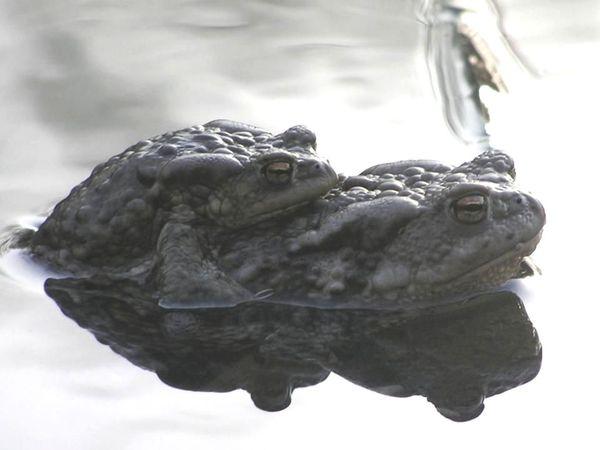
Spawning of common toads at Iskov Pond takes place in late March or early April. There is a fairly reliable phenological indicator that spawning has commenced: coltsfoot (Tussilago farfara) blooms during the spawning period...
...while Siberian squill (Scilla siberica) begins to fade.
Both the flowering of early spring plants and the emergence of toads from hibernation to spawn are triggered by the same factor: soil temperature at shallow depth.
Males are the first to arrive at the spawning grounds. In fine weather they wait for females at the water's edge...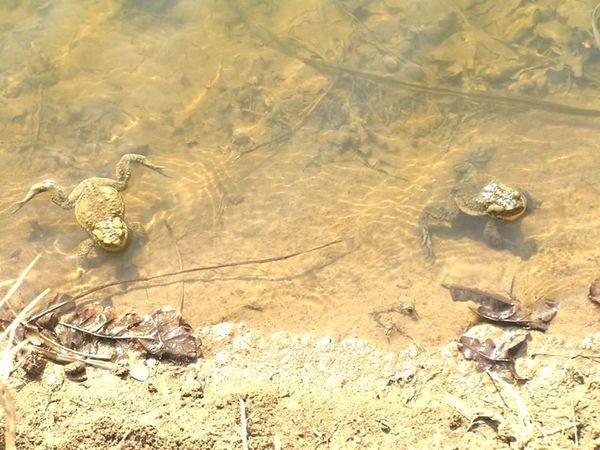
...while at other times, particularly during cold spells, they move to greater depths.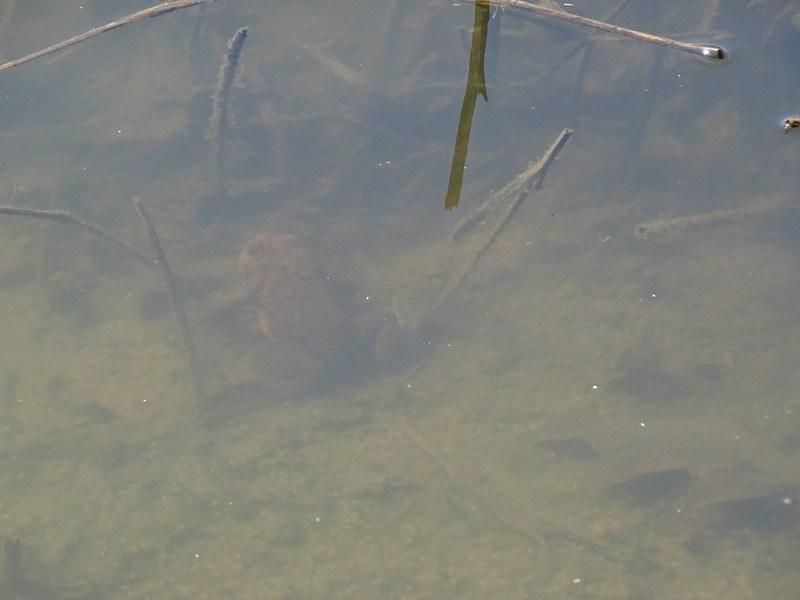
Different males select different positions while waiting for females. Males sometimes move from one part of the pond to another, attempting to find a more advantageous position. Observe, incidentally, how easily a common toad swims!
In a certain sense this is a lottery — where luck will strike is unknown in advance, but adopting the correct strategy can increase the probability of success.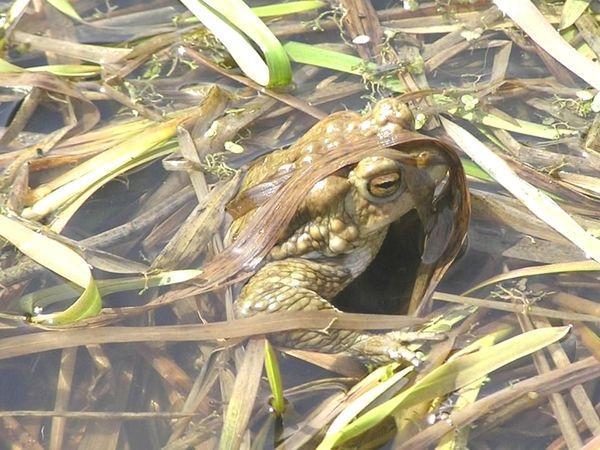
Common toads (unlike, for example, green toads) generally do not employ advertisement calls. However, if no other toads are nearby, males may vocalize.
Some males manage to intercept females on dry land, on the approach to the water. In such cases the male grasps the female in amplexus, and she must then carry him on her back.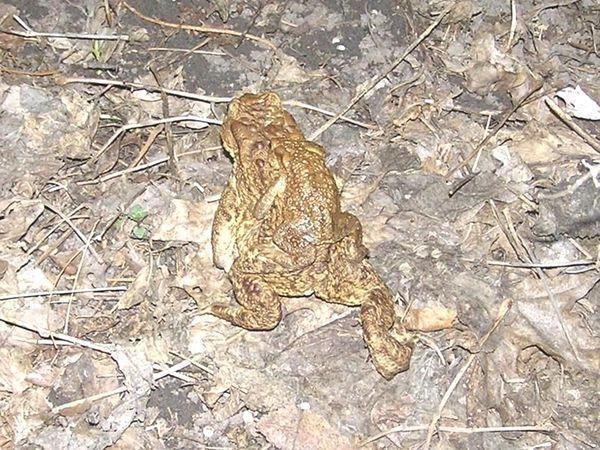
The female, already heavy with eggs, has difficulty moving even on her own, and now must additionally carry the male. His task is simple: to hold on...
The journey of common toads to their spawning site (through picturesque Western European parks) is well depicted in the film "Genesis".
The requirement for amplexus — the male’s clasping of the female — is a characteristic feature of anurans, associated with the fact that the vast majority of their species exhibit external fertilization. The eggs within the female's body pass through a series of developmental stages. Mature eggs ready for fertilization cannot be retained for long. It follows that at the moment of final maturation of the eggs, the male must be in proximity to the female. How is this achieved, given that male and female overwinter in different locations, may emerge from hibernation at different times, and must meet at a body of water whose journey may take varying amounts of time? The logical consequence is that the eggs reach final maturity only after the female has met the male. To ensure this, upon encountering a female, the male must establish close bodily contact with her, which will trigger her hormonal reorganization, resulting in final egg maturation.
Amplexus takes various forms...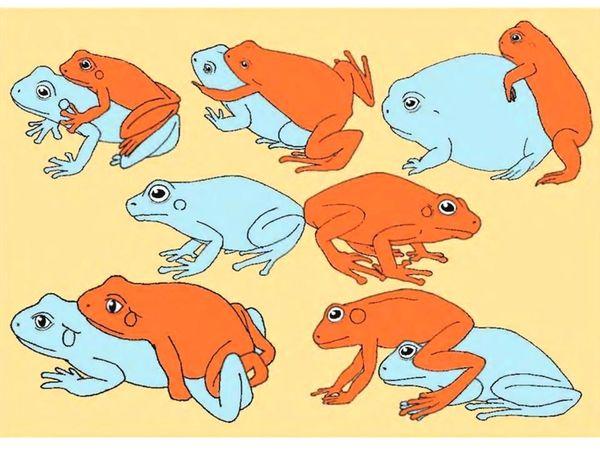
Male common toads, like most of our anurans, clasp the female in axillary amplexus...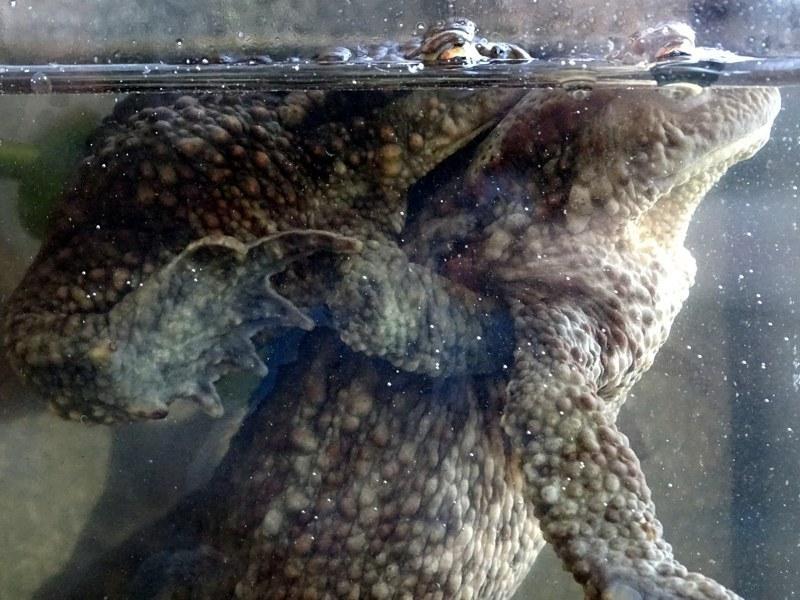
...while males of spadefoot toads (the species inhabiting our region is Pallas’s spadefoot, Pelobates vespertinus) grasp the female around the waist (inguinal amplexus).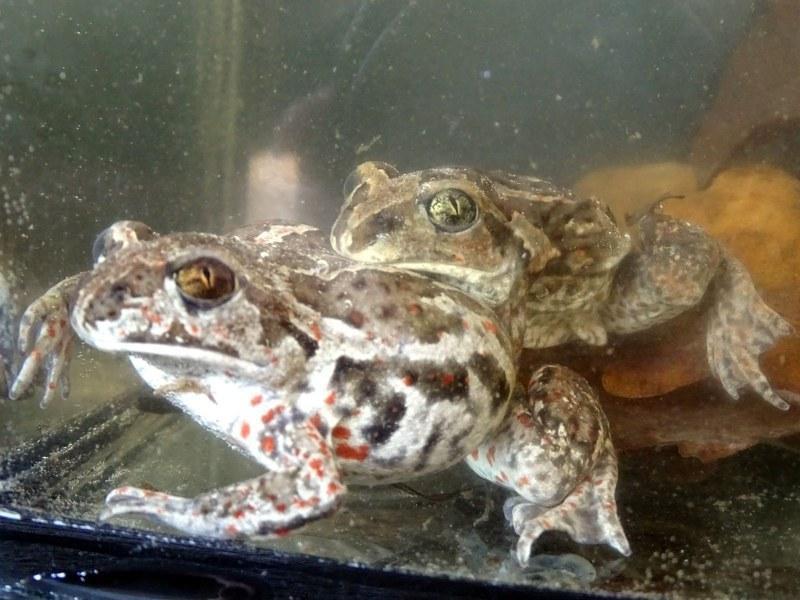
An adaptation to amplexus is the development of nuptial pads in the males of most anuran species. Retaining a slippery female in water is no easy matter, especially when rival males may interfere. For this purpose males develop patches of skin resembling sponge rubber in their microstructure: they are never mucus-covered.
Amplexed pairs wait for some time for egg maturation. This may sometimes take an entire day.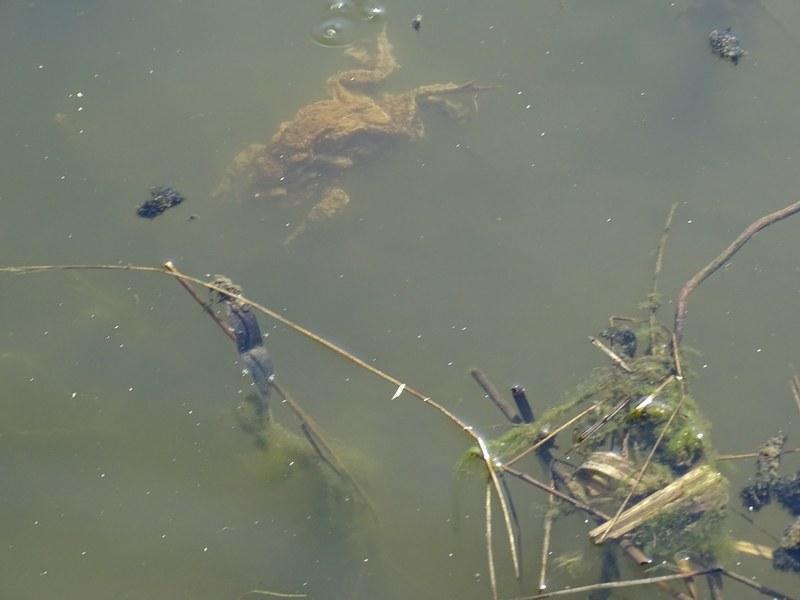
If the spring warming has proceeded rapidly, toad density at spawning aggregations may be extraordinarily high. This can be appreciated from the following video.
The toads are caught not for sport. Right there on the bank of the pond they are examined, and individuals bearing tags from previous years are identified. Untagged individuals are tagged and released.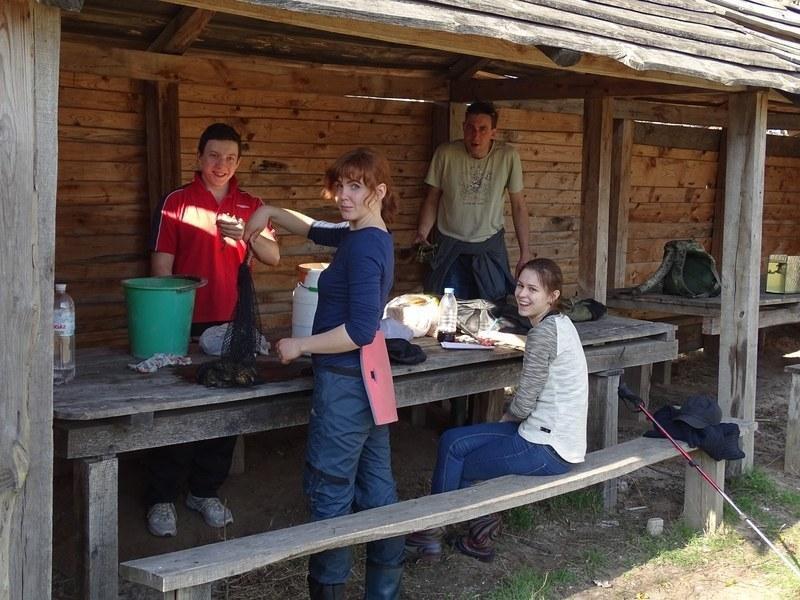
What follows is straightforward. Simplifying, the mark-recapture method can be explained as follows. If we tagged 100 toads, allowed them to mix with untagged individuals, and then caught 100 more and found 5 tagged among them — the population size is approximately 2,000 individuals. Do you see why? From the second sample we can establish that 1/20 of individuals have been tagged; 100 were tagged, so the total is 2,000. Of course this example is simplified, because if the marking and recapture are separated by a considerable period of time (a year or several years, for instance), calculations must necessarily account for the mortality of tagged individuals and the recruitment of new individuals into the breeding aggregation without tags. One must then consider that both mortality and recruitment into the breeding aggregation vary substantially from year to year, and data processing ceases to be a trivial task.
Imagine: we registered females that were first tagged at spawning twelve years earlier! This does not represent the full age of such females, because by the time we first encountered them at spawning (even if that was their first spawning season), they must already have lived several years (at minimum, until reaching sexual maturity).
Captured toads must be processed quickly, so that amplexed pairs ready to spawn do not deposit their eggs under inappropriate conditions. All this work proceeds to the accompaniment of the multivocal squeaking of male toads.
These sounds are release calls. In general, anurans have two main categories of vocalizations. Advertisement (nuptial) calls, by which a male attracts a female. Among other things, these calls are a trait subject to sexual selection.
When a male locates a female he attempts to clasp her in amplexus. However, he may grasp not only a female, but also another male or something else entirely inappropriate. The correct choice is confirmed by the female’s release call. The female laden with eggs and the female that has already spawned presumably respond differently. The first response will cause the male to attempt to hold her as firmly as possible; the second will eventually result in the male losing interest in the “empty” female. The release call of one male has a repellent effect on another. The male toads in the bucket in the penultimate video clamber over one another and emit release calls desperately, attempting to escape excessively close contact.
A peculiarity of common toads is that they often dispense with advertisement calls altogether. The voices audible at Iskov Pond are precisely release calls. However, this is not universal. One and a half kilometres from Iskov Pond lies the pond in Koryakovy Ravine. The common toad population there is considerably smaller, and spawning proceeds somewhat differently. In Koryakovy Ravine it is sometimes possible to observe common toads climbing onto the branches of bushes overhanging the water and emitting squeaking sounds that differ from release calls. In such a situation these should presumably be regarded as nuptial calls.
In the following video one can observe solitary males in a spawning aggregation (through which a thick cord of already-deposited eggs trails) reacting to each other’s movements, attempting to clasp one another, and releasing one another in disappointment. The presence of eggs indicates that this video was filmed closer to the end of spawning; this is one reason the males behave in relative calm.
In the initial phase of spawning, males behave far more actively. At this time intense competition among males for a female may occur. This is a contest of both strength and agility.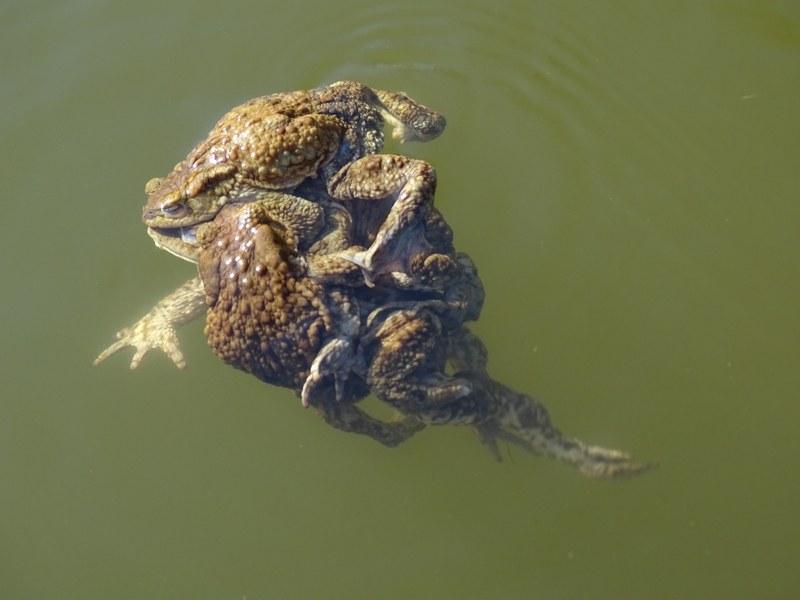

Every year we plan to film common toad combat as impressively as films of other anuran species fighting are made (see, for example, the video devoted to American poison dart frogs), and every year this somehow never quite gets done...
Attractive (i.e., primarily large) females may be mobbed by numerous males. This occurs especially often when spring warming develops rather slowly and an excess of males accumulates at water bodies at the outset of spawning.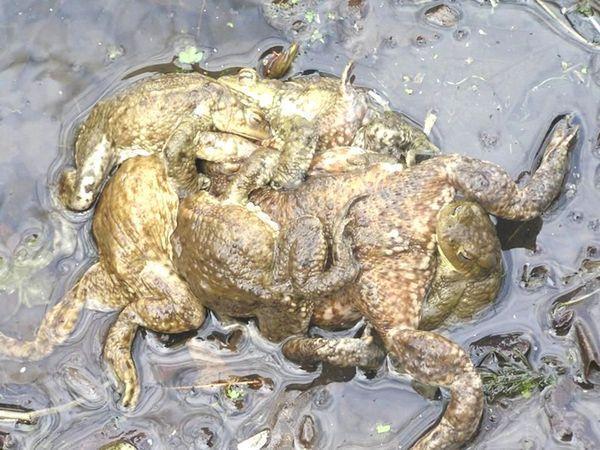
Several males were removed from the female shown in the preceding photograph.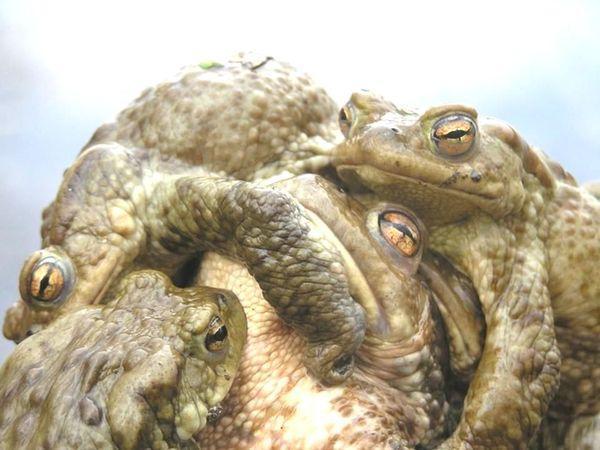
And what happens when no females are present? The level of motivation driving males to search for females rises to the point where they begin launching themselves at any more or less similar object. This might be a waterlogged bulrush’s “bobbin” swaying on the waves, a dead or live fish, or anything else. The absence of the female’s specific release call in such a situation no longer restrains them...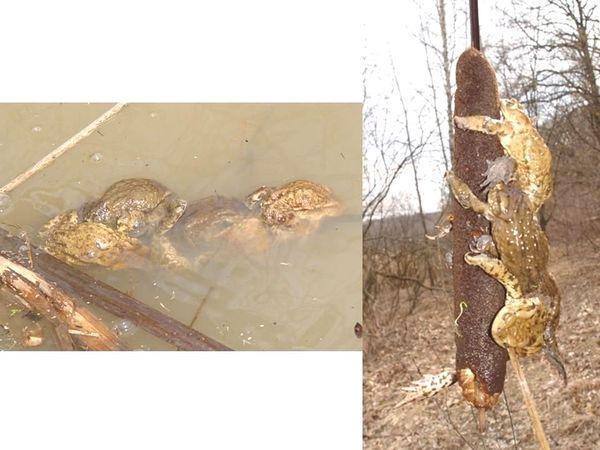
And finally, it may be an individual of another species. In the following photograph, a male moor frog, Rana arvalis, adorned in nuptial coloration, is clasping a male spadefoot toad.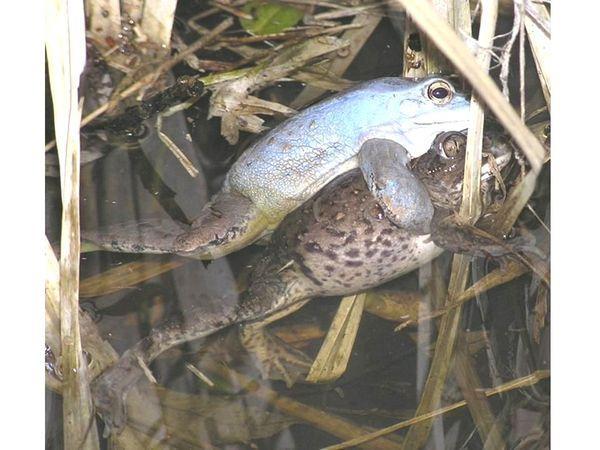
A male moor frog clasps a common toad in amplexus.
In this case, the male moor frog was unable to grasp the female toad, and is therefore holding onto the leg of a male.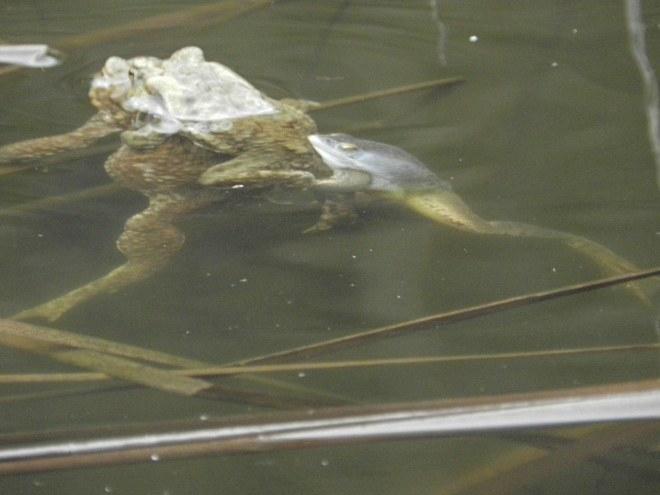
Here, a male spadefoot toad is clasping a male great crested newt.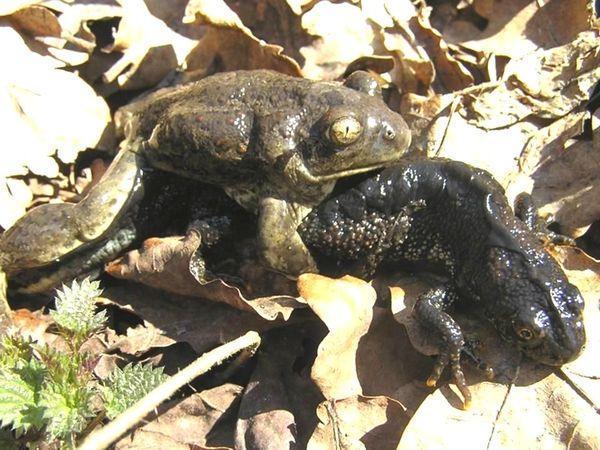
A male spadefoot toad and a male common toad.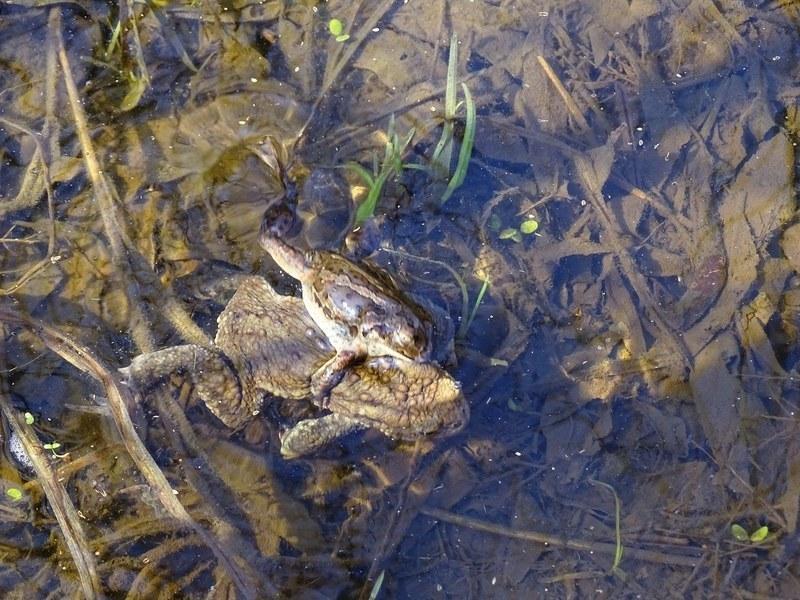
How do such heterospecific amplexuses end? Usually with nothing remarkable. It should be noted that all amphibians are toxic — some more so, others less. The outcome of close bodily contact depends on how the partners react to each other’s toxins.
The moor frog will feel ill from the cutaneous toxins of the spadefoot and the toad; the spadefoot and newt, as well as the spadefoot and toad, will mutually intoxicate one another. In the end, the male that has grasped an unsuitable partner will feel unwell and release the inappropriate object. Longer-term consequences are possible if the toxin of the active partner affects the passive one, who can offer no counteraction.
This description applies to one fairly common case. While male common toads are waiting for females, female marsh frogs, Pelophylax ridibundus, may be rising from hibernation on the bottom of the water body. These frogs are so large that male common toads, overcome with enthusiasm, launch themselves at them. Toads are insensitive to the toxins of green frogs, whereas for frogs the toad’s toxin is lethally dangerous...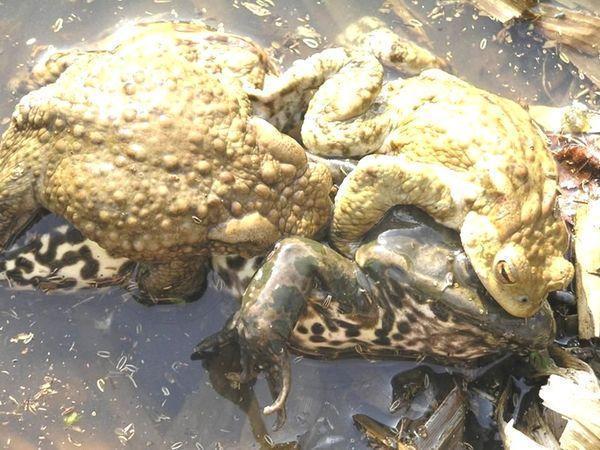
This frog’s eyes are clouded over. She is still alive, but already dying. Incidentally, the toxin of common toads is “tuned” (exhibits greatest potency) not against mammals or birds, but precisely against frogs...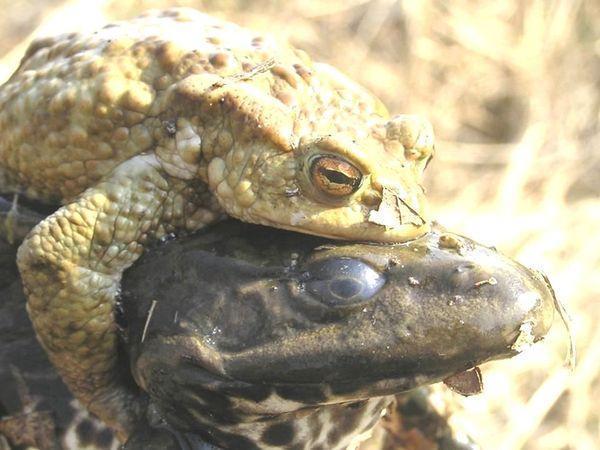
We removed the male toads from this female marsh frog and saw that she was swollen. The legs of the male toads had torn the skin of the frog on her right thigh. She is doomed in any case...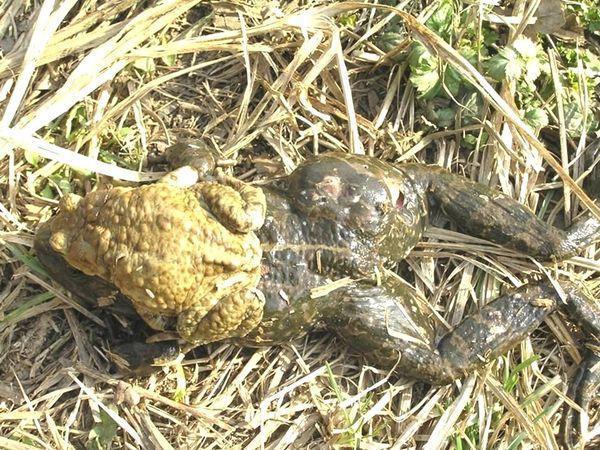
This frog has been in heterospecific amplexus for only a very short time. She is still fully alert, although her prognosis remains extremely unfavorable.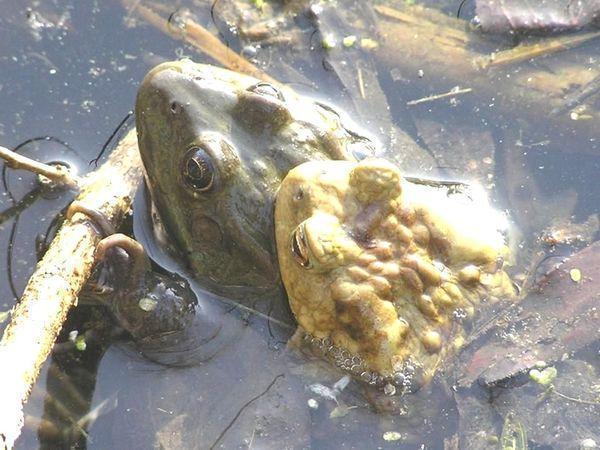
And this one is already nearly dead....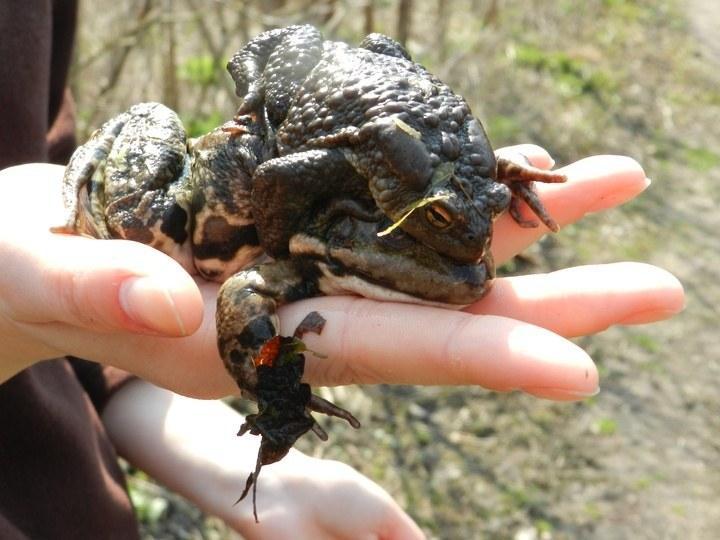
Adult marsh frogs and common toads are not competitors, but their tadpoles do compete with one another. This unusual mechanism of interspecific competition is presumably beneficial for the common toad population as a whole (although each individual male arguably loses by destroying a representative of the competing species rather than searching for a conspecific female). This competition is described in somewhat greater detail (though with essentially the same logic as on this page) in the article “Common Toads and Green Frogs: Love and Death in Cold Water.”
Another remarkable consequence of heterospecific amplexus is interspecific hybridization among water frogs (green frogs). The two species that hybridize in this case are sufficiently closely related to produce offspring, but sufficiently divergent for normal gametogenesis in the offspring to be disrupted. In such cases there are generally four possible outcomes: hybrid sterility, polyploidization, transition to clonal reproduction, and (apparently the rarest) hemiclonal reproduction. Water frogs have realized precisely this last variant.
The following photograph shows a perfectly normal situation, even though the frogs in the pair look very different from one another: these are moor frogs, where the male is in nuptial coloration. The photograph below is taken from an online source; in the Kharkiv Region, the nuptial coloration of male moor frogs is usually less intense.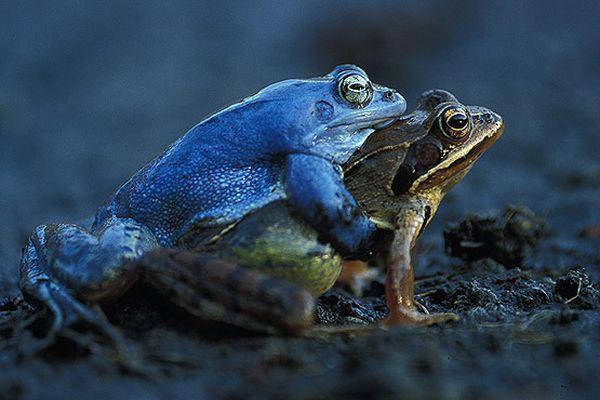
Moor frog spawning aggregations can be very dense.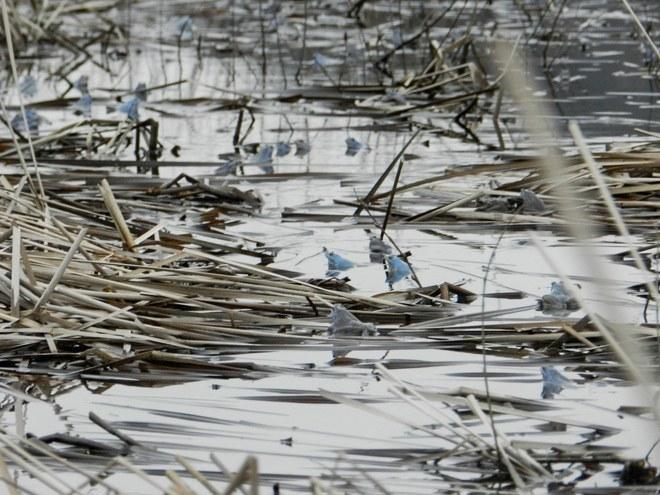
Note that different amphibian species frequently spawn simultaneously. For instance, at Iskov Pond during the common toad spawning period, moor frogs, Pallas’s spadefoot toads, and both smooth and great crested newts also spawn; and toward the end of spawning — eastern tree frogs, Hyla orientalis, join in as well. After some time the spawning of the first five species concludes, and fire-bellied toads, Bombina bombina, join the tree frogs, along with water frogs (Pelophylax ridibundus and Pelophylax esculentus) and green toads, Bufotes viridis.
Here, listen to how the birdsong, the calls of moor frogs (background sound resembling boiling water), and the calls of spadefoot toads (grunting in the foreground) all overlap.
This is how Pelophylax esculentus spawns.
The preceding video is, of course, chaotic: it is a nocturnal spawning aggregation at Nizhny Dobritsky Pond, situated not far from the biological station in the Homolsha River floodplain. But here is a solo vocalist, and in daytime at that rather than at night. Listen — how beautiful!
And this is an amplexed pair of green toads...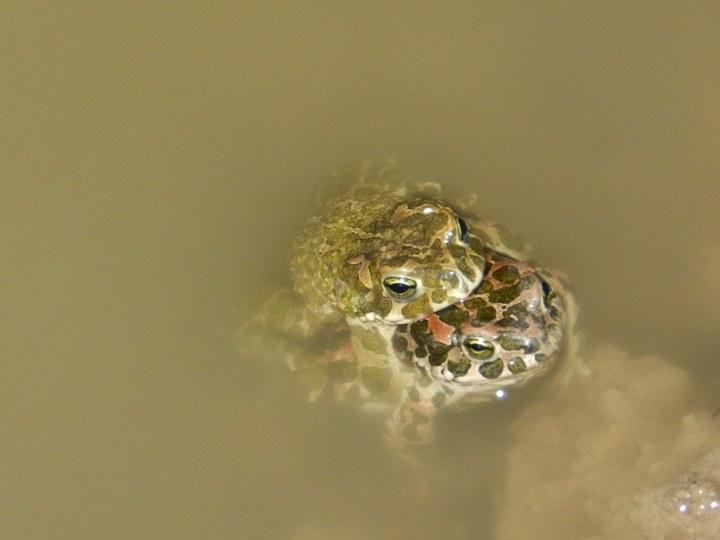
...and the song of a green toad suspended motionless on the water surface.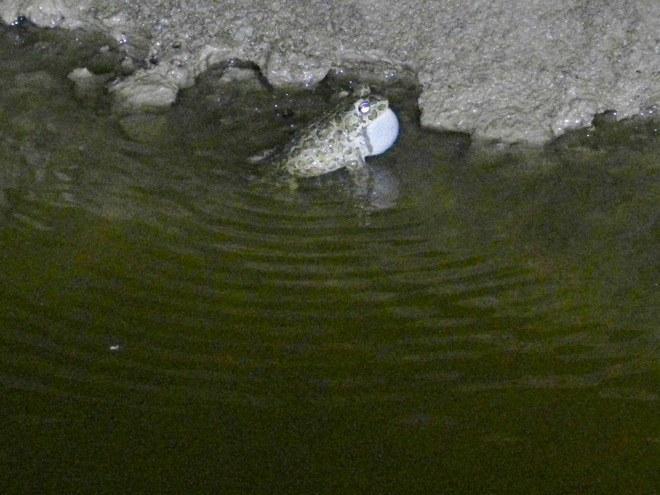
In an American species of toad this looks approximately like this:
These are tree frogs.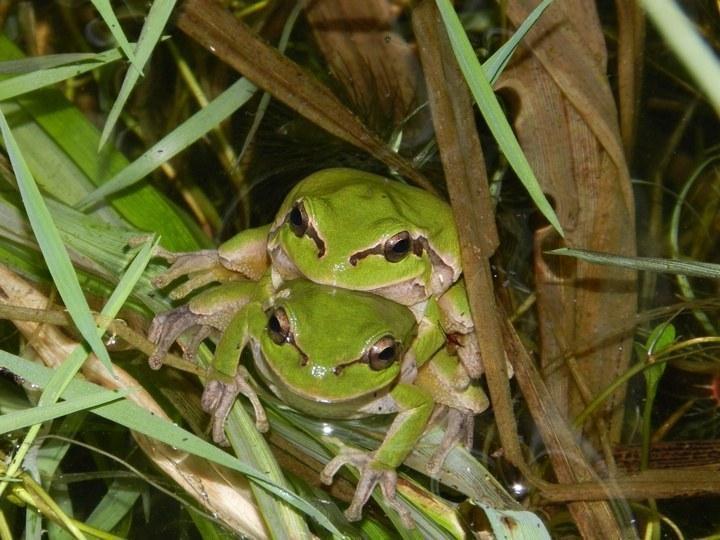
Tree frogs have the longest spawning season of all. Their calls can sometimes be heard even in September, though by then they are no longer associated with spawning. It appears that, like water frogs, male tree frogs call not only to attract females, but also “for their own sake” — or more precisely, to assert territorial rights.
Naturally, despite all the diversity of our local batrachofauna, the reproductive strategies realized by tropical species are far more varied.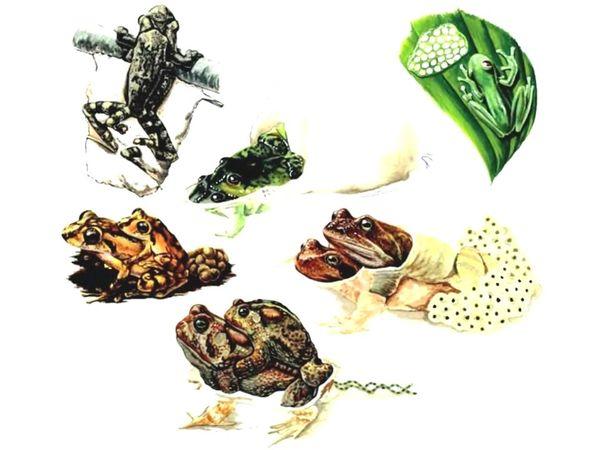
Let us return to common toad spawning. After some time the eggs mature, and the amplexed pair of toads begins to stretch out two cords of spawn (one from the right ovary, the other from the left). The pair sinks to the bottom, the male covers the female from above and helps her to expel a portion of eggs, simultaneously shedding his milt over them. The pair then rises to the surface, entangling the spawn among aquatic vegetation.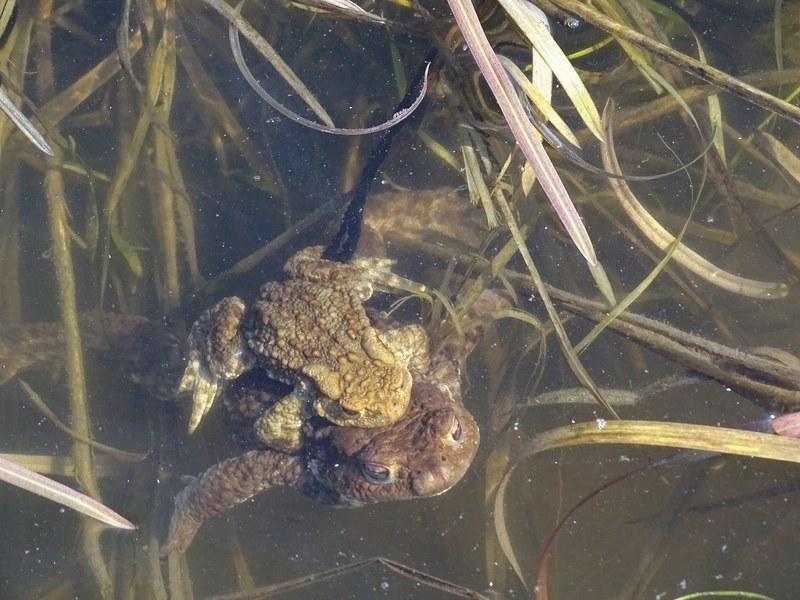
This is how the spawn of a toad appears...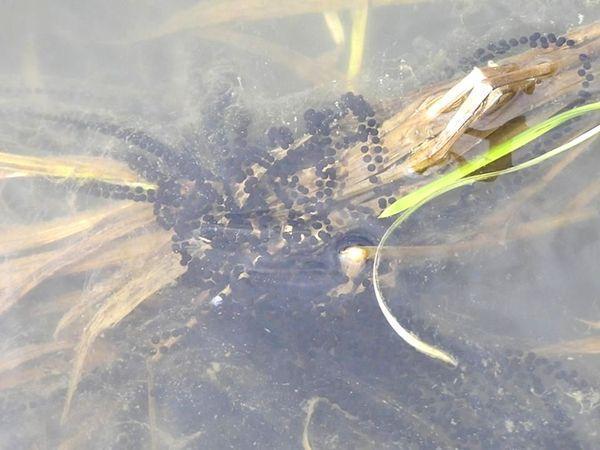
...this is how that of moor frogs appears,...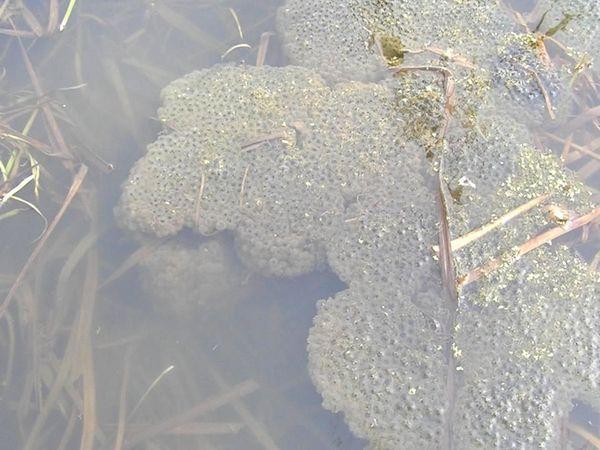
...and this is how that of water frogs appears.
The spawning of caudates (salamanders and newts) is quite different. In this excerpt from a David Attenborough film it is illustrated using the alpine newt, Ichthyosaura alpestris, as an example.
The following photograph shows larvae of moor frogs beginning to hatch from the egg mass. They secrete enzymes that dissolve the mucous membranes surrounding the eggs. Prior to hatching, these membranes acted as lenses, concentrating sunlight onto the developing embryos, and also protected them from infection.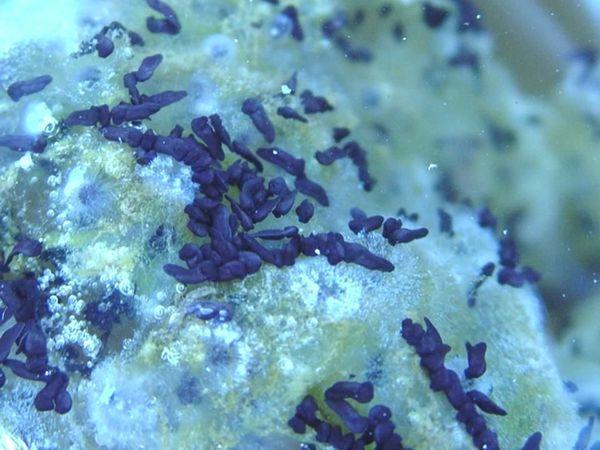
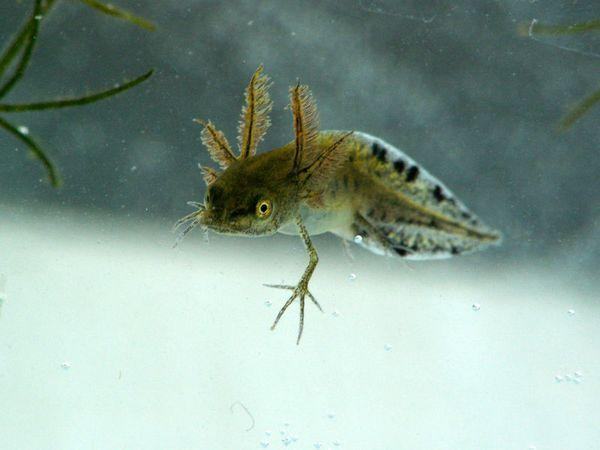
The larvae of caudates are naturally very different from tadpoles, the larvae of anurans.
Tadpoles of the common toad can achieve considerable densities in the water bodies where they develop. It is sometimes possible to observe the movement of shoals of tadpoles advancing as a single entity, resembling a giant amoeba. During the day the amoeba explores the pond, while at night it most frequently descends to the bottom.
The following photograph shows the bottom of the pond carpeted with tadpoles. Approaching them is a wave of turbidity stirred up by the feet of the author walking along the bottom in waders.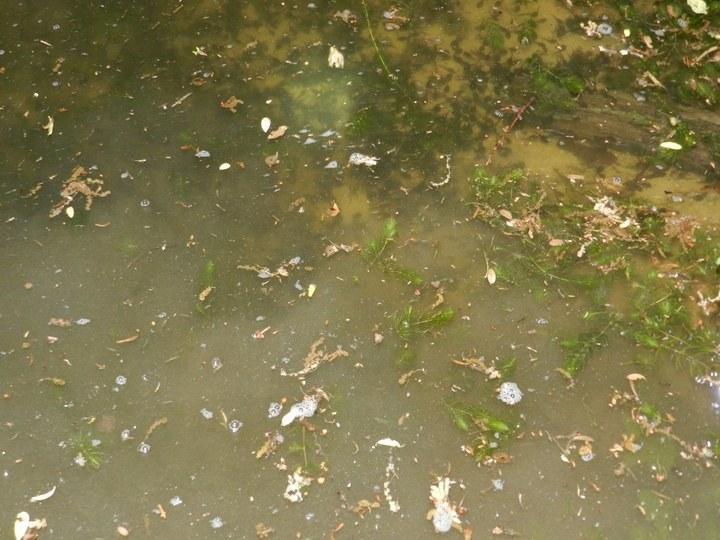
The time comes when development of common toad tadpoles approaches completion. They concentrate near the shore, forming characteristic banks or aggregations.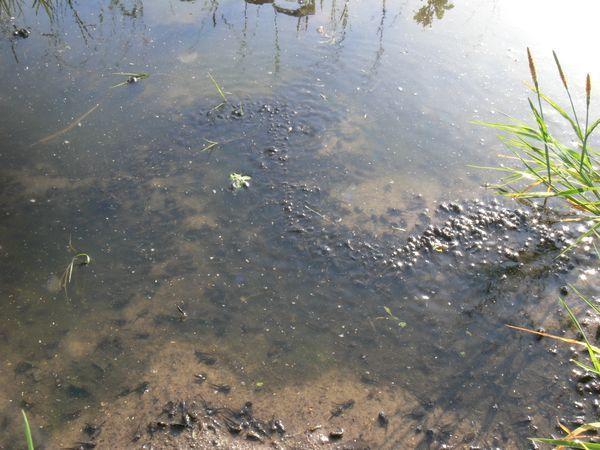
These aggregations consist of pre-metamorphic tadpoles and metamorphs.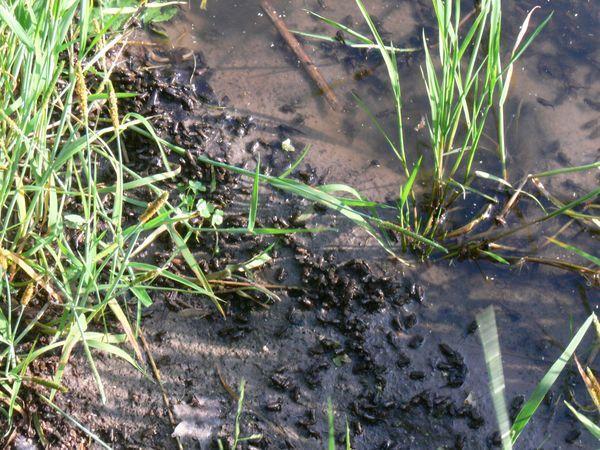
Gradually the metamorphs disperse into the surrounding habitat. How many toads can you count in this photograph, in the impression left by a goat’s hoof? There are no fewer than fifteen here...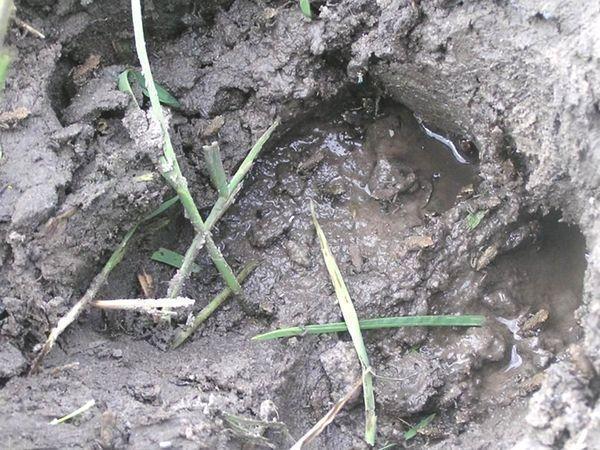
Generally speaking, on land there is a constant transfer of biogenic elements (elements essential for organismal development) from terrestrial to aquatic habitats. Rainwater flows into water bodies, carrying salts and organic matter; leaves fall into the water, wind carries dust into ponds... In water bodies, biogenic elements enter the bottom sediments, causing progressive bogging. There are several important processes that lead to the return of biogenic elements to land: the activity of piscivorous birds and other animals that consume fish and deposit their excrement on land; the export of biogenic elements by the emergence of aquatic insects that develop in water (dragonflies, mayflies, mosquitoes...); and the export of biogenic elements by this year’s terrestrial amphibian metamorphs. And so the cycle continues.
After several years, some (by no means all) of these year-class animals may return to the pond to spawn...
Life Cycle and Spawning of Lissamphibia (primarily using amphibians of the Kharkiv Region as examples)
Many amphibians lead a rather secretive existence. The apogee of their annual cycle is reproduction. This page is devoted to reproduction itself and to the extraordinary phenomena associated with it.
The first photograph on this page shows common toads (Bufo bufo) in amplexus, taken by O. V. Korshunov. This photograph was taken in the course of a long-term study of the common toad population inhabiting Iskov Pond in the vicinity of the Biological Station of V. N. Karazin Kharkiv National University. The authors of this textbook began monitoring the size of this population by mark-recapture methods in 2000. The year 2020 (the 21st year of observations) proved critical; this population nearly collapsed, but began recovering in 2021. Many of the photographs on this page were taken during this research.
Spawning of common toads at Iskov Pond takes place in late March or early April. There is a fairly reliable phenological indicator that spawning has commenced: coltsfoot (Tussilago farfara) blooms during the spawning period...
...while Siberian squill (Scilla siberica) begins to fade.
Both the flowering of early spring plants and the emergence of toads from hibernation to spawn are triggered by the same factor: soil temperature at shallow depth.
Males are the first to arrive at the spawning grounds. In fine weather they wait for females at the water's edge...
...while at other times, particularly during cold spells, they move to greater depths.
Different males select different positions while waiting for females. Males sometimes move from one part of the pond to another, attempting to find a more advantageous position. Observe, incidentally, how easily a common toad swims!
In a certain sense this is a lottery — where luck will strike is unknown in advance, but adopting the correct strategy can increase the probability of success.
Common toads (unlike, for example, green toads) generally do not employ advertisement calls. However, if no other toads are nearby, males may vocalize.
Some males manage to intercept females on dry land, on the approach to the water. In such cases the male grasps the female in amplexus, and she must then carry him on her back.
The female, already heavy with eggs, has difficulty moving even on her own, and now must additionally carry the male. His task is simple: to hold on...
The journey of common toads to their spawning site (through picturesque Western European parks) is well depicted in the film "Genesis".
When a male finds a female, he tries to clasp her in amplexus. However, he can grab not only a female but also another male or anything inappropriate at all. The correct choice is confirmed by the female's release call. It is likely that a female with eggs and a female that has already spawned respond differently. The first response will cause the male to try to hold her as tightly as possible, the second will eventually lead to the male losing interest in the "empty" female. The release call of one male acts as a deterrent to another. In the penultimate video, male toads in a puddle trample each other and desperately emit release calls, trying to get rid of the overly close proximity. A feature of common toads is that they often do without mating calls at all. Their voices, which can be heard at the Iskov pond, are precisely release calls. However, this is not the case everywhere. One and a half kilometers from the Iskov pond is a pond in the Koryakovy ravine. The number of common toads there is much lower, and spawning occurs a little differently. In Koryakovy ravine, it is sometimes possible to observe common toads climbing onto the branches of bushes leaning over the water and making squeaking sounds that differ from release calls. Probably, in such a situation, they should be considered mating calls. This video shows how, in a spawning pool (through which a powerful cord of already laid eggs runs), solitary males react to each other's movements, try to clasp each other in amplexus, and release them in disappointment. The presence of eggs indicates that this video was filmed closer to the end of spawning; this is one of the reasons why the males behave relatively calmly. In the initial phase of spawning, males behave much more actively. During this time, intense struggles for a female can occur between them. This is a competition of both strength and agility. Every year we plan to film common toad fights as beautifully as fights of other anurans are filmed (here, watch a video dedicated to American poison dart frogs), and every time we don't really get around to it...
Attractive (i.e., primarily large) females can be mobbed by many males. This happens particularly often if the spring warming develops quite slowly, and an excess of males accumulates in the water bodies at the beginning of spawning. Several males were removed from the female shown in the previous photograph. What happens if there are no females? The motivation level of males, which drives them to seek females, increases to the point where they start to pounce on any object that is more or less similar. This could be a wet cattail "rocker" swaying in the waves, a dead or live fish, or something else. The absence of a specific female release call does not stop them in such a situation... And, finally, it could be an individual of another species. In the next photograph, a male moor frog, Rana arvalis, adorned in breeding plumage, is holding a common spadefoot toad. A male moor frog is holding a common toad in amplexus. In this case, the male moor frog could not grab the female toad, so he is holding onto the male's leg. Here, a spadefoot toad male is holding a great crested newt male. Males of spadefoot toad and common toad. What is the outcome of such interspecific amplexus? Usually nothing special. It should be taken into account that all amphibians are poisonous - some more, some less. The result of close bodily contact depends on how the partners react to each other's poison. The moor frog will feel unwell from the skin poison of the spadefoot toad and the common toad; the spadefoot toad and the newt, as well as the spadefoot toad and the common toad, will poison each other mutually. Ultimately, the male who has taken an unsuitable partner in amplexus will feel unwell and release the inappropriate object. Long-term consequences are possible if the poison of the active partner affects the passive one, who can do nothing to resist it. This description fits one rather common case. At the time when common toad males are waiting for females, female lake frogs, Pelophylax ridibundus, may emerge from hibernation at the bottom of water bodies. They are so large that common toad males pounce on them, full of enthusiasm. Toads are insensitive to the poison of green frogs, but for frogs, the poison of toads is deadly... The eyes of this frog are covered with a film. She is still alive, but dying. By the way, the poison of common toads is "tuned" (has the highest activity) not for mammals or birds, but specifically for frogs... We removed the male toads from this lake frog and saw that she was swollen. The legs of the male toads tore the frog's skin on her right thigh. She is doomed anyway... And this frog has been in interspecific amplexus very recently. She is still quite herself, although the prognosis for her future is still extremely unfavorable. And this one is already practically dead.... Adult lake frogs and common toads are not competitors, but their tadpoles compete with each other. Probably, such an unusual competition mechanism is beneficial for the common toad population (although each individual male is more likely to lose out because, instead of looking for a female of his own species, he destroys a representative of a competing species). This competition is described in somewhat more detail (although, in general, in the same logic as on this page) in the article "Common Toads, Green Frogs: Love and Death in Cold Water". Another strange consequence of interspecific amplexus is the interspecific hybridization of green frogs. The two species that cross are, in this case, close enough to produce offspring, but far enough apart for normal gamete formation in the offspring to be disrupted. In such cases, there are generally four possible outcomes: hybrid infertility, polyploidization, transition to clonal reproduction, and (apparently the rarest) hemiclonal reproduction. Green frogs realize this particular option. Well, and in the next photograph, everything is normal, although the frogs in the pair are very different from each other: these are moor frogs, where the male is in breeding coloration. The photograph below is taken from the internet; in the Kharkiv region, the coloration of male moor frogs is usually less intense. Spawning pools of moor frogs can be very dense. Keep in mind that different species of amphibians often spawn simultaneously. For example, at the Iskov pond, during the spawning of common toads, moor frogs, Pallas's spadefoot toads, as well as common and great crested newts also spawn, and at the end of spawning - also eastern tree frogs, Hyla orientalis. Some time passes, spawning of the first five species ends, and the common spadefoot toads are joined by the European green toads, Bombina bombina, green frogs (Pelophylax ridibundus and Pelophylax esculentus), as well as the green toad, Bufotes viridis. Listen to how the singing of birds, moor frogs (a background sound resembling boiling water), and spadefoot toads (grunting in the foreground) overlap. This is how Pelophylax esculentus spawn.
The previous video, of course, is chaos: it is night spawning at the Nizhniy Dobrytsky pond, located near the biological station in the floodplain of the Homolsha River. And here is a solo singer, and during the day, not at night. Listen: it's beautiful!
And this is the amplexus of a pair of green toads... ...and the song of a green toad frozen in the wave on the surface of the water. It looks (using the example of some American toad species) approximately like this: These are tree frogs. Tree frogs spawn for the longest time. Sometimes their calls can be heard even in September, but they are no longer related to spawning. It turns out that, like green frogs, male tree frogs sing not only to attract females but also "for the soul," or rather, to confirm territorial rights. Naturally, despite the entire diversity of our batrachofauna, the spawning patterns realized by tropical species are much more diverse. Let's return to the spawning of common toads. After some time, the eggs mature, and the pair of toads begins to stretch out two cords of eggs (one from the right ovary, the other from the left). The pair descends to the bottom, the male covers the female from above and helps her squeeze out a portion of eggs, immediately fertilizing them with milt. Then the pair surfaces, entangling the eggs among the aquatic vegetation. This is what a toad's egg mass looks like... ...this is what moor frogs' egg masses look like,... ...and this is what green frogs' egg masses look like. The spawning of tailed amphibians is completely different. In this excerpt from a David Attenborough film, it is shown using the example of the alpine newt, Ichthyosaura alpestris.
The next photo shows larvae of the moor frog, which have begun to emerge from the egg mass. They secrete enzymes that dissolve the mucous membranes of the eggs. Before hatching, these membranes, like lenses, concentrated sunlight on the developing embryos and also protected them from infections. The larvae of tailed amphibians, naturally, are very different from the tadpoles, the larvae of anurans.
The development of tadpoles is very well shown in this American video, which shows the development of an egg mass of Lithobates sylvaticus, the wood frog (similar to our moor frog). The vast majority of anurans do not care for their offspring after laying eggs, although there are many exceptions to this rule. Many of them are shown on the following pages. Some of the most striking examples of parental care are characteristic of African pixie-faced frogs - as you understand, this is no longer our video...
The tadpoles of common toads can reach significant densities in the water bodies where they develop. Sometimes it is possible to see the movement of schools of tadpoles, which move as a single whole, resembling a giant amoeba. During the day, the amoeba explores the pond, and at night, they most often descend to the bottom. In the next photograph, the bottom of the pond is covered with tadpoles. A wave of turbidity, raised by the legs of the author walking on the bottom in waders, approaches them. The time comes when the development of common toad tadpoles is nearing its end. They concentrate near the shore, forming peculiar waves. These waves consist of pre-metamorphic tadpoles and metamorphs. Gradually, the metamorphs disperse to the surrounding areas. How many toads do you see in this photograph in the track of a goat's hoofprint? There are at least a dozen and a half of them here... Generally speaking, there is a constant transfer of biogens (elements necessary for the development of organisms) from terrestrial habitats to aquatic ones on land. Rainwater flows into water bodies, carrying salts and organic matter; leaves fall into the water, wind carries dust into water bodies... In water bodies, biogens enter the bottom sediments, leading to their eutrophication. There are several important processes that lead to the return of biogens to land. These are the activity of fish-eating birds and other animals that eat fish and leave their droppings on land; the removal of biogens with the emergence of insects that develop in water (dragonflies, mayflies, mosquitoes...); the removal of biogens by this year's terrestrial amphibians. This is how this process occurs. After a few years, some (by no means all) of these yearlings may return to the pond to spawn...