IV. Amphibia sensu lato-08. Order Anura — Tailless Amphibians. Part I — Basal Families
The first part of the systematic survey of tailless amphibians.
Дмитро Шабанов
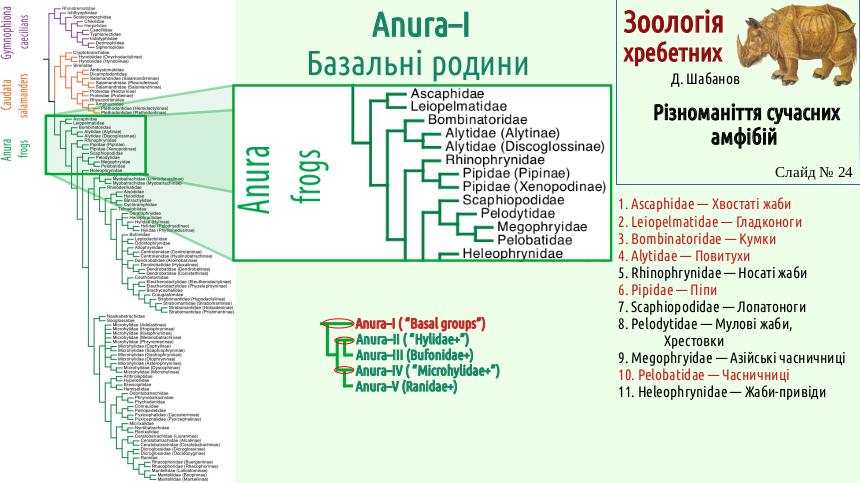
Here we consider the first group of families of modern tailless amphibians. Our understanding of their phylogeny can already be regarded as fairly stable. In more traditional systematics it was customary to divide the order Anura into three suborders: Archebatrachia, Mesobatrachia, and Neobatrachia. Let us indicate the composition of these groups using the families considered here:
Suborder Archebatrachia
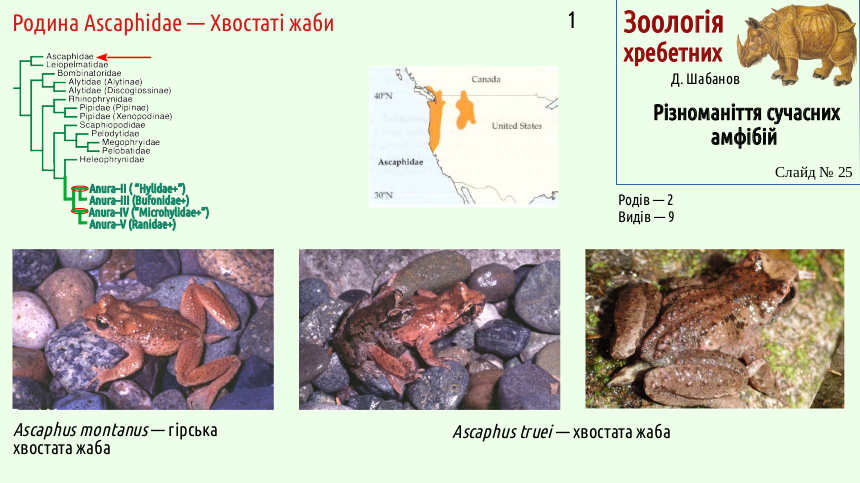
1. Ascaphidae — tailed frogs
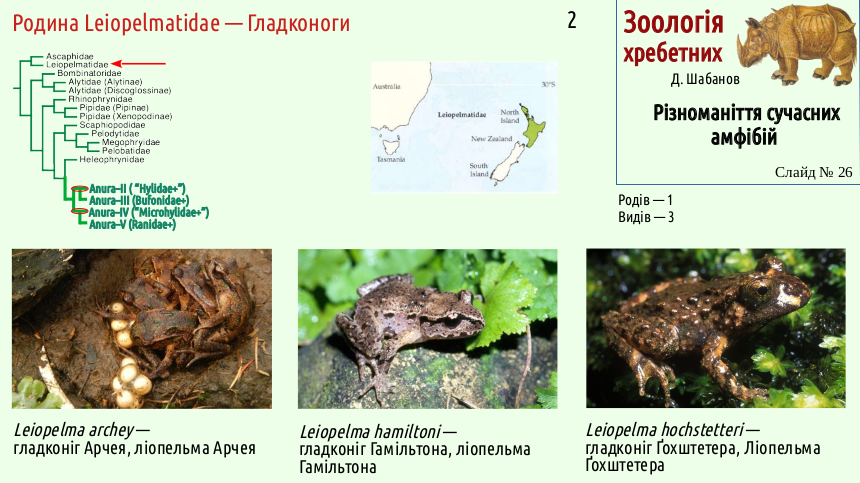
2. Leiopelmatidae — smooth-legged frogs
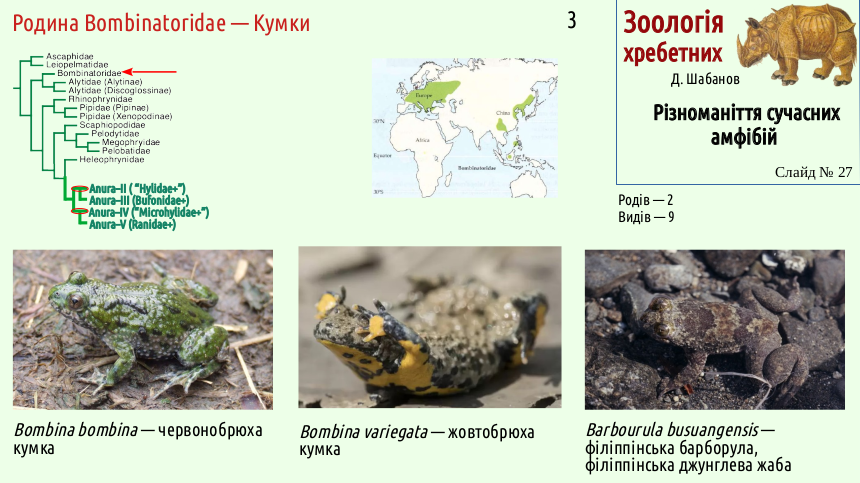
3. Bombinatoridae — fire-bellied toads
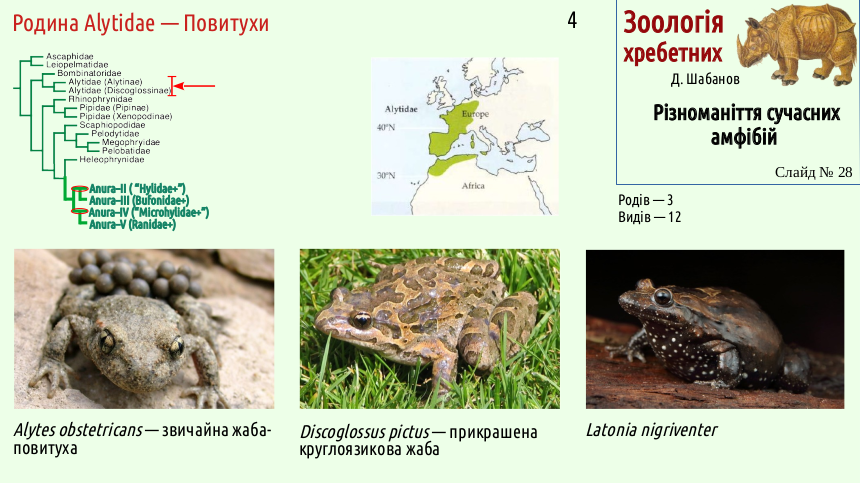
4. Alytidae — midwife toads
Suborder Mesobatrachia
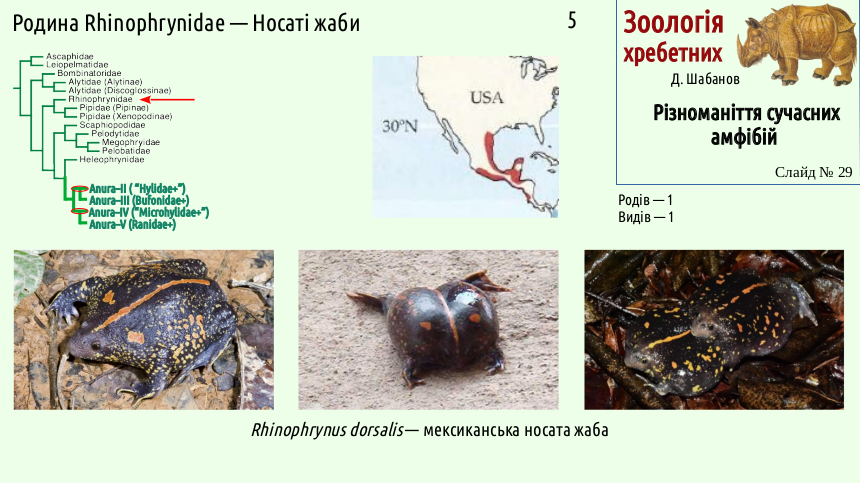
5. Rhinophrynidae — nose frogs
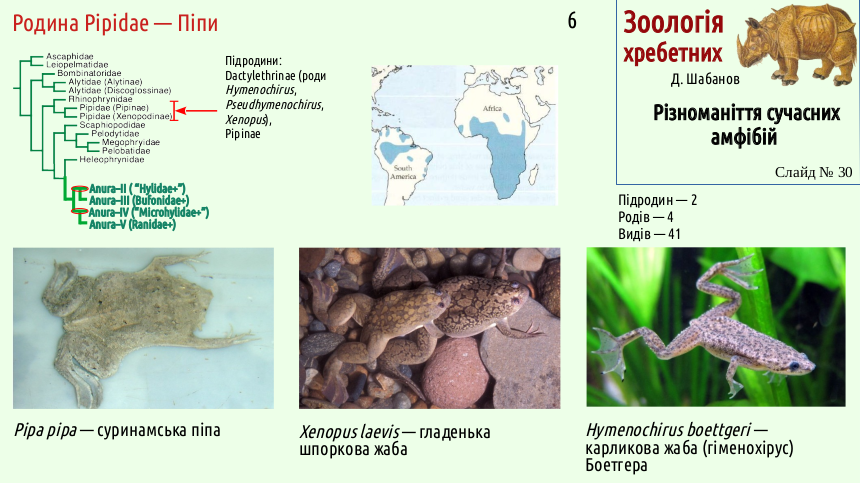
6. Pipidae — pipids
7. Scaphiopodidae — spadefoots
8. Pelodytidae — parsley frogs
9. Megophryidae — Asian spadefoot toads
10. Pelobatidae — spadefoot toads
Suborder Neobatrachia
11. Heleophrynidae — ghost frogs
... + 46 more families
All of the next 46 families that we will consider later also belong to Neobatrachia. However, the family Heleophrynidae is basal to this largest suborder, which, as you will see, after splitting off from Heleophrynidae developed along two large branches. Each of these branches will be the subject of a separate page on this site.
As in other parts of this course, the names of taxa whose most characteristic representatives students should know are highlighted in brick color.
As you probably know (and can see on the slide), fire-bellied toads are part of the fauna of Ukraine.
The mating call of the male European fire-bellied toad — Bombina bombina
For the yellow-bellied toad (Bombina variegata), a threat posture is very characteristic, in which it displays its brightly colored belly to a potential enemy. Sometimes this form of behavior is also shown by the European fire-bellied toad.
Clawed frogs are one of the classical objects of developmental biology. Exceptional attention to this species was associated with the fact that it was used in an early protocol for determining pregnancy, widespread at a time when modern chemical methods of pregnancy diagnosis had not yet been developed.
The point is that among the hormones of both amphibians and humans there is a gonadotropic hormone (gonadotropin). This is a protein whose structure differs somewhat between humans and amphibians, but frogs respond to the human hormone. In humans, chorionic gonadotropin is secreted during implantation of the embryo into the uterine wall. Its task is to stop the menstrual cycle and subsequent ovulations. In tailless amphibians, a similar hormone stimulates the release of gametes. Therefore, if a portion of urine from a woman in whom embryo implantation has occurred is injected into the subcutaneous lymph sac of a male clawed frog, after some time (about two hours) the action of the gonadotropin will cause the release of active sperm into the cloacal fluid.
The widespread use of clawed frogs in laboratory diagnostics led to their being kept under artificial conditions all over the world. Even when it turned out that, for diagnostics, green frogs were also quite suitable, certified laboratories continued to use clawed frogs specifically for such purposes. Incidentally, there is a version according to which the chytridiomycete Batrachochytrium dendrobatidis was spread around the world precisely with these frogs.
Your browser does not support the video tag.
In the previous video, the spawning of Carvalho’s Surinam toad, Pipa carvalhoi, was shown. Above are young individuals of the Surinam toad, Pipa pipa, in the cells on the mother’s back.
The previous video showed the spawning of Pipa carvalhoi. Above are young individuals of the Suriname toad, Pipa pipa, in the brood pouches on the mother's back.