
On the Immortality of Populations. Column in Computerra Online #9
{ "title": "", "summary": "", "body": "View the history of life on Earth as a branching tree of potentially immortal populations. It is they, populations, that inhabit the Earth, not we, organisms! BATRIMG<N>BATR" }
"- Volvox <...> interests us because it invented death. <...> Amoebas never die. And male reproductive cells that reach their goal give rise to new life, in which the father continues to exist. But volvox, this mobile, rolling ball of algae, consisting of vegetative and reproductive cells, something between a plant and an animal - under a microscope, it spins like dancers at a Christmas ball, - having first implemented the idea of cooperation, introduced life into the kingdom of inevitable - unlike random - death. Because - bear with me, children, you'll only have to suffer for seven more minutes - although potentially each cell individually is immortal, but, having voluntarily taken on a differentiated function within an organized community of cells <...> it wears out and dies. It sacrifices itself for the good of the whole organism."
John Updike ("The Centaur")
With Updike's help, a myth about volvox inventing death and immortal unicellular organisms spread through the memosphere. Is it really so?
An amoeba lives and, if it manages to avoid death, it will eventually divide. The "halves" (daughter cells) will start living independently, and if they manage to avoid death, they will divide themselves. Does this picture match our ideas about immortality? Not really. Firstly, death is lurking for these organisms at every step. Secondly, after cell division, it's not the old cell that continues to live, but its descendants. The division of an amoeba is the death of the old cell and the birth of two new ones!
In multicellular organisms, the situation is more complex. In a typical case (like in humans), a fertilized egg cell divides multiple times, forming a more or less numerous clone of its descendants. Almost all cells in the bodies of most of us are clones (genetic copies) of that first cell of ours, which resulted from the fusion of the mother's egg cell and the father's spermatozoon. The set of such clonal descendants of the fertilized egg cell makes up most of our body - the soma.
But even in early embryos, the cells - ancestors of reproductive cells - specialize. In humans, they can be identified even at the sixteen-cell stage. Sometimes they behave quite strangely. For example, in our species, as well as in other mammals, they are located outside the embryo's body during the formation of most organs - in the membranes of the yolk sac. The sex glands are formed from somatic cells. Having "waited out" key reorganizations, primary sex cells crawl (due to amoeboid movement) into already formed sex glands and populate them. It is the descendants of these cells that will give rise to egg cells, spermatozoa, and, ultimately, the next generations of organisms.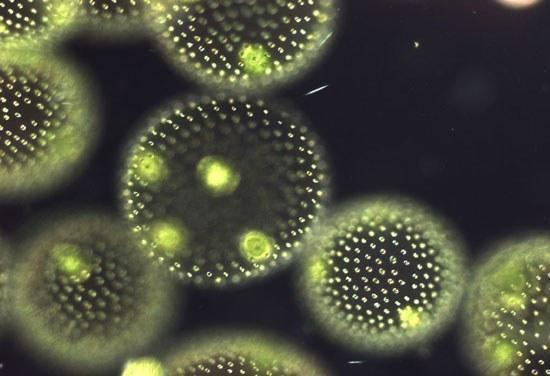
It's not that volvox consists of many cells, but that the following colonies are able to produce only some of them (Illustration: exploratorium.edu)
Yes, the division of soma and germ line was initiated by the first, still primitive multicellular organisms. In school, they are exemplified by the green alga volvox. Don't forget that volvox is a modern species, and those creatures that first took this path about a billion years ago were probably somewhat different.
So, both volvox and humans consist of two types of cells. Somatic cells will die over time, and their lineage will inevitably be interrupted. Germ line cells will also die, but with a small probability, the sequence of their descendants will stretch into the unlimited future.
So, there is no immortality, because germ line cells can be considered immortal only conditionally, like amoebas? It exists, but we need to look for it not at the level of cells and organisms!
Many biology courses are built in accordance with the concept of structural levels of biological systems. Remember? Molecules - cells - tissues - organs - organisms - populations - ecosystems - biosphere...
Oddly enough, they still argue about which set of levels of organization is correct to distinguish. The answer is simple. A separate level of organization should be distinguished if a new quality emerges when subsystems are combined into a whole.
Can I give an example that I once developed for a school textbook? Each system has two groups of properties. Additive properties of a system (Latin additio - addition) are the sum of the properties of its parts. Qualitatively new properties of a system are called emergent (Latin emergere - to emerge, to appear). The English adjective "emergent" is often transmitted in Russian as "emergent," which does not correspond to the established tradition of transmitting the letter "g" in terms: after all, we say and write "gene," not "jen," despite the English "gen"!
Weight is an additive property of a pen: the weight of the whole is equal to the sum of the weights of the parts
Suitability for writing is an emergent property of a pen; it is absent at the level of its disparate components
So, for each level of biological systems, one can indicate its emergent properties. The phenomenon of life emergently arises at the level of the cell. Below it, there are more or less complex molecular automata, and a cell - whether bacterial or human - is already a carrier of life.
When studying some physiological problems, it is useful to distinguish levels of functional systems, organ, tissue, and cellular levels, in addition to the organismal level. When solving other issues, it is enough to limit oneself to the levels of the organism and cell.
You have already understood where I am heading? Immortality (potential immortality) is an emergent property of populations.
We associate ourselves with bi systems of the organismal level. All organisms, both unicellular and multicellular, are mortal. And germ line cells are also mortal: in each division, the old cell disappears. And immortality is possible only at the population level (and higher; for example, the biosphere is potentially immortal).
Considering different levels of biological systems, we can understand what properties make them a single whole. For example, a biogeocenosis is integrated by the circulation of substances. Organs perform certain functions... And what emergent properties are characteristic of an organism?
It is more difficult to answer this question than to others: we ourselves are organisms, and it is difficult for us to see the specifics of our own existence from the outside. Maybe I searched poorly, but I did not find this answer in the literature. In any case, it is not generally recognized.
So. An organism is a biological system that survives or dies, and also participates in reproduction or withdraws from it as a single whole. An organism is a unit of natural selection!
The above explains many features of organisms. It is at this level that biological systems are separated from each other by the most distinct boundaries. All their components work for their survival and reproduction, and that is why we identify ourselves with these systems. And it is the mortality of any organisms that is the key to biological evolution.
Updike is fascinated by the "altruism" of somatic cells, drawing an analogy between cells in an organism and organisms in a population. This analogy is quite lame. The death of an organism means the death of its cells. If, God forbid, cells in an organism begin to compete with each other for survival and reproduction, the integrity of the organism will be violated. What is cancer? A clone of cells that multiply and disperse without control of the organism's systems. The successful development of such a part means the death of the whole.
A population is fundamentally different. Each of its components strives to survive and reproduce, to increase its contribution to the future of the whole. And it is precisely because of this that the population is potentially immortal and can acquire new properties.
There are also general population regulatory mechanisms, but they work in a completely different way than organismal ones. Usually, they do not exclude individuals from reproduction, but, on the contrary, are realized due to their competition. An exception, more like organisms, are families of eusocial organisms - bees, ants, termites, and naked mole rats. However, these families are not immortal, but only relatively "soft" populations that include them are immortal.
See the history of life on Earth as a branching tree of potentially immortal populations. The "trunks" of this tree diverge and move away from each other. They are formed by a multitude of "twigs." These "twigs" are able to diverge and merge again. The vast majority of them die, but throughout the history of the biosphere, their number has been steadily increasing. Planetary-scale catastrophes sometimes reduce their number, but they quickly make up for the loss. We, humanity, are one group of such closely intertwined "twigs," potentially immortal, like others.
It is they, populations, that inhabit the Earth, not we, organisms!