
Ecology: Biology of Interaction. V-18. Main Habitats and Their Characteristics
V-18. Main Habitats and Their Characteristics
The sphere of residence of living organisms (the arena of life) can be divided into four main environments: aquatic, terrestrial-aerial, soil, and intra-organismal. Habitats differ in their properties and in the relative importance of the ecological factors acting within them. For example, the aquatic environment, which is phylogenetically primary for terrestrial organisms, is characterised by high density, the possibility of distributing nutrients throughout its volume, relatively small temperature fluctuations, and low solubility of gases, especially O2. Sufficient illumination for photosynthesis is characteristic only of the surface layers of water bodies. Ultraviolet radiation is absorbed in the surface layer of water. The main influence on the water exchange of aquatic organisms is exerted by such a factor as salinity. The pH — the hydrogen index — is also significant in the aquatic environment.
Since the aquatic environment is fairly dense, many aquatic organisms have adaptations for floating in its depths (outgrowths, gas-filled cavities, fat inclusions, etc.). Actively swimming organisms usually have a streamlined body shape and adaptations for pushing off from water (fins, flippers) or jet propulsion. Organisms floating in the water column are called plankton; those that actively move within it — nekton; and inhabitants of the bottom of water bodies — benthos. In the aquatic environment, respiration predominates over photosynthesis (i.e. the breakdown of organic matter, including that washed in from land by water), and the diversity of animal life is usually higher than that of plant life.
In colonising dry land, terrestrial organisms were forced to adapt to the features of the terrestrial-aerial environment. These include: low air density, its frequently dry character, relatively sharp temperature fluctuations. The water exchange of organisms depends primarily on humidity. The heat flux from the sun is much more intense than in other environments, and since air is characterised by low thermal conductivity, organisms of the terrestrial-aerial environment often have a body temperature that differs from the ambient temperature. In vertical terms, the terrestrial-aerial environment consists of two clearly different parts: the aerial part (a transparent, mobile environment with high gas availability and almost complete absence of most nutrients) and the ground part (a solid support where there is no light but usually quite a lot of nutrients and other necessary substances). This contradiction is clearly manifested in the structure of higher plants, which have an underground part serving for mineral nutrition, and an aerial part that feeds phototrophically (fig. V-18.1). Many terrestrial animals push off from a solid support with their limbs when walking or running; some have managed to master flight, which requires quite a profound transformation of the body structure.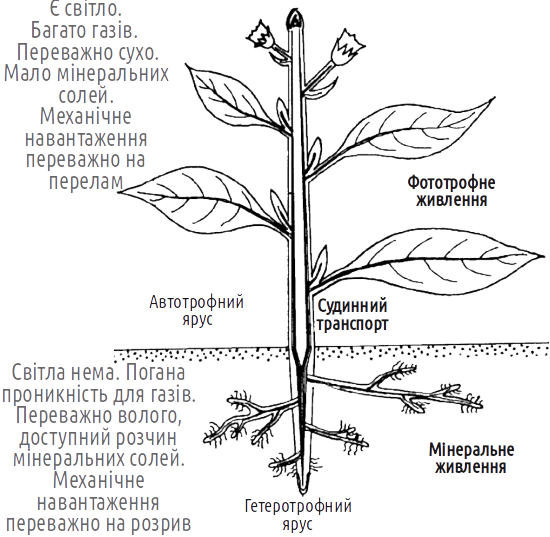
Fig. V-18.1. The terrestrial-aerial environment is characterised by a clear boundary between the conditions in the autotrophic (illuminated) and heterotrophic tiers
The soil habitat is characterised by very high density. It is a complex, multi-phase environment with a pronounced vertical gradient. To move within it, one must either use existing voids (which is accessible to small organisms) or have organs for loosening the soil or pressing through its layers. For large organisms, living in the soil environment is atypical. Water exchange is influenced both by moisture (usually quite high) and by salt content (the salinity of the soil solution). The dynamics of climatic factors in soil are smoothed out. The presence of a water phase in soil, as well as the enrichment of the gas phase with water vapour and carbon dioxide (with insufficient oxygen), brings the soil environment closer to the aquatic one.
The most difficult environment for habitation is other organisms as a habitat. In this environment there are usually sufficient nutrients and quite favourable values of “climatic” factors; however, the environment itself resists the habitation of organisms within it. The primary environment with respect to a parasite will be the body of the host, the organs and other parasites inhabiting it. The external environment acts on parasites indirectly and is called secondary. The totality of all parasites simultaneously inhabiting any organism is called a parasite community (parasitocenosis), and all symbionts together with the host organism — a symbiocenosis. Parasites constantly have to overcome the resistance of their hosts’ immune systems. Another feature of other organisms as a habitat is that this environment is fragmented into separate parts, and parasites must develop complex adaptations for colonising new hosts.