
Ecology: The Biology of Interaction. V-05. The Most Important Factors in the Earth's Biosphere
V-5. The Most Important Factors in the Earth's Biosphere
Examining the Earth's biosphere, we can determine which factors most strongly influence the distribution of organisms across the planet's surface. Those factors whose changes are most often associated with the limits of an organism's range are the limiting factors. The action of these factors was examined in detail in the section devoted to ecosystems; here we can note that the main factors for terrestrial ecosystems are temperature and moisture, while for aquatic ecosystems they are the availability of light and nutrients.
The most clearly expressed relationship between the distribution of organisms across Earth's surface is that with temperature. Recall the significance we assign to movement southward or northward, closer to the equator or to the poles. The primary factor that changes with such movement is temperature. For example, coffee can be cultivated only in those regions of the planet where the average monthly temperature during the coldest month does not drop below 13°C. Sometimes the dependence on temperature is more complex. For instance, the giant saguaro cactus (Carnegiea gigantea) lives in the Sonoran Desert in the state of Arizona (USA). This cactus can withstand night frosts in winter only if a thaw occurs during the day. Two consecutive nights with sub-zero temperatures without a thaw between them are lethal to this cactus, and the northern and eastern limits of its range almost (but not entirely!) coincide with the boundaries of regions where there are never winter days without a thaw (Fig. V-5.1).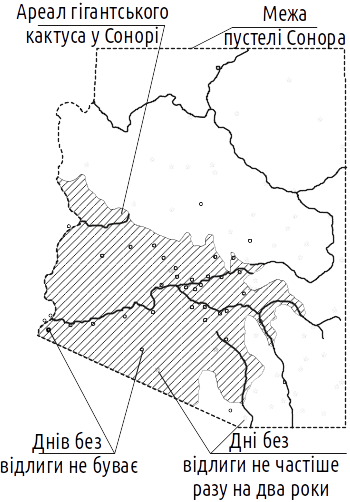
Fig. V-5.1. The distribution limits of the giant saguaro cactus in the Sonoran Desert depend on climate
It is impossible to determine which temperature is optimal for all living organisms on Earth, since different organisms prefer different temperatures. One can say that, in general, the vast majority of life processes on Earth occur within a temperature range of 0°C to +45°C, and even these temperatures are fatally dangerous for most organisms on our planet. Many organisms are capable of surviving temporary drops in temperature below 0°C, as occurs in winter in the temperate latitudes, but very few can endure temperature rises significantly above the stated upper limit.
The harmful effects of high temperatures are connected with the fact that they lead to disruption of the natural conformation (spatial folding) of enzymes and loss of their activity, while low temperatures cause deep inhibition of all reactions associated with the life processes of organisms. In addition, high temperatures can cause the death of organisms through dehydration, while low temperatures can damage cells through ice crystals forming inside them, or cause dehydration because the intracellular water becomes bound within those crystals.
The absence of available water turns out to be an even more acute problem for terrestrial organisms than unfavourable temperature. Water is, without exaggeration, the foundation of life, and where there is no liquid water, life becomes impossible. It is precisely the presence on Earth's surface of water in all three of its states (liquid, solid and gaseous) that stabilises the temperature conditions on the planet and makes it suitable for a vast diversity of organisms.
Another extremely important characteristic of Earth is the oxidising nature of its atmosphere. As we have discussed, this is the result of the activity of living organisms. The majority of them (including virtually all animals, as well as plants and fungi) are aerobes — that is, they require a sufficient amount of oxygen in the environment for their vital activities. The distribution of anaerobes (organisms that live without oxygen) on present-day Earth is limited to relatively few habitats.