
V. Reptilia sensu lato-14. Herpetofauna (sensu stricto) of Kharkiv Oblast
An overview of the reptiles of Kharkiv Oblast. The term "herpetofauna" is sometimes applied both to the reptile fauna and to the amphibian fauna. This is an example of interpreting the concept sensu lato, in the broad sense. Herpetofauna sensu stricto (in the strict sense) refers to the fauna of reptiles proper, as distinct from batrachofauna...
The term "herpetofauna" is sometimes applied both to the reptile fauna and to the amphibian fauna. This is an example of interpreting the concept sensu lato, in the broad sense. Herpetofauna sensu stricto (in the strict sense) refers to the fauna of reptiles proper, as distinct from batrachofauna — the amphibian fauna. The following is an overview of the herpetofauna sensu stricto based (with minor modifications) on the field guide by Atemasov T. A., Vlashchenko A. S., Goncharov G. L., Zinenko O. I., Korshunov O. V., Tokarsky V. A., Shabanov D. A., Shandykov G. A. Field practical course in vertebrate zoology. – Kharkiv: V. N. Karazin Kharkiv National University, 2019. – 196 p. The reptile section in that source was written by O. I. Zinenko.
Herpetofauna (sensu stricto) of Kharkiv Oblast
Order Testudines (Turtles)
An early-diverging and highly distinctive group of extant reptiles. Such characteristic anatomical features as the presence of a ventral and dorsal shell (plastron and carapace), which incorporate vertebrae, ribs, and the sternum; the breathing mechanism based on limb movements and changes in oral cavity volume; the position of the limb girdles inside (rather than outside) the thoracic cage; the presence of a horny beak in place of teeth, etc., were acquired by turtles as early as the Triassic. The modern fauna contains approximately 300 species in 2 suborders and 14 families. Turtles include marine, freshwater, and terrestrial forms. The smallest have a shell length of approximately 10 cm, while the largest belong among the largest extant reptiles: the leatherback sea turtle, with a body length exceeding 2 metres, can weigh up to a tonne. Reproduction is exclusively oviparous; there are no viviparous species, and even highly specialised marine species must leave the water to deposit their eggs. Both herbivorous and carnivorous species are known.
The traits regarded as characteristically "turtle-like" (slowness, longevity) are most pronounced in the herbivorous terrestrial tortoises of the family Testudinidae. The sole representative of our fauna — the European pond turtle — is a rather active and agile animal. Nevertheless, even individuals of this species may live more than 100 years.
European Pond Turtle (Emys orbicularis)
The only extant turtle species of Ukraine, belonging to the suborder Cryptodira and the family Emydidae. Carapace length in adults ranges from 145 to 195 mm.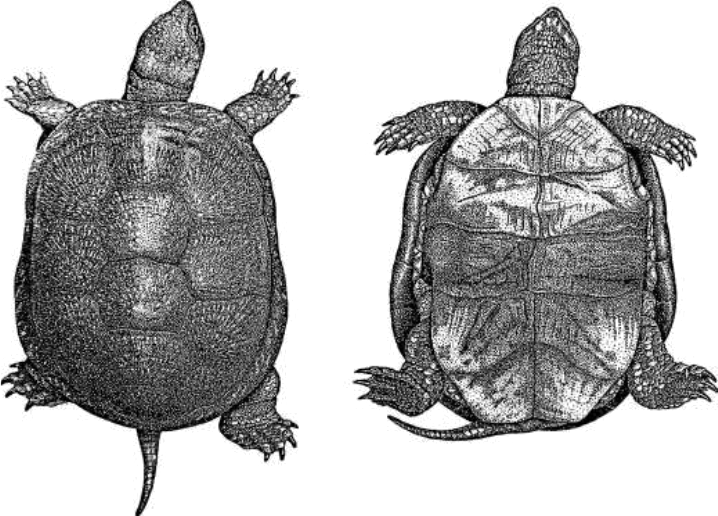
European pond turtle (dorsal and ventral views)
It inhabits, as a rule, small water bodies with slow or no current and well-developed aquatic vegetation: channels, oxbow lakes, lakes, floodplain marshes, bogs, ponds, and similar habitats. The European pond turtle has the largest range of all freshwater turtles, extending from the Iberian Peninsula to the Aral Sea. Its southward extent reaches northern Africa, Turkey, and northern Iran; the northern boundary of the range passes through France, Germany, Poland, Lithuania, and Russia. For a long time the European pond turtle was considered a monotypic species, but following revision it was shown that a number of taxa exist, most of which are subspecies (8), while the form from Sicily has been elevated to a separate species. The nominotypical subspecies inhabits the territory of Ukraine.
Eggs are laid in June. For oviposition, the female selects slopes of southern and south-western aspect with light soils, usually a few hundred metres from water but sometimes several kilometres away. Most clutches fall prey to carnivorous mammals (dogs, foxes, raccoon dogs). Hatchlings that emerge in September, or after overwintering in the soil in April–May, migrate to water bodies. Adults overwinter underwater. It feeds mainly on invertebrates, less frequently on fish and amphibians, as well as on plant material. It is a fairly common species, but its numbers are declining, especially as a result of nest destruction and loss of oviposition sites. In the vicinity of the biological field station, turtles can be observed in the floodplain of the Siverskyi Donets River as well as in ponds. During oviposition, females are encountered in Zaitseve Ravine, in the pine forest, and even on the territory of the field station itself.
Order Squamata
The most species-rich order of extant reptiles, comprising the suborders Lizards (Lacertilia, ~7,300 species) and Snakes (Ophidia, nearly 4,000 species). Previously, the small suborder Amphisbaenia (approximately 200 species) was also recognised separately. Molecular phylogenetic analyses revealed that several families of amphisbaenians are most closely related to true lizards (details — here). In Kharkiv Oblast, representatives of the families Lacertidae (true lizards) and Anguidae (glass lizards and allies) occur. Among snakes, representatives of the families Colubridae and Viperidae are present; amphisbaenians are absent from the fauna of Ukraine.
All squamates are characterised by a body covered with horny scales, shields, or granules, and by a mobile articulation of the quadrate bone with the skull. Among the squamates of the world fauna there are burrowing, terrestrial, aquatic, and even gliding forms. Body size ranges from a few centimetres (Brookesia chameleons) to 12 metres (reticulated python). The greatest diversity is found in the tropics, but individual representatives extend northward to the Arctic Circle. They are carnivorous; herbivorous forms occur only rarely and exclusively among lizards. Primitively oviparous, but species of temperate latitudes, high-altitude species, and aquatic species frequently shift to viviparity.
The body form of lizards is close to the ancestral tetrapod plan. In most species the flexible, elongate body can be raised off the substrate only briefly when the limbs are extended; the head and tail serve as counterweights in this posture, preventing the trunk from sagging to the ground between the limb girdles. As an adaptation to squeezing through obstacles in burrowing or life in dense vegetation, the limbs may be reduced or absent. Limblessness has evolved independently multiple times during lizard evolution.
The origin of snakes involved not only the loss of limbs but also reduction of the sternum and loss of rigidity of the thoracic cage, together with the development of cranial kinesis and the capacity to swallow large prey (macrophagy). The ancestors of snakes were probably burrowing animals living in moist soil or leaf litter, forcing their way through rigid obstacles (stems, roots, stones). The most basally diverging extant snakes — blind snakes, currently assigned to several separate families — are burrowers and do not feed on large prey. The existence of a common burrowing or aquatic ancestor is also suggested by the unique structure of the eye in extant snakes, which differs from the lizard eye in its mechanism of accommodation. Cranial kinesis and macrostomatisation, together with the acquisition of an "open" thoracic cage, allowed snakes to adapt to swallowing large prey, and have in large part ensured the success of this group. When hunting large prey, considerable difficulties are associated with its immobilisation and digestion. Advanced snakes acquired a venom apparatus: venom glands derived from modified salivary glands, and specially modified hollow, enlarged fangs designed to inject venom into the prey. The enzyme complement of the venom, at least in some species, not only kills or paralyses the prey but also initiates the early stages of digestion.
Suborder Lacertilia (Lizards)
Slow Worm (Anguis colchicus)
A limbless lizard with a smooth, glossy body, moveable eyelids, and small ear openings (in most individuals). Total length reaches 45 cm, of which half is tail.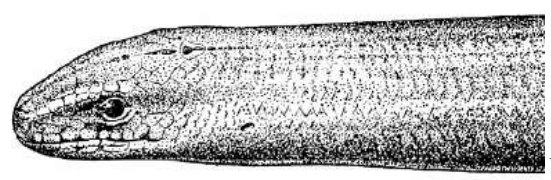
Slow worm
When attacked by a predator, the tail is readily autotomised and does not regenerate; only some adult individuals retain an intact tail. Males are silvery-grey with bright blue spots on the dorsum; females are light brown. Distributed in the Balkans, Eastern Europe, Asia Minor, the Caucasus, and northern Iran. In the north it reaches nearly to the Arctic Circle; in the east, to the Tobol River in Western Siberia.
The southern range boundary passes through Kharkiv Oblast. The species inhabits biotopes with a thick litter layer and high moisture levels. It feeds on slugs, earthworms, centipedes, spiders, and insects. Ovoviviparous. In late July–August, 9–19 young are born enclosed in transparent egg membranes. Most encounters both in the vicinity of the field station and in the forest-steppe zone as a whole occur in the upland oak forest (nahirna dibrova); it is less frequently found in moist forest stands in the river floodplain or in the pine forest.
Sand Lizard (Lacerta agilis)
The most widespread and abundant reptile species in the fauna of Ukraine, and accordingly a frequent subject of ecological and evolutionary research. Body length usually does not exceed 90 mm; tail length 150 mm. Adult males during the breeding season, and some females throughout the entire season (morpha viridinota), are green. The pattern consists of two (in western subspecies) or three (in eastern subspecies) pale longitudinal stripes along the dorsum with dark spots between them, and pale ocelli on the flanks. Individuals without pattern, the so-called morpha immaculata, occur occasionally.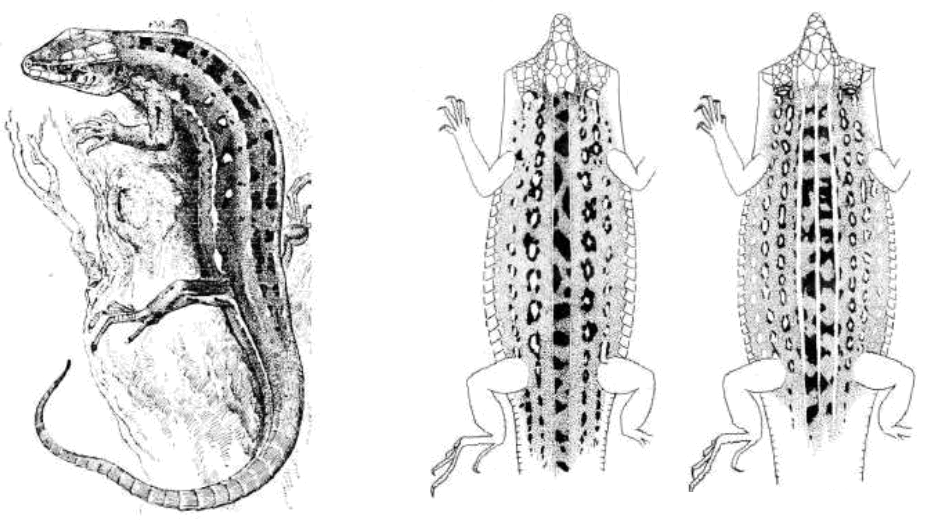
Sand lizard and dorsal colouration of the subspecies present in Kharkiv Oblast (left — southern, L. a. chersonensis; right — eastern, L. a. exigua)
The range extends from England to the Lake Baikal region and north-western China, and from Scandinavia to the Balkan Peninsula and northern Turkey. Between 6 and 10 subspecies are recognised, forming an eastern and a western subspecies group, as well as the distinctive subspecies L. agilis boemica from the north-eastern Caucasus. In Kharkiv Oblast the species is represented by two subspecies belonging to different subspecies groups: the eastern subspecies L. a. exigua Eichwald, 1831, occurring in the greater part of the oblast, and the southern subspecies L. a. chersonensis Andrzejowsky, 1832, occurring in Bohodukhiv, Kolomak, and Krasnokutsk districts. An intergradation zone exists between the subspecies, arising through hybridisation at the boundary of their ranges.
Within Kharkiv Oblast, the species occupies more or less open areas in almost all biotope types, although it is absent from arable fields (it may occur along field margins), large marshes, and the interiors of continuous forest massifs, and is gradually disappearing from large urban areas. The diet is based primarily on insects: Coleoptera, Hymenoptera, Lepidoptera, Orthoptera, Diptera, and Hemiptera, as well as arachnids and crustaceans. Eggs (3–17) are laid in June–July. In the vicinity of the field station, the highest densities are reached at the boundary of the floodplain and the pine terrace on the left bank of the Siverskyi Donets River, and on steppic meadow slopes.
Viviparous Lizard (Zootoca vivipara)
A small (body length 40–70 mm) lizard. Brown in general coloration, with a yellow (females) or orange (males) belly.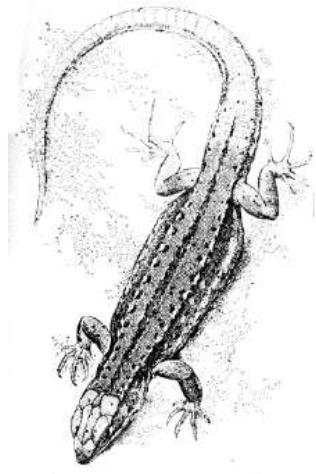
Viviparous lizard
Juveniles are almost black. Teeth are present not only on the jaws but also on the vomer of the palate. It has the largest range of any lizard in the world, extending from Ireland to Japan and from the Arctic to Bulgaria and northern Italy. In the southern part of the range it often inhabits mountains. Morphology is very uniform, and only 4 subspecies have been described; however, these include both viviparous and oviparous forms, as well as several chromosomal races differing in the structure of the female sex chromosomes. In Kharkiv Oblast the nominotypical subspecies, eastern chromosomal form, is present. For a long time the presence of the viviparous lizard in Kharkiv Oblast was considered doubtful, owing to its extreme rarity. It occupies very small areas of intrazonal biotopes: floodplain bogs and meadows, and dish-shaped depressions with relict northern vegetation on pine terraces. In the northern part of the oblast it also occurs along the banks of floodplain water bodies. The nearest known records of the viviparous lizard come from Balakliia district and along the Udy River south of Kharkiv; it has not yet been found in the vicinity of the field station. Farther north, already in the forest zone, it occurs in a wider range of biotopes and is one of the most numerous reptile species. The diet consists predominantly of arachnids and small soft-bodied insects.
Steppe-runner / Racerunner (Eremias arguta)
A small, stockily built lizard. Body length of adults 50–70 mm. The colouration consists of alternating black and cream spots, dots, and ocelli on a white background. The belly is white; the ventral scales are arranged in oblique rows; the scales surrounding the nostrils are inflated.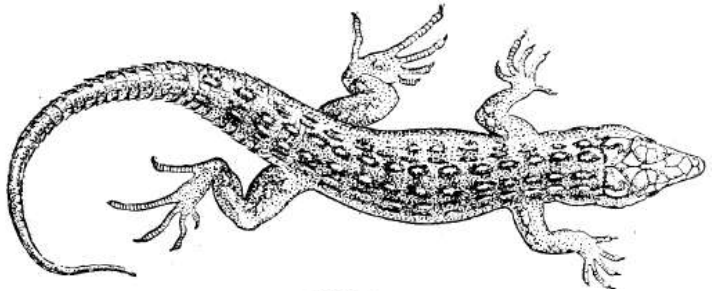
Steppe-runner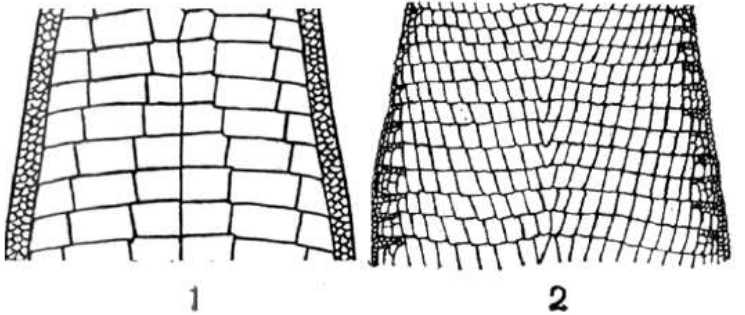
Ventral scales of true lizards (1) and racerunners (2)
The range extends from Romania to north-western China and Mongolia. Six subspecies are described; in Ukraine the subspecies E. a. deserti (Gmelin, 1789) occurs. In Kharkiv Oblast the species enters from the south along sandy pine terraces distributed along river valleys. Following afforestation of the sands with pine, the species has survived on clearings, clear-cuts, roadsides (railway and road), and other areas where woody vegetation is absent. In general, the biotopes of this species are characterised by the presence of unconsolidated sandy soil, low moisture and vegetation cover, and good illumination. In the vicinity of the field station it can be encountered in open areas within the pine forest on the left bank of the Siverskyi Donets River. The diet consists primarily of beetles, Hymenoptera, and arachnids.
Grass Snake (Natrix natrix)
One of the most common snakes. Total body length exceeds one metre; trunk length in females most often reaches 60–70 cm, in males 45–55 cm. The head is covered with large shields; the pupils are round; paired light spots of various shades of yellow are present on the nape. The scales have a well-marked central keel.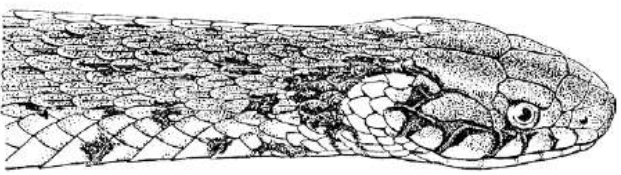
Head of the grass snake
The range extends from Western Europe to Lake Baikal and from Scandinavia to northern Africa and Asia Minor. Between 9 and 14 subspecies of the grass snake are recognised; some subspecies are not accepted, while others from Central Europe are now treated as separate species (N. helvetica). In Kharkiv Oblast the species is represented by the nominotypical subspecies N. n. natrix.
It occurs in all biotope types but typically keeps close to water bodies, which serve as the source of its principal prey items — amphibians. Far from water it may feed on terrestrial amphibians. Gestation is longer than in other oviparous reptiles of temperate latitudes. Retention of eggs within the female’s body and the use of decomposing vegetation as oviposition sites are adaptations that accelerate embryonic development under cool temperate conditions. In the vicinity of the field station, grass snakes are most frequently encountered among dense vegetation near ponds and along the banks of water bodies in the floodplains of the Siverskyi Donets and Homilsha rivers.
Dice Snake (Natrix tessellata)
A species closely related to the grass snake. Yellow nape spots are absent; the pattern consists of dark spots arranged in a chequered pattern on a lighter background. The overall colouration is olive; entirely black individuals are occasionally encountered.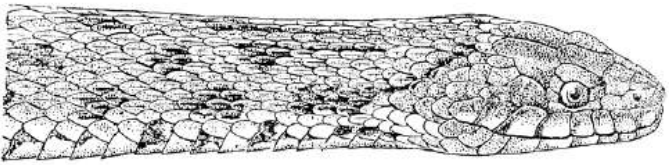
Head of the dice snake
The range extends from south-western France and northern Africa to the Persian Gulf and Pakistan in the south, and to western China in the east. In Kharkiv Oblast, the northern distribution boundary of the dice snake passes; several records are known from the vicinity of the field station. Further south, in Izium district, it is encountered regularly. In recent years, a locally established population of the dice snake has been found in central Kharkiv at the confluence of the Kharkiv and Lopan rivers. The origin of this population is probably associated with introduction.
Morphology within the range is fairly stable; the only subspecies described on morphological grounds is not recognised, although molecular-genetic studies indicate a population structure no less complex than that of other wide-ranging species of the northern Palaearctic. Compared with the grass snake, the dice snake is more strictly aquatic, favouring water bodies with gentle current and steep, rocky banks. The diet consists predominantly of small fish, frequently gobies. Reproductive features are the same as in the grass snake.
Smooth Snake (Coronella austriaca)
A small snake up to 65 cm in length. Pupils round; body light (olive, grey), sometimes with an irregular dark pattern on the head and two to four rows of small dark spots on the dorsum and flanks. Scales smooth, with apical pits.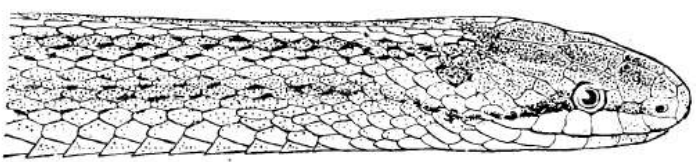
Smooth snake
Distributed across Europe, extending into Asia Minor, northern Iran, and Kazakhstan. Three subspecies of the smooth snake are described. In Kharkiv Oblast, as throughout Ukraine, the nominotypical subspecies C. a. austriaca is present. A fairly common species, but secretive in habits. Listed in the Red Data Book of Ukraine (Category II, Vulnerable). It occurs in ecotones at the forest edge and open biocoenoses, in forest massifs of various sizes, at the margins of pine and deciduous forests, in ravines in the steppe, on river valley slopes, in old orchards, floodplains, and occasionally in continuous dense forest. Although dietary specialisation of the smooth snake on true lizards (Lacertidae) is often emphasised, in the vicinity of the field station it frequently preys on murine rodents and slow worms, and occurs in areas where the sand lizard is absent. According to literature data and occasional observations, it may also feed on small vipers. Ovoviviparous.
Nikolsky’s Viper (Vipera nikolskii)
A small venomous snake with a body length up to 1 m. Males more commonly reach 45–60 cm; females 60–70 cm. Nikolsky’s viper is one of four taxa within the common viper species group, in which it is frequently cited in the literature as a subspecies, V. berus nikolskii. The uncertainty regarding the status of this form is due to the fact that, notwithstanding a whole array of distinctive characters in external morphology, ecology, and genetics, a large number of populations are of hybrid origin. This situation does not fit the so-called biological species concept, which presupposes reproductive isolation between distinct species. However, the majority of recognised viper species hybridise under certain conditions, and thus the status of Nikolsky’s viper remains controversial; some researchers regard it as a subspecies, others as a separate species. Nikolsky’s viper is characterised by uniformly black colouration without pattern in adults, a higher pholidosis polymerisation compared with the common viper, certain ecological peculiarities, venom composition, etc.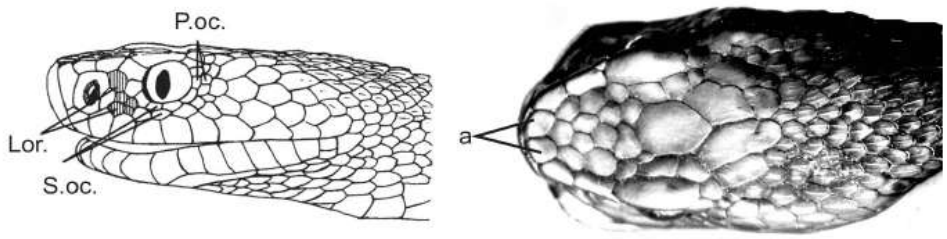
Nikolsky’s viper; left — lateral view of the head
(diagnostic characters indicated, the frequencies of which are elevated
relative to the nominotypical subspecies of the common viper:
Lor. — increased number of loreal scales,
S. oc. — two rows of suboculars, P. oc. — two rows of postoculars;
right — dorsal view of the head (a — apical scales)
Neonates are coloured similarly to other viperid snakes and have a dark zigzag dorsal pattern on a lighter, grey or brownish background. The eye has a vertical pupil; body scales have well-developed keels; on the tip of the snout there are two apical scales. The range of the common viper in the broad sense is one of the largest among reptiles. It extends from England to Sakhalin and from the Arctic to the mountains of Greece and Bulgaria.
Nikolsky’s viper occupies the southern portion of the common viper’s range within the forest-steppe natural zone, from Romania to Tatarstan. In Kharkiv Oblast the southern boundary of its range passes. It occurs in broad-leaved forests on watersheds and right riverbanks, less frequently and secondarily in floodplain forests. It favours ecotones, slopes, and shrub thickets. Permanently present on the territory of the field station. It feeds on rodents and, less commonly, on other terrestrial vertebrates. Viviparous, giving birth to 9–22 young. Venomous; isolated cases of human fatalities are known.
Steppe Viper (Vipera renardi)
A small venomous snake with a body length up to 70 cm. Characterised by a dark zigzag dorsal pattern, a vertical pupil, and a short tail.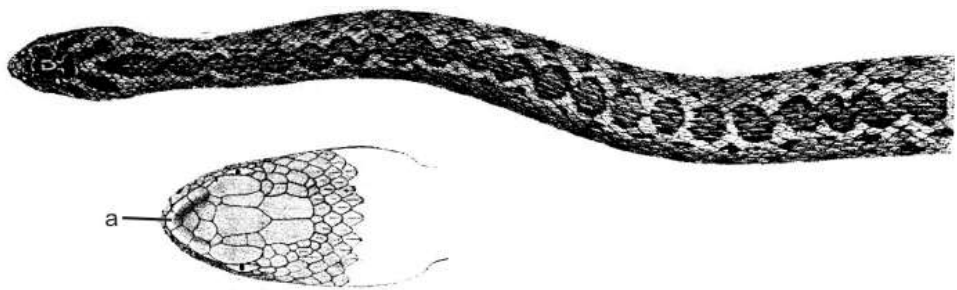
External appearance and head of the steppe viper, dorsal view (a — apical scale)
A single apical scale on the head; body scales with clearly expressed keels. Formerly treated within the species Vipera ursinii Bonaparte, 1835, but following research the eastern steppe viper was elevated to a separate species with 5–6 subspecies, distributed from Ukraine to north-western China. In Ukraine only the nominotypical subspecies occurs, but from the mountains of Crimea the subspecies V. r. puzanovi has been described, though it is not always recognised. The range lies mainly within the steppe and forest-steppe natural zones. In Kharkiv Oblast the species is disappearing. A sharp decline in numbers occurred in the second half of the 20th century, linked apparently to ploughing of the steppe, severe fragmentation of populations, and the use of pesticides. At present, in Kharkiv Oblast and other forest-steppe oblasts of Ukraine, the steppe viper inhabits remnant steppes in ravines, along the margins of ravine forests, among scattered trees on slopes, in old orchards, and on sandy terraces of river valleys in open pine stands. In addition to rodents, Orthoptera and lizards constitute a significant proportion of the diet. Viviparous.
Venomous, but not life-threatening to humans.