
Ecology: the biology of interaction. IV-19. (supplement) Evolution of altruism
Thus, according to the presented views, altruistic behavior can be maintained by selection at three different levels. Altruistic behavior toward relatives is a consequence of kin selection acting at the gene level; selection for the ability to engage in reciprocal altruism should most likely be considered...
IV-19. (supplement) Evolution of Altruism
Modeling reality, we find ourselves before the necessity of explaining many of its observable features. Phenomena whose causes are unclear become intellectual challenges for us. An example of such a phenomenon may be the phenomenon of altruistic behavior in representatives of a number of species (first of all – Homo sapiens Linnaeus, 1758), concerning individuals unrelated to them. First of all, for our discussion we should define how we understand the very concept of "altruism." In the humanities, approximately such definitions are widespread. Altruism (from Latin alter — other) is a concept by which activity is understood that is associated with selfless concern for the good fortune of other persons; it is related to the concept of self-sacrifice — that is, with sacrificing one's own benefits for the benefit of another person, other people, or in general — for the common good. Can one say that such an approach is incorrect? No. But this approach makes sense within a completely different, humanitarian discourse (from French discours, speech — the unity of speech and the situation in which it occurs). For the evolutionary-biological discourse, a different approach makes sense (see Fig. II-1.1). Altruism, altruistic behavior — actions of an individual that lead to an increase in the fitness of another individual at the cost of decreasing one's own fitness; the capability and propensity of an individual for such actions. Let us recall that fitness is a measure of the expected contribution to future generations.
Sometimes altruistic behavior in humans is a consequence of upbringing, a certain preparation for self-sacrifice. But quite often it is a "first movement" of the soul, an emotional (that is, one based on biological mechanisms of behavior) impulse. According to the views of evolutionary biology, the innate basis of altruistic behavior must be a consequence of selection. But how can selection (which is directed toward increasing the contribution to future generations) support self-sacrifice that leads to a decrease in such a contribution?
In modern pseudoscientific mythology, the thesis that evolution occurs exclusively at the gene level is widespread. From this viewpoint, kin altruism is easy to explain, the research of which was begun by John Haldane (1892–1964), and continued by William Hamilton (1936–2000) and other brilliant researchers. Kin selection can effectively explain the willingness of a mother to sacrifice herself for her offspring, altruistic behavior toward the closest relatives. If a certain allele (let us call it the "altruism allele") prompts an individual to sacrifice themselves for saving close relatives (who are most likely carriers of the same "altruism allele"), this, in the end, may ensure the spread of such allele in the population!
However, the behavior that kin selection can support does not exhaust the diversity of forms of altruistic behavior that can be observed both in humans and in other animals. If we understand altruism as behavior that decreases an individual's chances of survival and, consequently, of reproduction, selection would seemingly have to eliminate the genetic prerequisites of such behavior toward individuals who are not relatives of the altruist himself! However, observations do not support such a hasty conclusion.
Another explanation of the mechanism of altruism was proposed by American ethologist Robert Trivers (born in 1943). This is the so-called "reciprocal altruism" (from English reciprocity — mutual exchange; from Latin reciprocus — that which returns). These are relationships that can be explained by the phrase "you scratch my back, I'll scratch yours." For example, common vampire bats Desmodus rotundus (South American bats that feed on the blood of ungulates and other large mammals) may share the blood of their victims with other members of their colony. A vampire that failed to drink blood during the night's hunt is exhausted, and the next night will have fewer chances for success. If its more successful neighbor regurgitates some of the obtained blood for it, it will significantly increase the survival chances of the one it helps (and not critically decrease its own). Each of the vampires gives preference to those neighbors who previously shared blood with them... Such relationships are possible only in animals that remember their relationships with other members of the group. From the humanitarian viewpoint, they do not look like "exemplary" altruism, rather — as far-sighted egoism; however, they fully correspond to the evolutionary-biological definition of altruism.
Since Charles Darwin, the possibility of explaining "true" altruism by group selection has been known. However, attempts to associate numerous features of animal behavior with group selection, made by Vero Wynne-Edwards (1906–1997), were effectively refuted by George Williams (1926–2010). The return of this idea is associated with the hypothesis of parochialism (parochial altruism), proposed by economists Yong-Ki Choi from South Korea and Samuel Bowles from the USA.
According to the views of Choi and Bowles, despite the fact that altruistic behavior may lead to the defeat of altruists within groups, altruism may spread due to the advantage of groups containing many altruists. This may be the main reason for the spread among humans of altruistic behavior toward individuals who are not their direct relatives. The willingness to sacrifice oneself appears toward those who are perceived as "our own," and becomes sharper due to confrontation with "outsiders" (Fig. IV-19.1).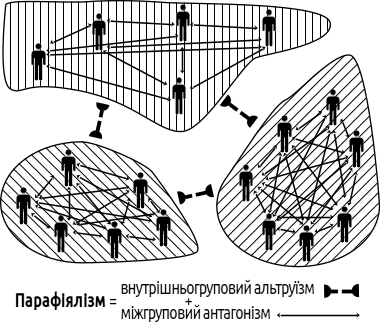
Fig. IV-19.1. Scheme explaining the relationships between individuals in the case of parochial altruism
One of the interesting situations from the evolutionary viewpoint that may influence the spread of parochial altruism is associated with the action of Simpson's paradox. Simpson's paradox as a separate phenomenon was described in 1951, but has a history of research going back to the 19th century, to the classic of statistics Karl Pearson. The essence of this paradox is that when combining two or more groups of data, in each of which a certain dependence or trend of changes is observed, this dependence or trend may disappear or even turn into the opposite. The idea that Simpson's paradox may have significance for evolution also has a certain history of research. For example, the fact that due to Simpson's paradox, individuals who lose in groups but ensure the victory of their groups was shown in experiments with bacteria. Probably, antagonistic relationships between human groups could promote the spread of parochial altruism (Fig. IV-19.2).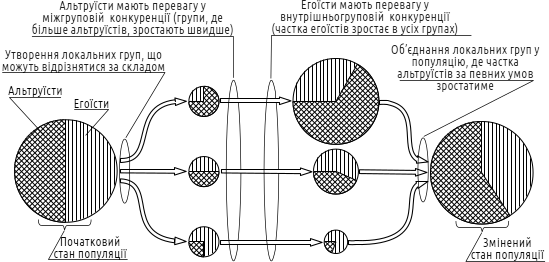
Fig. IV-19.2. Explanation of the action of Simpson's paradox using the example of a population where egoists (individuals that have an advantage in intragroup competition) and altruists (individuals that ensure the advantage of the group in intergroup competition) compete
Thus, according to the presented views, altruistic behavior may be maintained by selection at three different levels (see item I-18). Altruistic behavior toward relatives is a consequence of kin selection acting at the gene level; selection for the ability for reciprocal altruism is probably better considered as a phenomenon occurring at the organism level (although other viewpoints on this phenomenon are possible). Parochialism (parochial altruism) is probably a consequence of group selection due to Simpson's paradox.