
Ecology: biology of interaction. II-03. Gaia hypothesis (metaphor)
In 1972, James Lovelock and Lynn Margulis proposed the so-called «Gaia hypothesis» — the conception of Earth as a superorganism that maintains its homeostasis. As Lovelock later indicated, he and Margulis independently arrived at ideas previously expressed by James Hutton in the 17th century...
II-3. Gaia Hypothesis (Metaphor)
Earth is more than just a home; it is a living organism, and we are part of it.
James Lovelock
As noted above, at all levels of biosystem organization, regulation occurs according to the principle of negative feedback. However, the levels of biosystem organization differ in many respects. For example, an organism consists primarily of living tissues, is characterized by a high level of integrity, and possesses a certain set of control systems (for animals, these are the nervous, endocrine, and immune systems). It seems quite natural to us that an organism maintains homeostasis (preserving constancy of its most important properties). In contrast, the biosphere consists primarily of non-living components, has no "center" and no control systems. However, it too is capable of maintaining the stability of its important parameters!
This property of the biosphere made a strong impression on the English chemist James Lovelock, who worked at the American space agency (NASA) and tried to determine those characteristics by which planets harboring life could be identified. It became clear to him that the most important parameters of Earth's biosphere (atmospheric composition, ionic composition of the ocean, climate) are maintained by living organisms in a state far from equilibrium. Over a long period of time, the Earth's biosphere has maintained conditions favorable to itself on the planet's surface.
In 1972, James Lovelock and Lynn Margulis proposed the so-called "Gaia hypothesis" — the conception of Earth as a superorganism that maintains its homeostasis. As Lovelock later pointed out, he and Margulis independently arrived at the same idea that James Hutton in the 17th century and Vladimir Vernadsky in the 20th century had expressed earlier. Of course, for evaluating this idea, it is important to understand what is meant by the term "superorganism." A profane understanding of the hierarchical organization of biosystems leads to the incorrect conclusion that all levels must be organized in the same way. It is enough to consider the fundamental differences between organisms, populations, communities, and ecosystems to understand that a higher level need not necessarily resemble the lower one. For this reason alone, the "Gaia hypothesis" is more accurately a "Gaia metaphor," comparing the planet to an organism. This metaphor is useful already because it draws researchers' attention to the search for mechanisms of planetary regulation.
Let us return to the speculative model of global regulation proposed by J. Lovelock in 1979 — the "Daisyworld" (see section I-7). If a biosphere that can only change the color of petals on flowers growing on its surface is capable of regulating the planet's temperature within rather wide limits, what are the capabilities of Earth's biosphere? The properties of stars of the class to which the Sun belongs are such that over time they gradually increase their luminosity. During the existence of life on Earth, this should have led to a significant change in surface temperatures. Strangely, this did not happen. Most likely, the relative constancy of climate is the result of regulatory activity by the biosphere. The Earth's biosphere is much more complex than Daisyworld. Whether Daisyworld becomes more or less stable by adding additional components to the model that describes it remains a question that is still subject to debate.
Many of the interrelationships that ensure Gaia's functioning are still unknown. Let us give one example, discovered with Lovelock's participation. When dying, planktonic algae release gases — dimethyl sulfide and iodomethane. These gases perform several functions simultaneously. First, they enhance the condensation of water vapor in the atmosphere into clouds. If planktonic algae die from overheating, the release of these gases leads to cooling of the water thanks to cloud cover. This effect is not only local in nature. An increase in cloud cover increases the planet's albedo — its ability to reflect incoming radiation. The wind arising due to cloud cover promotes water mixing. Furthermore, these gases, entering the atmosphere, allow the return to land of sulfur and iodine compounds necessary for terrestrial ecosystems. An increase in the activity of terrestrial plants leads to their enhanced destruction of rocky terrain and an increase in the amount of biogens (needed by planktonic algae) entering the ocean with water runoff from land.
One direction of critique of the Gaia concept is that ensuring Earth's stability cannot be linked to differential mortality or differential reproduction of selection units at the planetary level. The purposefulness of biosystems at the organismal level is linked to the fact that they differentially (depending on their properties) survive and reproduce. Clearly, there can be no direct analogy with a biosystem at the planetary level. Although planets may die, they do not reproduce, and moreover, they do not transmit to their "offspring" sets of hereditary traits that promote their survival and reproduction.
"Lovelock's hypothesis would have instantly been dealt a deadly blow if he had asked himself at what level of the natural selection process the supposed adaptation of Earth was supposed to evolve. Homeostatic adaptations in individual bodies develop because individuals with improved homeostatic apparatus transmit their genes into the future more efficiently than individuals with imperfect homeostatic apparatus" (Richard Dawkins).
Probably, to answer Dawkins's objections, it is necessary to consider not only the classical variant of Darwinian selection (differential survival and reproduction of organisms) and certainly not the variant of its use at the gene level, which corresponds to the "selfish gene" concept (i.e., differential replication of genetic sequences). In the evolution of the biosphere, we observe changes in processes that occur at a level lower than the biospheric level. Some of these processes are stable, some are not. For example, the cause of successions (see section 3.8) is that the presence of unstable communities turns out to be transient, and over time they are replaced by stable (climax) communities — until some disturbance deprives them of stability. The authors of this textbook suggest that planetary regulation mechanisms can arise and improve as a result of competition between alternative processes at the biocenotic level (Fig. II-3.1). Unfortunately, the degree of study of such competition is clearly insufficient.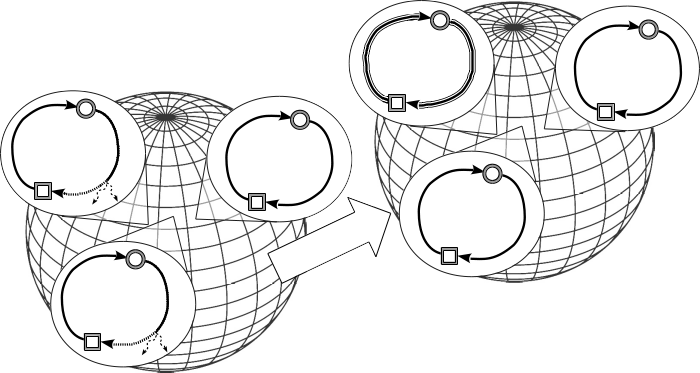
Fig. II-3.1. More stable processes displace less stable ones. This may be the cause of the evolution of planetary regulation mechanisms
In any case, in the Gaia hypothesis, elements of scientific theory and religious prophecy are intertwined. In recent years, James Lovelock has been making predictions of catastrophe. He considers humanity to be the "nervous system" of Gaia, through which it becomes aware of itself. Unfortunately, humanity has not recognized its own role and has disrupted Gaia's functioning.
"Gaia made me a planetary doctor, and since I take my profession seriously, I am compelled to report bad news... Climate research centers around the world — which are the equivalent of a diagnostic laboratory or hospital, reporting on the physical condition of the Earth — and specialists see that the planet is seriously ill, and will soon develop a fever that will last at least 100,000 years. And I must tell you, members of the Earth family, and its closest part — that you, and especially civilization, are in mortal danger....
We must be the heart and mind of Earth, not just a viral disease. So let us take courage to think not only of human needs and rights, but also of the harm we have done to Earth, and how we can reconcile ourselves with Gaia. We must take action while we are still strong enough to do so, while we are still not a pitiful mob of humans, broken by the cruel will of savage military dictators. The most important thing we must remember is that we are part of Earth, and that it truly is our home" (J. Lovelock).
An interesting development of the Gaia metaphor is the Medea metaphor, proposed by American paleontologist Peter Ward. Medea — a heroine of ancient Greek myths, wife of Jason, who killed her own children. The point is that mass extinctions in the history of life on Earth can be considered as regulatory influences from the planet on its biota. Unfortunately, we are compelled to seriously consider the scenario in which humanity puts the biosphere into an unstable state and thus disappears. Planetary and biospheric responses to such human activity, which will ultimately lead to humanity's demise, can be considered within the framework of the Medea metaphor, which destroys its children.
Whatever one's stance on the Gaia hypothesis, one must agree with Lovelock that one of the main parameters of the biosphere is the CO2 content of the atmosphere. The problems raised by Lovelock probably require serious study. One effective method of such study, in the opinion of the authors of this textbook, may be simulation modeling.