III. Pisces-08. Actinopterygii (III): Percomorpha from Anabantiformes to Tetraodontiformes
Anabantiformes, pleuronectiforms, syngnathiforms, scombriforms, perciforms, scorpaeniforms, lophiiforms, and other orders.
Order Anabantiformes - anabantiforms
Representatives of this order are characterized by the presence of a suprabranchial organ, an adaptation for air breathing. In the typical case it has the form of a labyrinth located beneath the gill cover and formed by folds of skin with a rich blood supply. This organ helps labyrinth fishes live in oxygen-deprived water. They seize air bubbles with the mouth, place them under the gill cover beside the labyrinth, and conduct gas exchange there. 3 families, 19 genera, 120 species.
Most representatives of the family Anabantidae live in Asia. A typical representative is the climbing perch, Anabas testudineus, capable of crawling out of water and moving across land. The family Osphronemidae includes many aquarium fishes, including the Siamese fighting fish, Betta splendens.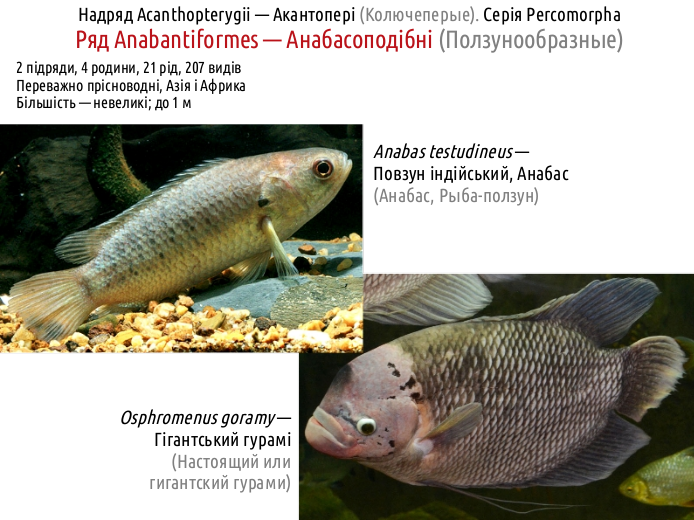
A suprabranchial organ is also present in representatives of the family Channidae - snakeheads, with 2 genera and 37 species. These are freshwater predators of Africa and Asia reaching up to 1.2 m in length. The northern snakehead (Channa argus), originating from the Far East, has spread widely across Central Asia. This predator reaches up to 1 m in length, tolerates the drying of water bodies, and is able to crawl across land.
Order Pleuronectiformes - flatfishes
A very peculiar order of fishes whose representatives lose bilateral symmetry in the adult state because they lie on the bottom on one side. Both eyes are located on the side of the body that faces upward. 10 species are freshwater, and several others can also enter freshwater.
Order Syngnathiformes - syngnathiforms


Order Scombriformes - scombriforms
Order Trachiniformes - trachiniforms
The great weever, or marine dragonet (Trachinus draco), also inhabits the Black Sea. This fish is considered the most dangerous fish in Europe; cases are known of people dying after stepping on a weever hidden in the sand. A puncture by the weevers' spines causes severe pain, which may lead to drowning. This fish, with a body length of up to 40 cm (usually less), can easily be distinguished from others that remotely resemble it by its black first dorsal fin.
Order Labriformes - wrasses
Many small wrasses act as cleaners, freeing larger fishes from external parasites and dead pieces of skin.
The family Scaridae, parrotfishes, unites coral-reef fishes in which a powerful "beak" is formed that can crush coral branches.
Order Perciformes - perciforms
Two dorsal fins, spines in the dorsal, anal, and pelvic fins (in the pelvic fin one spiny and five soft rays), ctenoid scales. The pectoral fins are located on the sides, and the pelvic fins are located beneath the pectorals.
The suborder Notothenioidei includes most coastal fish species of Antarctica. Some species live at a water temperature of -1.9 C (salt water does not freeze at temperatures below zero). Some species have lost hemoglobin, myoglobin, and erythrocytes. Gases dissolve better in cold water than in warm water, activity in such fishes is reduced, and the loss of erythrocytes allows energy expenditure on circulation to be decreased.
The family Mullidae includes the well-known Black Sea fish, the red mullet or surmullet (Mullus barbatus). These fishes are very tasty; in Ancient Rome large red mullets (they grow to 33 cm) cost as much as a piece of silver of equal weight. They were brought to banqueting tables in special vessels; their heads were crushed with special tongs, and people watched how the dying fish changed colors.
Order Scorpaeniformes - scorpaeniforms
Among scorpaeniforms is the family Liparidae, the snailfishes. These are sluggish bottom fishes that are record holders for life at depth, having been recorded in the deepest trenches.
Order Acanthuriformes - surgeonfishes
Some surgeonfishes, like wrasses, perform the function of cleaners. Some of them have sharp spines on the caudal peduncle (resembling a surgeon's scalpel) that may lie against the body or be set out to the sides, turning into formidable weapons.

Order Lophiiformes - anglerfishes
A group of marine, mostly deep-sea fishes with a remarkable appearance. The first ray of the first dorsal fin (if present) is located on the head and transformed into a special organ, the illicium (the "fishing rod"), which serves to lure food into the mouth. The gill opening is small and resembles a tube.
Frogfishes (family Antennariidae) are characteristic fishes of coral reefs. They camouflage themselves perfectly thanks to their unusual appearance.
Despite their comical appearance, frogfishes are serious predators.
Many deep-sea anglerfishes are characterized by the phenomenon of dwarf parasitic males. The meeting of partners at great depth is unlikely. In such species the male strives to find the female and attach to her with his mouth. After some time the male grows onto the female, most of his organs degenerate, but his testes are then always able to fertilize the female's eggs during spawning.
The European anglerfish (Lophius piscatorius), a species of anglerfish, occurs in the Black Sea. This is a fairly large fish (up to 2 m), one third of whose length is the head. A small illicium is located above the upper edge of the mouth. The life form to which this fish belongs is called a living trap. Having lured its prey, the anglerfish abruptly opens its mouth, sucking in a large volume of water and its prey together with it.

Order Tetraodontiformes - tetraodontiforms
Many possess a stomach capable of great expansion; such fishes are able to swallow water (or air) and inflate to considerable size.
As you can see, this order also includes the family Molidae, whose representative was mentioned in the lecture devoted to the general characteristics of bony fishes. The ocean sunfish (Mola mola) is a fish weighing more than a ton and capable of releasing up to 300 million eggs during a single spawning. Representatives of the family Ostraciidae, boxfishes, have the body enclosed in a bony carapace.
The brown fugu (Takifugu rubripes) is the fish from which the famous dish of Japanese cuisine is prepared. Fugu tissues contain tetrodotoxin, which disrupts the functioning of excitable tissues. Lovers of this dish (if it is prepared correctly) receive a small dose of the toxin and experience a state compared to orgasm; an overdose of the toxin (for example, if the dish is prepared incorrectly) leads to paralysis of the respiratory musculature and death (apparently, a rather pleasant one).