Sample
Week 1. How has science changed our life? |
||
|
1.1 Fairy tales and technologies |
||
Key ideas |
● The human is a part of nature and of the Universe in which we live. |
|
|
● Culture is what people learn, what they absorb, develop and pass on through teaching. |
||
|
● Thanks to culture, the complex inner world of a human arises. |
||
|
● A part of culture is the natural sciences, the knowledge about the laws of nature. |
||
|
● The natural sciences are the basis of the technologies that change the modern world. |
||
Master the concepts |
● Nature |
|
|
● Culture |
||
|
● Technologies |
||
Theoretical part |
1.1 |
Fairy tales and technologies |
|
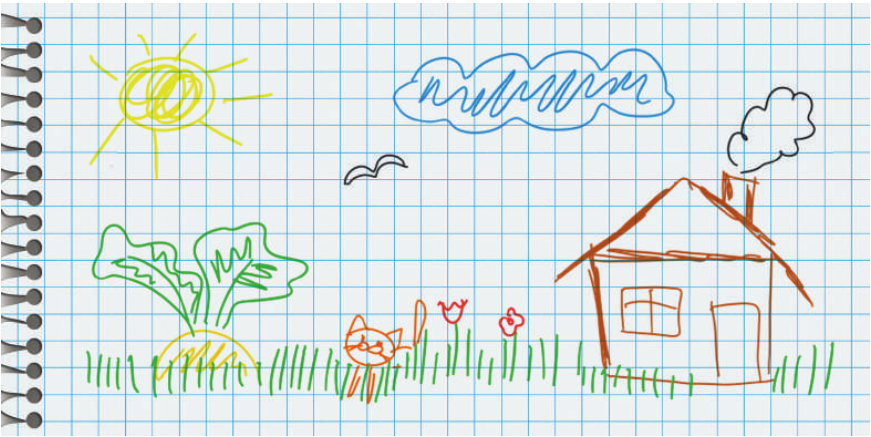
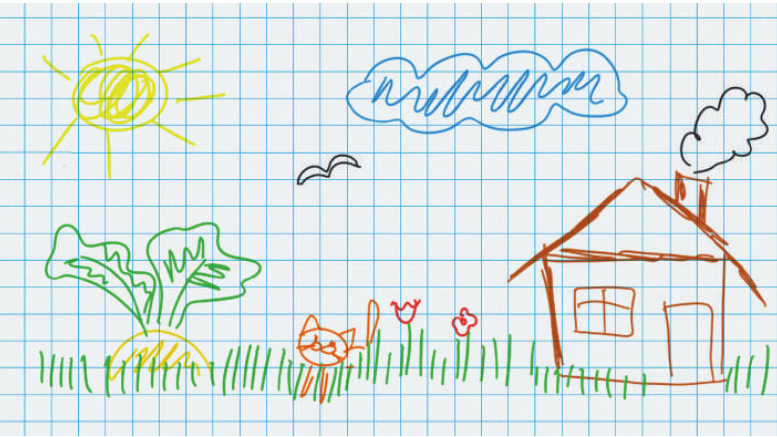
Open your notebook and recall your favourite folk tale. Draw the world of this tale (or at least imagine and describe your drawing). What is depicted in it? |
||
|
We, for example, ended up with this illustration for the fairy tale 'The Turnip', and you? |
|
|
|
Look around. How does our world differ from the world of fairy tales? |
||
|
When our ancestors composed fairy tales, the world around them was very different from today. They lived in small dwellings and fed themselves from their own homestead, and in fairy tales they imagined various wonders. Today many of these wonders have become reality thanks to science. |
||
|
Compare the wonders of fairy tales with the achievements of modern technology! Which devices now do what in fairy tales was done by the magic apple on a silver saucer, the flying carpet, the seven-league boots? Which of the modern achievements of technology did people to some extent foresee in fairy tales? Thanks to what have wonders that require no sorcery become possible? |
||
|
|
1.2 |
Why is our world changing? |
|
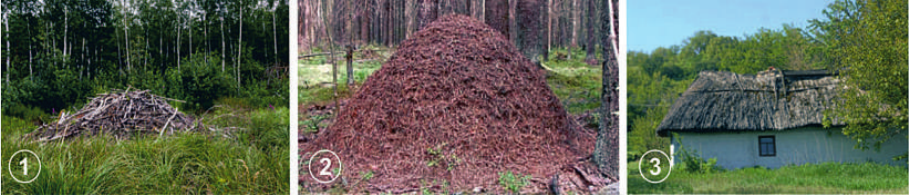
It is not only people who change their surroundings. Beavers build a dam, ants raise an anthill. Look how much the construction of the dwellings shown has in common! The beaver's lodge on the water and the anthill in the forest are built of randomly interwoven twigs. There is something similar on the roof of a house too. |
||
|
1. A beaver's lodge. |
|
|
|
But in fact there is a big difference between these dwellings. |
||
|
And several thousand years ago, beaver dams and anthills were the same as they are now. But the human way of life has changed fundamentally over the last few centuries. The actions of beavers and ants are mostly determined by their innate abilities. Unlike them, a human needs to learn a great deal in order to absorb the achievements of humanity. |
||
|
The main difference between these dwellings concerns not their structure. It is that the builders of the house had to learn to build it from other people. |
||
|
Why is it precisely the human that fundamentally changes its world? We need to understand the place of the human in nature. |
||
|
|
1.3 |
Nature and culture |
|
The entire world in which we live, near to us and far, living and non-living, is nature. The human is a part of living nature, one of many species of living beings. All other species are our relatives. |
||
|
And is there anything that does not belong to nature? Among the objects we can see and touch with our hands, there is none. Some of them are natural in origin, some are man-made. Man-made things are also a part of nature, although a changed part. |
||
|
But remember - there is not only the external natural world! Each of us has an inner world: thoughts, imagination, spiritual values... Where do they come from? |
||
|
We learn culture - everything that we learn, that we pass on to other people during teaching. |
||
|
It is precisely thanks to learning that the inner, cultural world of a human arises. Our brain is a part of nature, but culture and the inner world it creates are not. |
||
|
It is almost impossible for us to imagine the inner world of a beaver or an ant, but we are sure that it is not like ours and is much simpler, since beavers and ants have no complex culture. |
||
|
|
1.4 |
Science is a part of culture and the basis of technology |
|
Culture has many components. The natural sciences, which we will discuss in this textbook, are also a part of culture. They are our ideas about the laws by which nature exists and develops. When we understand the laws of nature, we can embody our knowledge in technology. |
||
|
Appendix: The role of science in protecting humans from disease |
Technologies - these are the means of solving the tasks that life sets us, the ways of meeting our needs with the help of tools. We compared the achievements of modern technology with the wonders of fairy tales. Thanks to them, people change nature and build a man-made world around themselves. |
|
|
Does this not amaze you? The human is a part of nature. It creates culture, and a part of this culture is the knowledge of nature. We are a part of the Universe that can come to know and change itself! |
||
Practical part |
1.5 |
How to search for information on the Internet? |
|
While doing schoolwork, or simply out of curiosity, you may need to search for information. For this you can use printed encyclopedias, reference books, dictionaries and so on. With the development of the worldwide Internet, most often we look for information precisely there. |
||
| What life hacks can be used for this? | ||
|
An example of a search bar. They are similar in different search engines. A search query can be made by entering text from the keyboard or by voice. You can start searching! |
|
|
|
1. Use specialized search engines. You can search not only for text, but also for images, videos and so on. |
||
|
2. To begin searching for information, you need to enter into the search bar the word that best describes your question. |
||
|
For example, we need information about the pea plant, namely what it looks like. We enter the word into the search bar pea. Most likely you will be offered to buy peas, and the pictures will show its pods or seeds. |
||
|
3. To get exactly what you need, the search query can be refined. By the way, pea we add the word plant and we get a description of the plant, in which we will find the answer to the question. |
||
|
4. If we put a phrase in quotation marks, the search engine will look in texts for exactly that, word-for-word wording. This is convenient for finding poems, stories and so on whose titles you have forgotten but a fragment of which you remember. |
||
|
5. Prepositions and pronouns complicate the search. Most often it is better to avoid them when searching. |
||
|
|
1.6 |
Appendix. The role of science in protecting humans from disease |
|
Changes in the world around us can be connected with natural causes: floods, earthquakes, volcanic eruptions and so on. But no less destructive can be the agents of infectious diseases, invisible to the eye. |
||
|
In the Middle Ages, outbreaks of typhus or plague devastated whole cities. By the way, we owe the existence of summer holidays precisely to epidemics in Ancient Greece! In summer, on the hottest days, infections spread in the overcrowded cities. At that time studies stopped and the students went home. Fortunately, science can now restrain the spread of many diseases. One of the most important means of our protection is vaccination, or inoculation. Vaccination teaches our body to recognize and quickly overcome the pathogen. This is exactly how humanity got rid of one of the most terrible diseases - smallpox. Most of the planet's population was vaccinated against this disease over 15 years, and the virus that caused smallpox disappeared from nature. |
||
|
However, the fight against infections is not over. A vivid example is the Covid-19 pandemic. Quite quickly the development of vaccines and the search for medicines were launched. But it is not only medicine that is changing. Our life in general has changed. The size of humanity has grown many times over the last century. Numerous contacts are maintained between the populations of different continents and countries. New infections today can spread across the entire globe. To prevent the spread of this viral disease, your studies, among other things, were halted several times. You began to study remotely, and the teachers began to use new ways and technologies of teaching. Perhaps for some of you even the work of your parents or relatives moved home, onto the home computer. One could say that we saw clearly how rapid changes can be in a world that seemed stable! |
||