
Ecology:the biology of interaction. VI-09. The problem of food supply
<b>Prepared by: Dmytro Shabanov</b> <b>Course: Vertebrate Zoology</b> <b>Section: Amphibians (Amphibia)</b> <b>Topic: Features of the structure and vital activity of amphibians as terrestrial vertebrates with incomplete development.</b> <i>Note: This text is part of the educational material of the course "Vertebrate Zoology". It does not claim to be exhaustive and may contain errors. When using materials, always cite the source.</i> The animal world of Ukraine includes
Humanity's existence depends on the use of primary production. Each person requires approximately 1 million kcal per year, and the human population has exceeded 8 billion. More food is produced (by several tens of percent), but due to high losses and poor distribution, it is insufficient. Human food constitutes about 1% of the net production of the biosphere; livestock feed is 5 times greater. A partial reduction of humanity's pressure on the biosphere could be achieved through reduced meat consumption, and in the future—through population reduction.
Depending on the purpose for which ecosystems are exploited, their productivity can vary. Fish hatchery ponds serve as an example. In Western Europe and North America, fisheries are oriented toward growing predatory fish for sport fishing (secondary productivity, even with supplementary feeding, reaches 112–175 kg/ha), while in developing countries, the focus is on obtaining detritivorous and phytophagous fish (without supplementary feeding—1750 kg/ha).
Reducing meat consumption by residents of developed countries to the level typical of developing countries would free up excess food capable of feeding 2–3 billion people (more than 90% of plant food is lost when converted to meat).
In the 20th century, technological achievements of developed countries came to developing countries and ensured growth in their populations. In addition to medical successes, this growth was facilitated by agricultural development, which became known as the "Green Revolution." During its course in the 1950s–1960s, with the help of the UN, high-yielding varieties of rice, wheat, and other crops were disseminated in Asia and Latin America, and progressive agricultural methods were introduced, which allowed crop yields to increase 3–5 times. It was precisely thanks to the Green Revolution that the human population reached the level we can observe today.
Unfortunately, the methods of increasing crop yields that ensured the success of the Green Revolution can practically no longer help in further increasing Earth's yields. For example, until now, food production growth was achieved through the cultivation of new arable lands. The area of arable land increased from 1950 to 1981, when it reached its peak, by 24%. Currently, the area of arable land is decreasing due to soil erosion, salinization, water depletion, and appropriation for cities and roads. Deforestation and breaking of virgin lands cannot compensate for losses of arable land due to inefficient farming.
An important component of increasing crop yields in the 20th century was irrigation. Over several decades, the volume of fresh water used for field irrigation increased several times, reached its maximum, and began to decline. This is related to the depletion of fresh water sources and field salinization. Probably, the most catastrophic manifestation of excessive fresh water withdrawal for irrigation needs was the disappearance of the Aral Sea, which was once the fourth largest inland sea on the planet. This sea, located on the territory of Uzbekistan and Kazakhstan, dried up and broke into several relatively small reservoirs as a result of using the waters of the Amu Darya and Syr Darya for irrigation (Fig. VI-9.1).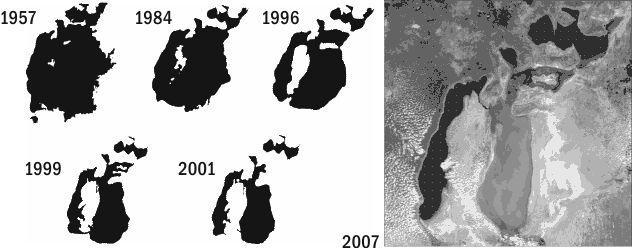
Fig. VI-9.1. Reduction of the Aral Sea area and its photograph from space taken in 2007. The white color in the photograph is the color of salt flats
Some reserves for irrigation use have been preserved. They are related to the use of drip irrigation systems that deliver water directly to the roots of each plant. Unfortunately, the implementation of such systems requires significant resources, as do all methods of agricultural mechanization. Currently, such measures require the expenditure of significant amounts of fossil fuel energy.
Another way to increase agricultural efficiency is the application of fertilizers. Since any agriculture is connected with the removal from fields of part of the products produced on them, without replenishing biogenic nutrient reserves, fields quickly become depleted. This replenishment can be achieved by applying organic matter (for example, animal manure or plant biomass), as well as chemical fertilizers. Unfortunately, it is impossible to do without applying organic fertilizers: to compensate for the loss of biogens from fields, they must be extracted from other ecosystems. Using the same biogens that were removed from fields is impossible at the current level of technological development: they end up in urban waste, where they combine with various toxic substances. Societies that use human waste for field fertilization suffer from parasitic diseases. This means that chemical fertilizers must be used. Their widespread introduction into agricultural practice ensured a rise in crop yields, but the reserves associated with this method are now exhausted. On the main agricultural lands of the planet, the optimum level of biogenic nutrient supply has been practically achieved. Of course, some progress is possible here, related to the transition to fertilizers that bind better in the soil and are not washed out by rain, as well as to less toxic and cheaper compounds.
Ultimately, one of the foundations of the Green Revolution was the creation of high-yielding varieties of agricultural crops. The potential of traditional methods, unfortunately, has been largely exhausted here as well. Let us consider, for example, the old dream of breeders: to enable mutualism with nitrogen-fixing bacteria in grain crops. Attempts to solve this problem have been ongoing for several decades. It can be assumed that sooner or later it will be solved, probably using genetic engineering methods. Will this lead to a significant increase in field yields? Surprisingly, no. Grain crops are already supplied with nitrogen—primarily from fertilizers. Mutualism with nitrogen-fixers will allow many problems to be solved (reduce energy costs for fertilizer production and application, reduce fertilizer runoff from fields into water bodies, etc.), but it will not lead to a significant increase in food available to humanity.
According to UN estimates, the main regional problems relating to agriculture are as follows:
Europe—industrial pollution of land, deforestation;
North America—wide spread of monocultures;
Southwest Asia—overpopulation, overgrazing, threat to the gene pool;
Southeast Asia—destruction of tropical forests, threat to the gene pool;
South America—destruction of tropical forests, destruction of traditional agricultural crops.
Africa—overpopulation, destruction of tropical forests, overgrazing, desertification.
Significantly, the expected warming of the Earth will lead to a shift of climatic zones that cannot be accompanied by adequate soil change.
On average, about 11,000 m³ of river water per year falls per person on the planet. Most of Ukraine's territory belongs to regions with limited water resources (less than 1,000 m³ per person per year); these include Crimea, Eastern, and Southern Ukraine. Sufficient (1,000–2,000 m³ per person per year) water supply is in Western Ukraine and Poltava Oblast, and excessive—in part of Western Ukraine and Sumy Oblast. 70% of river flow falls on the northwestern part of Ukraine, where 40% of the population lives. From one-quarter to one-third of small rivers in Ukraine have ceased to exist.
There is a close connection between soil destruction and disruption of the water cycle. Disruption of soil structure leads to reduced absorption and replenishment of groundwater. Increased surface runoff intensifies soil erosion, and groundwater use intensifies this process.
From 1980 to 1990, Ukraine lost 463,000 hectares of agricultural land. Currently, according to some estimates, up to 200,000 hectares are lost per year. Over 20 years, the humus content in soils has decreased by 20%. One-third of arable land is susceptible to water erosion.
The catastrophe in Kharkiv in 1995 can serve as an example of the danger of surface runoff from large territories. The heavy rain that fell on the city was directed into urban runoff systems and arrived at the treatment plant. The influx of excess water caused the destruction of treatment facilities and the discharge of their contents (including municipal sewage waste). During the prolonged repair (which required, among other things, divers to descend into the fluid with high fecal content), it was necessary to practically completely stop water supply to city water mains to minimize the influx of runoff to the treatment facilities.