
Ecology: Biology of Interaction. V-10. Organismal Characteristics Related to Body Size
Appendices: Syllabus. Questions. References. Biographies. Glossary. R Commands.
V-10. Organismal Characteristics Related to Body Size
Have you ever wondered why a grass blade can have a thin, flexible stem, while tall trees possess thick, sturdy trunks? Why can there be no tall tree with the proportions of a grass blade (Fig. V-10.1)? Why do large animals find it harder to support their own weight than small ones, and why does the skeleton constitute a much larger fraction of their body volume and mass?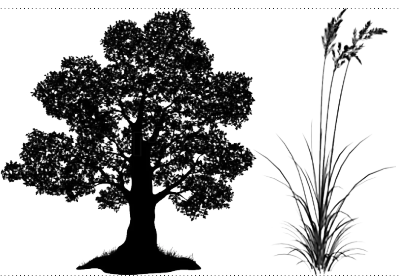
Fig. V-10.1. Which of these plants is taller? How can you tell, given that their images are the same size? You know, of course, how tall thick trees and grasses are; but if you did not, could you have guessed?
Let us consider a simplified example (Fig. V-10.2). Suppose the linear dimensions of an organism (body length and, proportionally, all other measurements) double. The surface area of that organism will increase not twofold but fourfold (2×2). The volume of such an organism will increase even more dramatically — eightfold (2×2×2)! The reason for the non-uniform scaling of linear dimensions, surface area, and volume is straightforward and follows from elementary geometric relationships. As linear body size increases, surface area — and the area of any cross-section — grows in proportion to the square of that dimension, while volume grows in proportion to its cube. Area is proportional to the square of linear dimensions; volume is proportional to the cube!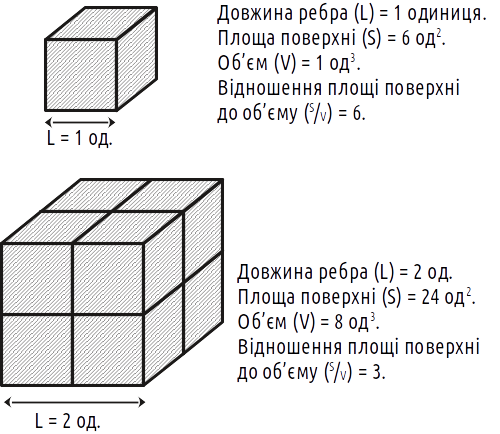
Fig. V-10.2. Doubling the size of a cube causes the ratio of its surface area to volume to decrease by half.
The strength of supporting structures (plant stems, animal skeletons) is approximately proportional to their cross-sectional area. However, the body weight that such structures must bear increases more rapidly: it is proportional to body volume. Consequently, if body proportions remain unchanged as size doubles, the organism's capacity to support its own weight decreases by half — the body effectively becomes twice as heavy for itself! Thus, as an organism grows, it becomes progressively heavier relative to its own structural capacity.
Recall how a young child walks: it stumbles and falls quite often. Falling from a height equal to its own stature may bring tears but almost never causes serious injury. Unfortunately, for an adult — who has a far stronger skeleton — a fall from a height equal to one's own stature can be considerably more dangerous (causing, for example, fractures).
Similar scaling relationships govern not only self-support. For instance, it is far easier for small animals to fly than for large ones. The lift generated by flying animals is proportional to the area of their wings or other lift-producing structures, and thus increases in proportion to the square of their linear dimensions. Muscle force likewise increases in proportion to the square of linear dimensions: it is proportional to the cross-sectional area of the muscles. Body weight, however, increases much more rapidly with size — in proportion to the cube of linear dimensions, since it is determined by body volume. A small aphid needs only tiny wings with weak musculature to become airborne. An albatross, by contrast, requires a body whose entire architecture is subordinated to minimising weight and maximising lift. An albatross with a wingspan of 3.5 metres weighs only about 15 kg (Fig. V-10.3)!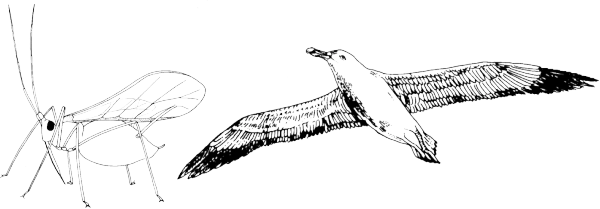
Fig. V-10.3. Both the aphid and the albatross are capable of flight. Why have flight adaptations altered the body plan of the albatross so much more profoundly than that of the aphid?
Note that the considerations discussed above are not specific to living organisms. By the same reasoning, for example, a dust particle drifts freely in air, whereas a stone of identical material and shape, once unsupported in air, falls rapidly.
We have established that, as an organism grows, its relationship to its own weight changes. Yet both a newborn and an adult human belong to roughly the same size class: their body lengths differ by no more than a factor of 4–5. How different, then, are the conditions faced by organisms that are incomparable in size?
We can provisionally divide terrestrial organisms into three groups (size classes) according to their dimensions. The microworld encompasses organisms whose size is typically less than one millimetre. The mesoworld covers sizes from millimetres to tens of centimetres. The macroworld comprises animals whose size exceeds several tens of centimetres (sometimes reaching tens of metres). Within each size class, organisms may differ in size by a factor of hundreds (it should be noted that in other contexts — for example, in the physical sciences — the terms microworld, mesoworld, and macroworld may carry different meanings). The differences in body size across size classes mean that environmental factors act upon them in fundamentally different ways!
In the microworld, gravitational force is practically imperceptible. Organisms of this size class drift easily in water and may even be suspended in air currents like dust. By contrast, surface forces (surface tension, capillary effects) are virtually insurmountable for microworld organisms. Some microworld organisms are highly complex (for example, ciliates), yet they lack specialised physiological systems for enhancing gas exchange. Such small organisms possess a very high surface-area-to-volume ratio. The distance from any internal point to the body surface is extremely small, so the concentrations of gases and other substances equilibrate rapidly. Temperature differentials equalise equally quickly. The body temperature of microworld organisms invariably matches that of the surrounding medium.
Mesoworld organisms ‘sense’ both gravitational and surface forces, yet are simultaneously capable of overcoming them. Consider water striders running across the water surface, or pond snails crawling along the surface tension film. Many mesoworld organisms — ants, for example — readily lift loads many times their own body mass. Representatives of this size class possess well-developed respiratory and circulatory systems. Incidentally, the fact that in insects gas exchange and circulation are functionally separated is a consequence of these animals having originated within the intermediate size class. Gas exchange is accomplished through a system of tracheae that deliver air almost directly to each cell, while hemolymph ensures the circulation of substances within the body. As body size increases, body volume grows faster than surface area (including the surface area of the tracheae), the movement of air through the narrow tracheal tubes becomes increasingly impeded, and the organism begins to experience difficulties with gas exchange. This is one of the principal reasons why insects have not made the transition from the mesoworld to the macroworld. Nevertheless, a considerable number of mesoworld animals are capable of flight. Mesoworld plants and fungi possess certain supporting structures (which most commonly function by means of turgor pressure), but generally retain a degree of elasticity in their bodies.
Finally, in the macroworld the dominant force that must be overcome is gravity. Our muscles scarcely register the resistance of water surface films, yet must constantly exert effort to support our weight. Only a few representatives of the macroworld — and only the smallest among them — are capable of flight. With rare exceptions, macroworld animals possess an internal skeleton; the great majority are vertebrates. Beyond vertebrates, macro-scale dimensions (in the aquatic environment) have also been attained by cephalopod molluscs, most notably squids. It is noteworthy that the remnant of the squid's internal shell forms an internal support structure within the body, whose functional properties are somewhat analogous to a notochord.
In macroworld plants (trees, for instance), a substantial proportion of the body is occupied by rigid mechanical tissues. Fungi, even when they attain macro-scale dimensions, effectively remain within the mesoworld, since they are situated within or on the surface of some substrate.
Of course, organisms of the micro-, meso-, and macroworlds are connected by transitional forms, yet it is difficult even to imagine how profoundly the properties of the surrounding environment differ for each of them! You have undoubtedly encountered arguments in which characteristics of organisms of one size are extrapolated to those that differ substantially in magnitude. A human cannot jump to the same height relative to its body as a flea, carry a load exceeding its own body mass as many times over as an ant, or move at the same relative speed as a fly. Not because the human is ‘constructed’ less well — but simply because it belongs to a different size class!
Since, as an organism grows, the relationships among its various parameters change — surface area and volume, muscle force, skeletal strength and weight, and so forth — growth in the vast majority of organisms is accompanied by a change in proportions.
This is why we can readily distinguish a photograph of a child from a photograph of an adult, even when the actual dimensions of the individual in the image are not apparent. A child and an adult differ in proportions. A child has a considerably larger and rounder head, and shorter arms and legs. As growth proceeds, proportions change continuously — a property shared not only by humans but by all extant animals and plants.
The change in proportions with organismal growth was termed allometric growth (allometry) by Julian Huxley. One of the simplest equations that describes such growth reasonably well is known as the Huxley equation: y = bx^a, where y is the size of a given organ, x is the overall size of the organism, and b and a are the constants of allometric growth.
For instance, if a given organ grows precisely such that its surface area (or cross-sectional area) increases in proportion to the overall volume of the organism, the allometric constant a will equal 1.5.
If growth proceeded with the preservation of proportions (i.e., were isometric), the corresponding equation would reduce to simply y = bx. It has been proposed, for example, that many organisms inhabiting the Earth during the Vendian (Ediacaran) period grew isometrically, without any change in proportions. This constitutes one of the significant grounds for not classifying Vendobionts as true animals.
Allometric growth can be detected by comparing organisms of different sizes. Depending on which individuals are compared, the following forms of allometry may be distinguished:
— ontogenetic allometry, observed during the ontogeny of an individual or established by comparing individuals of different ages within the same species;
— intraspecific allometry, revealed by comparing individuals at the same stage of development (typically adults) that differ from one another in size;
— interspecific allometry, detected by comparing mean values of the trait under study, characteristic of individuals (usually adults) of different species belonging to the same taxonomic group;
— evolutionary allometry — interspecific allometry within a series of phylogenetically successive forms.