
Ecology: the Biology of Interactions. I-01. "Ecology" — What Is It?
The term «ecology» was coined by Haeckel from two Greek roots: oicos — home and logos — word, science. From the moment the concept of «ecology» was established, there has been an unbroken succession of researchers who interpreted it in this sense. In modern terms...
First "Quarter". BIOSYSTEMS. THE BIOSPHERE
Part I. Ecology and the Biosystems It Studies
I-1. "Ecology" — What Is It?
Zilu said:
— The ruler of Wei awaits you for matters of governance. What will you begin with?
The Teacher replied:
— It is necessary to rectify names.
— Do you think so? — objected Zilu. — You, Teacher, are taking a roundabout path. Why rectify them?
The Teacher replied:
— How uncultured you are, Yu! ... If a name is not fitting, then its interpretation is inappropriate; if the interpretation is inappropriate, no success in affairs is possible; without success in affairs, ritual and music cannot flourish; but if ritual and music do not flourish, then punishments miss their mark; when punishments miss their mark, the people are left in confusion. Therefore, everything that the noble man names can always be interpreted, and what he interprets can always be carried out. The noble man avoids carelessness in interpretation.
Confucius. Analects
Before studying the general ecology course, one should discuss the very meaning of the concept "ecology". Strange as it may seem, in Ukraine and throughout the post-Soviet space there is no unified view on the meaning of this word. To answer this question, one must turn to history. The concept of "ecology" was created and unambiguously defined by Ernst Haeckel in 1866.
"By ecology we understand the general science of the relations of organisms to their environment, including in the broad sense all the conditions of existence. These are partly organic, partly inorganic in nature" (E. Haeckel).
The term "ecology" was coined by Haeckel from two Greek roots: oicos — home and logos — word, science. From the moment the concept of "ecology" was established, there has been an unbroken succession of researchers who interpreted it in this sense. In modern terms, ecology is the science that studies the interactions of organisms and supraorganismal systems with the environment. Ecology is a biological science about interrelationships! Such a concept fully corresponds to the modern understanding prevalent in developed countries. For example, the Nature website provides the following definition of ecology.
"Ecology is the study of how organisms interact with each other and their environment. It considers processes that occur at the population, community and ecosystem levels and has a particular focus on biodiversity" (https://www.nature.com/subjects/ecology).
As you can see, the understanding of ecology reflected in the very title of our textbook — "Ecology: the Biology of Interactions" — corresponds both to historical priority and to the approach of the most authoritative contemporary sources.
On the other hand, the words "ecology" and "ecological" may form part of the names of non-biological sciences: industrial ecology, social ecology, geoecology, environmental law, and so on. The Russian cultural scholar D. S. Likhachev introduced the concept of "ecology of culture" into usage. Drawing a boundary between these fields of activity and ecology in its classical sense is the concern of representatives of those fields. Unfortunately, since the word "ecology" has become fashionable, attempts to "appropriate" it on the part of representatives of non-biological specialties are frequently observed. The question "how is ecology doing in your city?" is understandable to everyone. Naturally, when asking such a question, people have in mind not the development of a particular science, but the quality of the living environment. In this case, the word "ecology" is used to denote the quality of the human living environment and the various processes that affect it. In English there exists the word environmentology (from environment) to denote such a field, which differs from the word ecology. In Ukrainian, the transliteration of the English term is sometimes used — "envaironmentolohiya" — a word that is not easy to pronounce. In our view, it is far better to use the Ukrainian analogue of this concept — "seredovyshcheznavstvo" (environmental science).
For a biologist, it is important to distinguish scientific ecology from lay "ecology", and also ecology as a biological science of interrelationships from environmental science and nature conservation.
Very often the concepts of "ecology" and "ecological" are used to denote nature conservation activities or the practice of natural resource use (the Ministry of Ecology does not engage in science at all). In general, nature conservation can be defined as a set of measures designed to limit the adverse impact of human activity on the environment. Despite the importance of these fields, they are far removed from ecology proper. The scientific foundation of nature conservation (sozology) relies to a great extent on ecological data, but also draws on the findings of other natural and social sciences (geography, economics, medicine, psychology, etc.).
It should be noted that the concepts under discussion are widely used in the domain that may be called lay "ecology" (Lat. profanus — uneducated, unenlightened; hence profanation — vulgarisation, trivialisation).
|
A characteristic feature of lay "ecological" texts is the widespread use of the word "nature" (usually capitalised: "Nature", and similarly, for the most part, "Cosmos") and a large number of emotionally evaluative judgements. Let us consider a characteristic example of lexical constructions typical of lay "ecology" and related currents. «"Mother Earth is in convulsions. People are bewildered. The Thousand-Eyed Cosmos has turned its Gaze upon the world of men. Energy has Come to Earth from Beyond. The Fate of the Planet is being Decided..." (Yu. Cherepakhin). (Yu. Cherepakhin). Very often, authors who praise "Nature" and condemn humanity love to point out that the human being is part of "Nature", which renders the entire construction logically self-contradictory. Since the word "nature" is used to denote both the physical world and "wild Nature" (natural ecosystems), it is better to abandon its use as a concept altogether. The spread of idyllic views of "Mother Nature" became a reaction to the ecological crisis. All readers have surely encountered texts and speeches in which the authors assert that "the human being" is bad, while "Mother Nature" is good. Such texts typically demand that "the human being" immediately reform and begin living "according to the Laws of Nature". What is a person addressed by such texts to do? Most probably, first to wring their hands theatrically, and then to banish the impossible demands of lay "ecologists" from their mind and live as they had always lived before... A widespread example of more respectable lay views may be the so-called "laws" (which are in fact not laws but aphorisms) of Barry Commoner, frequently quoted in the "ecological" literature. One of these "laws" states: "Nature knows best." When this judgement is invoked to assess the consequences of anthropogenic impact on the habitat, it permits condemnation of the very fact of human activity (and in general sets human existence in opposition to "Nature"), but does not permit any decisions to be made (example of an absurd construction: "nature knows best what to do with spent nuclear fuel"). Medieval cartographers reported dangerous and unexplored territories by means of a beautiful metaphor - 'Hic sunt dracones' (Fig. I-1.1).
Fig. I-1.1. In old times cartographers had to combine images of known lands with 'blank spots'. So as not to leave empty places on the maps, they wrote there 'Hic sunt dracones', that is, 'here be dragons', and in this way marked unexplored and dangerous territories Fig. I-1.1. In former times, cartographers had to combine depictions of known lands with "blank spots". In order not to leave empty spaces on maps, they wrote "Hic sunt dracones", meaning "here be dragons", thereby marking unexplored and dangerous territories.Hic sunt dracones». |
First "Quarter". BIOSYSTEMS. THE BIOSPHERE
Part I. Ecology and the Biosystems It Studies
I-1. "Ecology" — What Is It?
Zilu said:
— The ruler of Wei awaits you for matters of governance. What will you begin with?
The Teacher replied:
— It is necessary to rectify names.
— Do you think so? — objected Zilu. — You, Teacher, are taking a roundabout path. Why rectify them?
The Teacher replied:
— How uncultured you are, Yu! ... If a name is not fitting, then its interpretation is inappropriate; if the interpretation is inappropriate, no success in affairs is possible; without success in affairs, ritual and music cannot flourish; but if ritual and music do not flourish, then punishments miss their mark; when punishments miss their mark, the people are left in confusion. Therefore, everything that the noble man names can always be interpreted, and what he interprets can always be carried out. The noble man avoids carelessness in interpretation.
Confucius. Analects
Before studying the general ecology course, one should discuss the very meaning of the concept "ecology". Strange as it may seem, in Ukraine and throughout the post-Soviet space there is no unified view on the meaning of this word. To answer this question, one must turn to history. The concept of "ecology" was created and unambiguously defined by Ernst Haeckel in 1866.
"By ecology we understand the general science of the relations of organisms to their environment, including in the broad sense all the conditions of existence. These are partly organic, partly inorganic in nature" (E. Haeckel).
The term "ecology" was coined by Haeckel from two Greek roots: oicos — home and logos — word, science. From the moment the concept of "ecology" was established, there has been an unbroken succession of researchers who interpreted it in this sense. In modern terms, ecology is the science that studies the interactions of organisms and supraorganismal systems with the environment. Ecology is a biological science about interrelationships! Such a concept fully corresponds to the modern understanding prevalent in developed countries. For example, the Nature website provides the following definition of ecology.
"Ecology is the study of how organisms interact with each other and their environment. It considers processes that occur at the population, community and ecosystem levels and has a particular focus on biodiversity" (https://www.nature.com/subjects/ecology).
As you can see, the understanding of ecology reflected in the very title of our textbook — "Ecology: the Biology of Interactions" — corresponds both to historical priority and to the approach of the most authoritative contemporary sources.
On the other hand, the words "ecology" and "ecological" may form part of the names of non-biological sciences: industrial ecology, social ecology, geoecology, environmental law, and so on. The Russian cultural scholar D. S. Likhachev introduced the concept of "ecology of culture" into usage. Drawing a boundary between these fields of activity and ecology in its classical sense is the concern of representatives of those fields. Unfortunately, since the word "ecology" has become fashionable, attempts to "appropriate" it on the part of representatives of non-biological specialties are frequently observed. The question "how is ecology doing in your city?" is understandable to everyone. Naturally, when asking such a question, people have in mind not the development of a particular science, but the quality of the living environment. In this case, the word "ecology" is used to denote the quality of the human living environment and the various processes that affect it. In English there exists the word environmentology (from environment) to denote such a field, which differs from the word ecology. In Ukrainian, the transliteration of the English term is sometimes used — "envaironmentolohiya" — a word that is not easy to pronounce. In our view, it is far better to use the Ukrainian analogue of this concept — "seredovyshcheznavstvo" (environmental science).
For a biologist, it is important to distinguish scientific ecology from lay "ecology", and also ecology as a biological science of interrelationships from environmental science and nature conservation.
Very often the concepts of "ecology" and "ecological" are used to denote nature conservation activities or the practice of natural resource use (the Ministry of Ecology does not engage in science at all). In general, nature conservation can be defined as a set of measures designed to limit the adverse impact of human activity on the environment. Despite the importance of these fields, they are far removed from ecology proper. The scientific foundation of nature conservation (sozology) relies to a great extent on ecological data, but also draws on the findings of other natural and social sciences (geography, economics, medicine, psychology, etc.).
It should be noted that the concepts under discussion are widely used in the domain that may be called lay "ecology" (Lat. profanus — uneducated, unenlightened; hence profanation — vulgarisation, trivialisation).
A characteristic feature of lay "ecological" texts is the widespread use of the word "nature" (usually capitalised: "Nature", and similarly, for the most part, "Cosmos") and a large number of emotionally evaluative judgements. Let us consider a characteristic example of lexical constructions typical of lay "ecology" and related currents.
"Mother Earth is in convulsions. People are bewildered. The Thousand-Eyed Cosmos has turned its Gaze upon the world of men. Energy has Come to Earth from Beyond. The Fate of the Planet is being Decided..." (Yu. Cherepakhin).
Very often, authors who praise "Nature" and condemn humanity love to point out that the human being is part of "Nature", which renders the entire construction logically self-contradictory. Since the word "nature" is used to denote both the physical world and "wild Nature" (natural ecosystems), it is better to abandon its use as a concept altogether.
The spread of idyllic views of "Mother Nature" became a reaction to the ecological crisis. All readers have surely encountered texts and speeches in which the authors assert that "the human being" is bad, while "Mother Nature" is good. Such texts typically demand that "the human being" immediately reform and begin living "according to the Laws of Nature". What is a person addressed by such texts to do? Most probably, first to wring their hands theatrically, and then to banish the impossible demands of lay "ecologists" from their mind and live as they had always lived before...
A widespread example of more respectable lay views may be the so-called "laws" (which are in fact not laws but aphorisms) of Barry Commoner, frequently quoted in the "ecological" literature. One of these "laws" states: "Nature knows best." When this judgement is invoked to assess the consequences of anthropogenic impact on the habitat, it permits condemnation of the very fact of human activity (and in general sets human existence in opposition to "Nature"), but does not permit any decisions to be made (example of an absurd construction: "nature knows best what to do with spent nuclear fuel").
Medieval cartographers indicated dangerous and unexplored territories by means of a beautiful metaphor — "Hic sunt dracones" (Fig. I-1.1).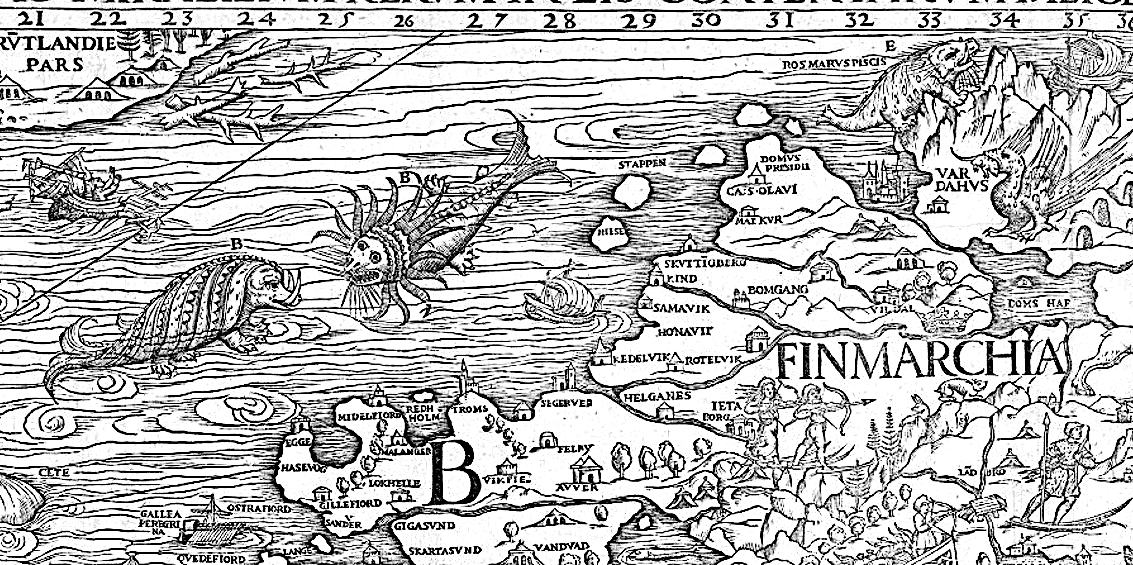
Fig. I-1.1. In former times, cartographers had to combine depictions of known lands with "blank spots". In order not to leave empty spaces on maps, they wrote "Hic sunt dracones", meaning "here be dragons", thereby marking unexplored and dangerous territories.
To indicate the territory where dragons hold sway, they were drawn on maps. But how can one understand that one is on the territory of dragons when the subject is lay "ecology"? By means of a number of lexical markers. We have just spoken of "Mother Nature", "Guidance from the Cosmos", and constructions of the type "The Human Being is a Parasite of the Planet". However, unfortunately, even the adjective "ecological" is most often used in senses unrelated to ecology. "Environmentalism", "ecologist", "ecologists", "deep ecology", "ecofeminism", "ecological action", "ecological imperative", "ecology of the spirit" and "ecology of the soul", "ecological consciousness" — these are all signals that it is useful to perceive as a yellow (or sometimes red) traffic light. In most cases they are used by those who, at the very least, do not think about the concepts they employ. The same applies to constructions such as "ecologically pure", "bad ecology", "good ecology", "pollution of ecology", and so on: "Hic sunt dracones".
Lay "ecology" cannot be assessed in a straightforward manner. Its adherents frequently act under the influence of aspirations that can only be approved. Its positive side is that it draws public attention to important problems. On the other hand, it cannot serve as a foundation for purposeful activity and does not allow the problems it raises to be resolved. For example, unfounded fears associated with the use of genetically modified organisms only hinder the development of genuinely important measures designed to make new technology safe. In mass culture, lay "ecology" is probably ineradicable; however, in education and in scientific and nature conservation activities, it must be replaced by scientific ecology. The energy released in a steam locomotive's boiler can be converted into forward motion, or it can be dissipated through the whistle — loudly, but largely without benefit. Contemporary changes in the life of humanity are the cause of an emerging readiness for change. When the potential readiness for change reaches a certain level, humanity may begin to transform its relations with the biosphere. Unfortunately, lay "ecology" contributes to this potential energy for change being expended "through the whistle".
"Moving with high efficiency in the wrong direction is worse than not moving at all" (Haruki Murakami).
Creating a scientific description of the world is one of the exceptional properties of human beings. We do not simply learn to use one or another property of the phenomena around us — we create scientific models of those aspects of reality that we encounter and about which we can make assumptions. Modern humanity is developing an entire complex of sciences, each of which has its own significance both for building our picture of the world and for our practice. Representatives of each science can surely say what makes their particular speciality important. And yet ecology — specifically ecology in its biological sense, as it is examined in this course — occupies a special place in the structure of our knowledge.
We, human beings, and all our other relatives — terrestrial organisms — are living entities organised in a particular way. Our characteristics are adaptations to a particular mode of life, to particular relations with the environment. We, as organisms, are constituent parts of populations, ecosystems, and the biosphere as a whole. The properties of these supraorganismal systems are also explained by the specifics of their existence. One might say that life is interaction, and therefore ecology, the science of interrelationships in the living world, is the science of survival! Let us cite one further definition of ecology, which may be called an actualised definition — one that emphasises the contemporary significance of this science.
Ecology is the science of the interrelationships that ensure the existence of organisms (including human beings) and supraorganismal systems: populations, ecosystems, and the biosphere.
The special significance of the science of interrelationships that ensure our existence becomes particularly apparent at a moment of change in the mode of life. Our global species is currently at such a stage.
In all likelihood, every generation of human beings feels that it lives at a special time. But whatever the case, the generation to which today's university students belong has more grounds for such a view than all preceding generations. In the authors' opinion, one should not frighten oneself: let us hope that humanity will survive. However, during the lifetime of the readers of this textbook, unprecedented changes in humanity's mode of life will take place.
The growth of the human population will cease (let us hope — under the influence of natural causes, rather than catastrophes and calamities). The growth that has continued for many centuries will give way to relative stability (let us hope — not a catastrophic decline as a result of global overpopulation and ecological collapse). The character of humanity's relations with the environment will change. Dependence on non-renewable and sharply limited resources (oil, gas, coal, metal ores, biogenic elements such as phosphorus) will become less acute. Humanity will learn to satisfy its needs in a manner different from that of recent times. Even the very mechanism of decision-making will change — both for the individual human being and for the constituent parts of humanity: peoples, states. The way in which any action will affect the living environment will become the most important consideration in every choice.
What is the basis for the assertions made above? The named changes are a condition for the survival of humanity.