
Student Works Following the Second-Year Practicum – 2012 (Part I)
In 2012, the number of student works completed as part of the collaborative project I organized during the practicum was exceptionally high. Specifically, this was due to the fact that Olha Mykhailova, Anastasiia Bondareva, and Olena Meleshko were present during the practicum in Haidary, where they assisted second-year stu...
Student works after the II year practice – 2008 Student works after the II year practice – 2009 Student works after the II year practice – 2010 Student works after the II year practice – 2012 (Part II) Student works after the II year practice – 2013 Student works after the II year practice – 2014 Student works after the II year practice – 2015 Student works after the II year practice – 2016 Student works after the II year practice – 2017 In 2012 there were especially many student works produced within the joint project that I organized during the practice. In particular, this was a consequence of the fact that during the practice in Haidary there were Olha Mykhailova, Anastasia Bondareva and Olena Meleshko, who helped second‑year students complete their research works. The 2012 student abstracts are posted on two pages: the beginning here, and the end here. They are arranged not in alphabetical order but rather according to some internal logic. Dependence of the composition of green frog samples on the place and method of collection V.B. Moskalyov, O.O. Kashirin, R.G. Melamed Kharkiv National University named after V.N. Karazin, Faculty of Biology, 4 Svobody Square, Kharkiv, Ukraine The observed hemiclonal inheritance in green frogs is of scientific interest to both geneticists and zoologists. The hybridogenic complex of green frogs (Pelophylax esculentus complex) consists of pond frogs Pelophylax lessonae (Camerano), which do not occur at the study site, lake frogs P. ridibundus (Pallas), and their hybrids – edible frogs P. esculentus (L.). Table 1. Location, collection method of studied samples and their composition Location of capture Method of capture
Place of capture
Catch method
Representatives of P. esculentus complex
Σ
Pelophylax esculentus
Pelophylax ridibundus
Pelophylax sp. (undetermined)
♂♂
♀♀
♂♂
♀♀
♂♂
♀♀
River bank (N 49°38'08", E 36°20'28")
From the shore
9
0
6
6
3
0
24
From the boat
24
0
13
0
1
0
38
Pond (N 49°33'22", E 36°18'37")
From the shore
24
12
1
13
0
0
50
Floodplain lake (N 49°37'51", E 36°20'04")
From the boat
31
0
2
0
0
0
33
Σ
88
12
22
19
4
0
145
From a boat 31 0 2 0 0 0 33 Σ 88 12 22 19 4 0 145 The Zmievsky district of the Kharkiv region is located in the Seversky‑Donets center of green frog diversity, attracting the attention of many researchers. Various authors report different data on the ratios of different forms of green frogs in this center. In this work we tested the hypothesis that differences in the composition of green frog samples collected around the HNU biological station may be related to the choice of location and collection method. We studied four samples, the data for which are presented in Table 1. The samples were collected in mid‑June 2012 on a forested bank of the Seversky Donets River, in a floodplain lake, and in the Nizhny Dobrytsky pond (near the floodplain of the Gomolsha River). Frogs were collected at night, either from the bank or from a boat. Data were processed in Statistica 8.0, and sample composition was compared using Pearson’s χ² test. The method of collection significantly (χ² = 37.8313, p < 0.00001) affected the sex ratio in the sample: collections from the bank contained a markedly higher proportion of females. The proportion of P. esculentus in the sample depended significantly on the place of capture (χ² = 19.58, p = 0.00606). The influence of capture location on sex ratio and of collection method on hybrid proportion were not statistically significant. Even samples collected at the same time and in the same area can differ substantially depending on the exact collection site and method.
The described results were obtained during a student research project in vertebrate zoology practice. The authors thank Assoc. Prof. D.A. Shabanov for scientific supervision. Moskalyov V.B., Kashirin O.O., Melamed R.G. Dependence of the composition of green frog samples on the place and method of collection // “Biology: from Molecule to Biosphere”. Materials of the VII International Conference of Young Scientists. – Kh.: FOP Shapovalova T.M., 2012 – pp. 271‑272.
Estimation of the population size of the green frog system in Is’kov Pond, Zmievsky district, Kharkiv region E.V. Meleshko, E.P. Malchenko Kharkiv National University named after V.N. Karazin e‑mail: meleshko.e.v@gmail.com, edoktor07@gmail.com. The green frog group, Pelophylax esculentus complex, includes two parental species, Pelophylax lessonae (Camerano, 1882) and Pelophylax ridibundus (Pallas, 1771), as well as their hybrids – Pelophylax esculentus (Linnaeus, 1758). A characteristic feature of the group is hemiclonal inheritance, in which during gametogenesis the genome of one parental species is eliminated in Pelophylax esculentus. The genome of the other parental species then undergoes endoreduplication, and the hybrid produces identical gametes. Representatives of different species of the Pelophylax esculentus complex can live and reproduce together, forming hemiclonal population systems (HPS) (Shabanov et al., 2009). One such system inhabits Is’kov Pond (near the village of Haidary, Zmievsky district, Kharkiv region). Observations of this HPS have been conducted since 1995 (Lada, 1996). Currently the studied population system is emerging from a critical state described for it in 2000‑2008. Accordingly, the aim of the study was to assess the size of the Pelophylax esculentus complex HPS for future monitoring. In summer 2011 the first similar work was carried out (Suvorova, Meleshko, 2011), estimating the HPS at 330 males and sub‑adult green frogs (females were not counted). The work was carried out in June‑July 2012 as part of the field practice of HNU students. To achieve the aim, we used the Petersen mark‑recapture method (Koli, 1979), based on equal probability of recapturing marked and unmarked frogs. Frogs were captured at night, blinded with a flashlight, along the right‑hand shoreline of the pond. Marks were applied by clipping a toe of the fore‑ and hind‑limbs. During the captures (June‑July 2012) 161 frogs were marked and released. Recaptures were performed on 29 June, 2 July and 26 July 2012, yielding three population estimates: 92 ± 25, 286 ± 82 and 697 ± 224. The estimates differ markedly. It should be emphasized that the interval between release of marked animals and the first two recaptures was insufficient for mixing with unmarked frogs in the pond. Therefore, only the third capture results satisfy the method’s assumption of equal recapture probability and can be considered reliable. Thus, the size of the Pelophylax esculentus complex HPS in Is’kov Pond in July 2012 was about 700 sexually mature individuals, exceeding the 2011 estimate. The results highlighted shortcomings of the Petersen abundance estimation method. Further monitoring will require refinement of individual marking techniques. Summary. The green frogs living in Is’kov pond (near the village Gaydary in Zmievsky area of the Kharkov region) form a hemiclonal population system. The main goal of our research was to estimate the number of this system. Three counts by the tagging and repeated capture method of Petersen were made in June and July 2012. The number of pubertal individuals in the pond is estimated at about 700. The authors thank the scientific supervisor, Candidate of Biological Sciences, Associate Professor of the Department of Zoology at HNU named after V.N. Karazin, D.A. Shabanov, as well as the catch participants – I. Biryuk, R. Mironova and A. Leonova.
Meleshko E.V., Malchenko E.P. Estimation of the population size of the green frog system in Is’kov Pond, Zmievsky district, Kharkiv region // “Biology: from Molecule to Biosphere”. Materials of the VII International Conference of Young Scientists. – Kh.: FOP Shapovalova T.M., 2012 – pp. 267‑270.
Composition of the green frog population system (Pelophylax esculentus complex) of Is’kov Pond (Zmievsky district, Kharkiv region) Yu.N. Kravchenko, S.L. Ogiienko Kharkiv National University named after V.N. Karazin, Faculty of Biology, 4 Svobody Square, Kharkiv, Ukraine. e‑mail: ogienko.sveta@mail.ru, yulchik.kravchenko@gmail.com The green frog group, Pelophylax esculentus complex, consists of pond frogs Pelophylax lessonae (Camerano, 1882), lake frogs Pelophylax ridibundus (Pallas, 1771) and edible frogs Pelophylax esculentus (Linnaeus, 1758). Diploid P. esculentus transmit one (clonal) genome to gametes. Representatives of different species of the Pelophylax esculentus complex can co‑occur, forming hemiclonal population systems (HPS) (Shabanov et al., 2009). In Is’kov Pond (near the village of Haidary, Zmievsky district, Kharkiv region) a green frog HPS lives, which has changed its composition several times during study. Observations have been ongoing since 1995, when a large population of P. esculentus with effective reproduction was discovered (Lada, 1996). The HPS composition changed over time. After the pond was drained (2000) the HPS was in a critical state. In 2005, during spawning only males were observed. In 2011 successful reproduction was recorded. Therefore, studying the HPS structure is of considerable interest. The aim of our study was to examine the sexual and species composition of the Is’kov Pond HPS for future monitoring. Species and sex were determined visually by a set of morphological characters (Korshunov, 2010). Ploidy was assessed by measuring the mean erythrocyte length, for which blood smears were taken using a standard method. Data were processed with Statistica. A total of 74 individuals were examined. The sample was dominated by males (76 %); females comprised 24 %. Diploid hybrids accounted for 98.65 % of the sample, triploid P. esculentus 1.35 %, P. ridibundus 2.7 %. The influence of sex and body size on erythrocyte size was also examined. A non‑significant trend of decreasing erythrocyte size with increasing body size was recorded. Erythrocyte length did not depend on sex. Thus, we established that the Is’kov Pond hosts an REt‑type population system, close to a pure E‑type. Diploid males of P. esculentus predominate. No significant effect of sex or body size on erythrocyte size was found. Summary. The green frogs living in Is’kov pond (near the village Gaydary in Zmievsky area of the Kharkov region) form a hemiclonal population system. The main goal of our research was to define the sexual and specific structure of this system. Our work revealed that an REt‑type system close to a pure E‑type lives in Is’kov pond. Diploid males of P. esculentus prevail. No significant effect of sex or body size on frog erythrocyte size was detected. The authors thank the scientific supervisor, Candidate of Biological Sciences, Associate Professor of the Department of Zoology at HNU named after V.N. Karazin, D.A. Shabanov, as well as E.V. Meleshko for assistance and students I. Biryuk, R. Mironova, A. Leonova, and E.P. Malchenko for help with frog capture. Kravchenko Yu.N., Ogiienko S.L. Composition of the green frog population system (Pelophylax esculentus complex) of Is’kov Pond (Zmievsky district, Kharkiv region) // “Biology: from Molecule to Biosphere”. Materials of the VII International Conference of Young Scientists. – Kh.: FOP Shapovalova T.M., 2012 – pp. 264.
Kravchenko Yu.N., Ogiienko S.L. Composition of the green frog population system (Pelophylax esculentus complex) of Is’kov Pond (Zmievsky district, Kharkiv region) // “Biology: from Molecule to Biosphere”. Materials of the VII International Conference of Young Scientists. – Kh.: FOP Shapovalova T.M., 2012 – pp. 264.
An approximate method for determining frog ploidy is measuring erythrocyte length. Previously it was shown (Bondareva, Shabanov, 2011) that the mean erythrocyte size of diploid P. esculentus is 21.8 ± 1.8 µm, whereas triploids exceed 26 µm. For each frog the longest toe of the right hind limb was clipped (the removal served as a mark), a drop of blood was expelled and spread on a slide. Slides were air‑dried and photographed at high magnification with a USB camera attached to a computer. A micrometer slide was photographed under the same conditions. The major axis of erythrocytes was measured from the photographs in PDF‑XChangeViewer (20 cells per slide) and converted to micrometres. Data were analysed with Statistica 8.0. The mean erythrocyte size for diploid specimens was 24.7 µm, and for triploids 29.5 µm. Among the 87 frogs we found 10 triploids (11.5 %). In the river channel, 6 of 36 captured individuals were triploids (~18 %); in the oxbow lakes, 1 of 31 (~3 %); in the Dobrytsky pond, 3 of 22 (~14 %). Earlier studies reported that the proportion of triploids in the P. esculentus population of the Kharkiv region was 36 % (Borkine et al., 2004). The discrepancy between those results and ours may be due to the 2004 study sampling a high proportion of juveniles, whereas we examined sexually mature frogs. Summary. We investigated the percentage of triploids of Pelophylax esculentus in the NPP “Gomolshansky Forests” and its environs. Catch sites were the channel of the Seversky Donets River, oxbow lakes and Dobrytsky pond. To find triploids we used the method of measuring red blood cell length. The average red blood cell size for the investigated diploids was 24.71 µm, and for triploids 29.49 µm. Out of the total 87 specimens, 10 triploids (11.5 %) were found. The greatest number of triploids was found in the river channel (17.7 %). Statistical analysis showed that differences between samples from different catching locations were not significant. The authors thank D.A. Shabanov for assistance in material collection and scientific supervision, and A.A. Bondareva for help with the practical part of the work. Kozak N.A., Hladkova Yu.D., Kulyma M.D. Determination of the proportion of triploids among Pelophylax esculentus in the NPP “Gomolshansky Forests” and its surroundings // “Biology: from Molecule to Biosphere”. Materials of the VII International Conference of Young Scientists. – Kh.: FOP Shapovalova T.M., 2012 – pp. 261‑262.
Kozak N.A., Hladkova Yu.D., Kulyma M.D. Determination of the proportion of triploids among Pelophylax esculentus in the NPP “Gomolshansky Forests” and its surroundings // “Biology: from Molecule to Biosphere”. Materials of the VII International Conference of Young Scientists. – Kh.: FOP Shapovalova T.M., 2012 – pp. 261‑262.
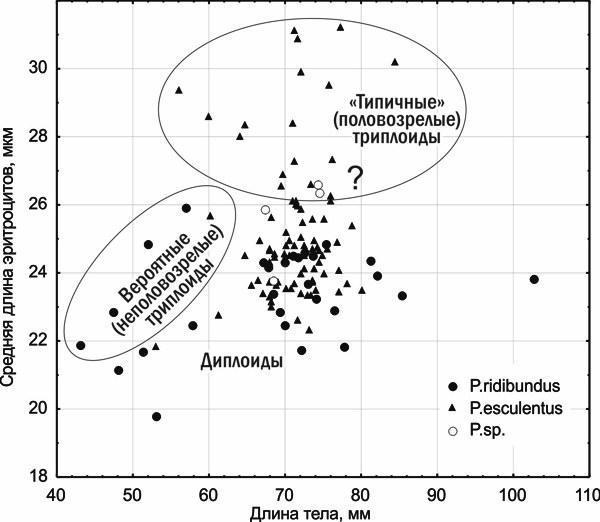
In June 2012 in the vicinity of the HNU biological station (village Haidary, Zmievsky district, Kharkiv region) we collected a sample of 118 green frogs. For each animal we measured body length, prepared a blood smear by standard technique, photographed the smear under a microscope, measured erythrocytes (20 cells per smear) from the digital images (using PDF‑XChange Viewer) and converted the measurements to micrometres. Data were processed in Statistica 8.0 (Fig. 1). [IMG_1] Fig. 1. Dependence of erythrocyte length on frog body length. Two groups of presumed triploids are visible: those with erythrocyte length > 26 µm (possibly > 28 µm) and those with shorter erythrocytes belonging to smaller individuals. A positive correlation between body length and erythrocyte length was found. As shown in Fig. 1, we hypothesize that small triploids may have erythrocytes shorter than 26 µm (22–26 µm). Summary. Dependence of erythrocyte size on body length in representatives of the Pelophylax esculentus complex was studied. A positive correlation between the measured sizes was found. Among mature frogs, individuals were found whose erythrocyte size is characteristic of triploid P. esculentus. Possibly, triploids are among the small frogs, whose erythrocytes measure 22–26 µm. The work was performed during vertebrate zoology field practice. The authors thank Assoc. Prof. D.A. Shabanov for scientific supervision.{"translated_text": "Iskenderova N. E., Pavliuk O. V., Chebukina M. V. Zavisimost razmerov eritrotsitov ot razmerov zelenykh liagushok (Pelophylax esculentus complex) // «Biologiia: vid molekuly do biosfery». Mat. VII Mizhnar. konf. mol. naukovtsiv. – Kh.: FOP Shapovalova T.M., 2012 – P. 256-257."}