
Three old news items about the planet we have altered and its pristine areas
The planet is in collective ownership. Russians clearly remember the sad experience of farming in kolkhozes – it should be obvious to them. Unfortunately, the planet is still under communal ownership. "This is the place most resembling Eden that can be found on Earth…". Over time...
The planet in collective-farm ownership
Sad forecasts are contained in an article by an international group of researchers recently published in the journal Science. Analysing biodiversity in fishing areas all over the world, the authors of the article recorded its universal decline. Marine ecosystems are in some ways similar to a house of cards: pull out one of its elements, and the house collapses. Fortunately, in the regions where the ideas of protecting the diversity of marine animals are put into practice, the destruction of ecosystems slows substantially or even reverses.
By the way, the "ideology" of fishing still remains the most backward among all the branches that provide humanity's food. This is not about fishing technology, which over recent decades has noticeably advanced. It is simply that, since the times when humans were hunter-gatherers, we have managed to move from gathering wild plants to agricultural cultivation, and from hunting (as a means of subsistence) to animal husbandry.
But with regard to fish and other marine resources the approach has hardly changed: grab whatever has grown of its own accord. Fish-farming would be an example of a different attitude toward aquatic resources, if for feeding the cultivated fish ruthlessly caught "wild" feed were not used everywhere. And this is not even the worst option: where fish are fed with compound feed, the waste in time turns the seabed into a rubbish dump poisoned by the products of decay.
How will humanity react to such unfavourable forecasts? We shall live and see. Unfortunately, the most likely scenario proves to be the one called "the tragedy of the commons". Its essence is this. In old sheep-rearing England, lands were divided into private (where only their owner could graze cattle) and common (which any herdsman could use). As long as there was grass on the common land, any owner preferred to graze his sheep on the ownerless territory. What do you think the average Englishman did, seeing that because of this the common land was withering? Right — he grazed all his cattle on it, so that his livestock could snatch at least some particle of the vanishing ownerless grass. After a certain time the common pastures turned into wasteland.
On the other hand, what are examples from English life to us? Russians remember well the sad experience of farming on collective farms — to them everything should already be clear. Unfortunately, the planet is still in communal ownership. I wonder how it will all end?
"This is the closest thing to Eden you can find on Earth…"
A hard-to-reach region in the Foja Mountains, located in the Indonesian part of New Guinea, was visited by an American-Indonesian expedition. Its astonishing discoveries call to mind Arthur Conan Doyle's "The Lost World".
The Foja massif is a practically unexplored region of 300 thousand hectares. A quarter of a century ago the American geographer Professor Jared Diamond was a guest not far from these places. Now twenty-five scientists set off here. The expedition was led by specialists of the American organization Conservation International, while the larger part of the participants was sent by the Indonesian Institute of Sciences.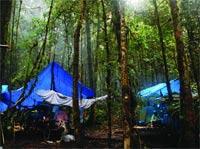
The expedition camp in the jungle
In a month the international team managed to assemble astounding collections. 550 species of plants were found (including 5 previously unknown species of palms), 40 species of mammals, 250 of birds, 150 species of butterflies (4 of them new), 60 species of tailless amphibians (20 of them new). Besides species unknown in the world's fauna and flora, many finds expanded the understanding of New Guinea's nature.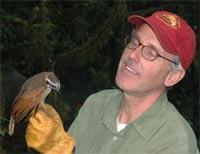
Bruce Beehler and a rediscovered bird of paradise
The astonishing richness of life in the Foja Mountains is explained, above all, by the fact that this area is covered with tropical forest, the most complex natural community on Earth. Moreover, the mountainous landscape divides the area into isolated patches, where kindred groups evolve differently and ultimately give rise to different species. Finally, although this region is in one of the most populous countries in the world¹, it is still not developed by humans. One of the reasons for Foja's pristineness is the wise policy of the Indonesian government, which closed this region to loggers and geologists.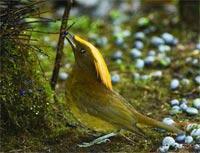
A male golden-fronted bowerbird decorates with berries the complex structure (the "bower") intended to attract females. The female will choose the male who builds the most beautiful bower. After this the pair will go to another (!) place, where they will build a banal nest into which the female lays eggs. This species, described in 1825, could not be found throughout the entire 20th century.
Since the times of Alexander von Humboldt and David Livingstone, sharp changes have occurred in the business of discovering "lost worlds". The modern researchers arrived by helicopter at a place whose geography was known to them in advance. The main difficulty the travellers had to overcome (and the leader, Bruce Beehler, had nurtured the idea of the expedition ever since Diamond's trip) was finding sources of funding. More than a dozen attempts to reach this region, made by various groups of researchers, proved not too successful, not least because of poorer preparation and more modest provisioning.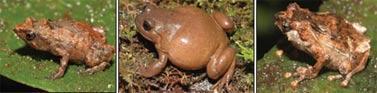
These tailless species have not yet been described. The first photograph shows a representative of the narrow-mouthed frog family, whose adults are less than a centimetre and a half long.
About the wondrous encounters of the travellers of the past we learn from their travel diaries, while the modern discoverers presented detailed photo and video materials. Yet mishaps happen even today: when the expedition leader saw the mating dance of a bird of paradise known only from a single find made in the 19th century, he was so struck that he forgot to turn on the video camera.
Are there many such places left on Earth? Probably not. In Bruce Beehler's opinion, it is worth searching in tropical Africa and South America.
Besides the lush diversity of life, the Foja Mountains reminded the researchers of a paradise garden in one more feature. The animals there are not afraid of humans. For fear is caused only by well-known dangers, and a human is something new, hitherto unseen². Many beasts (including echidnas — not the most docile creatures) allowed themselves to be picked up, and the birds took up courtship right before the observers' eyes.
So, paradise on Earth exists. Where there are no people.
1 The population of Indonesia is considerably larger than, for example, that of Russia, given the relatively small area of the island state. Return to the text
2 Fear of humans is the result of the harsh selection for caution and timidity that our species conducts on the whole animal world of the planet. We can be proud of ourselves — almost everything alive on Earth fears us. Return to the text
A crowded planet
Humanity increasingly recognizes itself as a global force, discovering ever new consequences of its activity. The recent weeks have been marked by a whole series of reports on various forms of our influence on the environment.
Beyond competition, of course, is the theme of global warming. The results, published in the journal Science, of a large-scale study by American climatologists of the planet's heat exchange should put an end to the old disputes. The scientists managed to determine the Earth's heat balance fairly precisely and to ascertain that it absorbs more heat than it emits. A key role in the study was played by buoys scattered across the World Ocean, as well as by measurements taken from space. Of course, the creation of a digital model of climatic circulation was not dispensed with.
The calculated heat imbalance (the excess of incoming heat over outgoing) amounts to 0.85 W/m². Climatologists connect it with the growth of the concentration of carbon dioxide and other greenhouse gases in the atmosphere. It has also been shown that our planet's thermal system is characterized by high inertia, and even having ceased to influence the climate, we will long continue to reap the fruits of our recklessness.
However, despite the conclusiveness of the published results, they did not convince the opponents. Some scientists still believe that global warming is the cause, not the consequence, of the growth of CO₂ concentration. And from what does the planet warm? From some other causes that bring about long-term climate changes. Of course, only a few specialists insist on such a conclusion, but scientific truths are not accepted by voting. As was to be expected, the critics of the study under discussion point to the insufficient validity of the computer model. So what if it adequately describes the dynamics of the measured parameters? The parameters key to assessing the future climate were not measured directly, but estimated from the model itself…
The accumulation of CO₂ influences not only the heat balance of the planet as a whole, but also the temperature of the outer part of the atmosphere (the thermosphere and exosphere). However, while carbon dioxide on the whole warms the Earth, the extremely rarefied gas at a height of several hundred kilometres, on the contrary, cools it. This is connected with the fact that the solar energy absorbed by the thermosphere is removed mainly by heat transfer to the lower mesopause (in the thermosphere there are few molecules capable of radiating effectively in the IR range, while in the mesopause zone there are enough of them). With the growth of carbon dioxide concentration in the atmosphere and the mesopause, the efficiency of heat removal from the thermosphere grows, and the density of the gas correspondingly falls. At present rates the density of the outer envelopes may halve over a hundred years.
What significance does this have for us? At present about ten thousand fragments of spacecraft larger than 10 cm fly around the planet, gradually descending lower and lower and, finally, disappearing into the dense layers of the atmosphere. Collisions with them (at an impact speed of up to 15 km/s) are a serious danger for space technology. So, the extremely rarefied gas envelopes that reach near-Earth orbits shorten the service life of space debris, while the growth of carbon dioxide concentration hinders this. Thus, debris will remain in space longer, and the probability of spacecraft colliding with it will grow (there is, however, another side effect of the rarefaction of the upper atmospheric envelopes, this one positive: less energy will have to be spent on maintaining the stable trajectory of low-orbit satellites).
However, the terrestrial consequences of global warming are more important to us, since climate change affects the multitude of living creatures inhabiting our planet. Especially sensitive to changing conditions are rapidly reproducing animals. The results of a twenty-year study of the genetic diversity of Australian fruit flies (Drosophila, the geneticists' favourite object) have been published. In comparing populations living in different regions, it was possible to identify genes characteristic of flies inhabiting warmer areas. The thing is that the activity of enzymes depends on temperature, and the alcohol dehydrogenase optimal for a warm environment differs from the same enzyme that works effectively in a cooler climate. So, over two decades the share of "warm" genes has substantially grown in the fly populations. The frequency of the tropical form of the flies' gene in Melbourne (located in the south of Australia) is now the same as it was twenty years ago in Sydney (which is closer to the equator).
The recorded phenomenon allows us to hope that Drosophila will successfully endure the warming, and the geneticists of the future will not be left without natural populations for testing their hypotheses. And what awaits other, not so rapidly evolving species? In most cases, nothing good. It has been found, for example, that it has become harder for southern elephant seals to feed their young. The melting pack ice affected the productivity of algae, through them — the amount of krill, and ultimately — a reduction in the elephant seals' traditional food, squid and fish. As a result the pups of these giant seals do not gain the necessary weight during milk feeding and set off into the ocean with poorer chances of survival. The number of elephant seals is inevitably decreasing.
However, warming is not the only danger threatening marine mammals. The beluga whales living in Canadian waters have set one of the recorded records for the number of cancerous tumours among populations of wild animals. The cause is a mixture of pesticides washed into the seas from the land. Unfortunately, many pollutants are capable of being transmitted along food chains. At the top of the food pyramid, belugas suffer far more than other species. Some belugas accumulate so many toxins that their bodies can be considered hazardous waste, whose disposal requires special safety measures.
It is clear that pesticides affect humans too. The decline in the number of viable spermatozoa in men's semen all over the world was described long ago. Studying this phenomenon in Missouri, the American epidemiologist Shanna Swan found that it concerns rural dwellers more than urban ones. Although this effect was connected with chronic pesticide poisoning (alachlor, atrazine and diazinon), it was usually observed not in the farmers who treated the crops with chemicals, but in other persons. It turns out that water-supply sources in rural areas are more often polluted by run-off containing pesticides, and so in men who consume this water the risk of developing azoospermia grows dozens of times.
The effect of pollutants may manifest not only in a decline in the viability of semen or its capacity for fertilization. It has been shown that the organochlorine substances contained in Baltic fish change the composition of spermatozoa in Swedish fishermen. The toxic influence increases the share of spermatozoa with a Y chromosome (which, upon fertilization, produces boys) and decreases the share of carriers of the X chromosome (which ensures the appearance of girls).
In these and many other examples the cause-and-effect chain is clearly visible. A high population leads to an intensification of human influence on the habitat, and the change of environmental parameters complicates the population's reproduction and ultimately may lead to a decline in population numbers. It is precisely thus that the numbers of most species on our planet are regulated. Unfortunately, the regulation of population numbers has not been worked out in the course of evolution, since in the epoch of our species' formation people led an entirely different way of life. This circumstance is complicated by the speed of human cultural evolution, unprecedented for the biosphere, and by the nonspecific character of our influence on the environment. In species that have a perfect mechanism for controlling population numbers, the fluctuations in the number of individuals are relatively insignificant. The more poorly regulated populations of other species constantly undergo strong fluctuations in numbers. But least of all amenable to ecosystem regulation is humanity itself. To "get" our species, one must strike the ecosystem a blow of such force that everything will suffer. Moreover, humans are the only global species, and our existence depends not only on local conditions, but on the resources of the whole planet. It turns out that until we radically spoil the conditions for life across the whole Earth, we will not change our behaviour? How one would like to hope that the ability to foresee the future will help us avoid this sad fate!
D. Shabanov. The planet in collective-farm ownership // Computerra, Moscow, 2006. — No. 42 (662)
D. Shabanov. "This is the closest thing to Eden you can find on Earth…" // CT, Moscow, 2006. — No. 6 (626)
D. Shabanov. A crowded planet // Computerra, Moscow, 2005. — No. 20 (592)