
Ecology: the science of interactions. I-05. Selection as the cause of adaptiveness in biosystems
Evolution of organisms is linked to their reproduction. Adapted organisms spread, unadapted — disappear. Can an object evolve that doesn't create copies of itself, but simply changes its states? Yes. An example can be the complication of the brain of an individual person. The brain solves...
We have established that a characteristic feature of biological systems is the hierarchical nature of their organization (Section I.3). Biosystems at each level demonstrate the purposefulness of their organization; let us provide several examples:
— characteristic biological macromolecules, such as enzymes, demonstrate fantastic adaptation in their structure for the regulated conduction of specific chemical reactions;
— typical organisms, for example, the human organism, are formed by tens of trillions of cells of hundreds of different types that coherently ensure the survival and reproduction of the entire aggregate;
— the unique, the only known to us biosphere effectively maintains stability of conditions on the planet it has transformed, despite the continuous change in its composition.
What is the cause of such purposefulness of biosystems? Purposefulness is the correspondence between the properties of the system we are considering and its relations with its environment. Organisms are purposeful if they effectively survive and reproduce in the environment with which they interact in a manner characteristic of them, according to their way of life. From a general standpoint, the purposefulness of the systems we consider may be obtained from another source or arise during the formation of these systems. When a person constructs a mechanism that successfully performs certain work, the purposefulness of this mechanism is a consequence of the purposeful work of the human brain, its creator. It is precisely this analogy that prompted understanding the purposefulness of biosystems as a consequence of the design of their Creator. William Paley (1743–1805), author of the so-called "natural theology" and the idea of "intelligent design," believed that the purposefulness of nature could become the key to understanding the features of its Creator. Charles Darwin (1809–1882), who in his youth was under the influence of Paley's ideas, made a significant contribution to understanding another, much more effective mechanism. It is this mechanism, as there are substantial grounds to be convinced, that is "responsible" for all these interesting and perfect systems that we can observe. This mechanism, which is, in essence, the main architect of the Universe, is natural selection.
Are we attempting in the previous sentences to deny the existence of God? No. In our view, faith at best is the result of an individual choice that does not require natural-scientific arguments. In a more widespread and, unfortunately, worse case, faith is the result of norms and requirements imposed by society, but even in this case it does not rely on scientific arguments. While it seemed to Paley that the perfection of the world requires a perfect Creator, the observable features of systems in the surrounding world were explained through references to the creative design; the features of observable systems were treated as arguments that allowed understanding this design. When we began to understand that the perfection of biosystems could be a consequence of selection and saw in biosystems features associated with precisely such a path of their formation, references to anyone's design became superfluous. Among other things, this is evidenced by the enormous number of features of biosystems.
"Our language and mode of thought divide the world into two categories: that which was conceived and created by humans, and that which was created by nature and has no purpose. ... We do not even have an appropriate word to describe evolutionary phenomena. An umbrella that protects from rain is a product of human planning and human activity, but a downpour that will soak you through if you go outside without an umbrella is neither one nor the other. But where does one place a system in which there are stores where one can buy an umbrella, in which the very word "umbrella" exists and behavioral norms that recommend tilting the umbrella to pass on the sidewalk with an oncoming pedestrian? These phenomena—market, language, customs—were created by humans, but none of them were planned. They arose without any plan.
...the general theory of evolution can be applied to the development of society, money, technology, language, laws, culture, music, violence, history, education, politics, religion, morality. ...all objects and phenomena in the world change ... gradually, but inevitably, depend on the trajectory of their own changes, are "transmitted with modifications" by the method of trial and error, and are subject to selection." Matt Ridley (Matthew White, 5th Viscount Ridley). "The Evolution of Everything"
As Matt Ridley quite reasonably defined, language, market, and customs develop "by themselves," as a result of selection, that is, the preservation, modification, and propagation of those states that better correspond to their environment. The "miracle" of selection occurs as a result of the interaction of what is evolving with a selective (non-indifferent; one that better supports some variants than others) environment. The listed phenomena can be described; for this, a certain amount of information must be used (from Lat. informatio — explanation, idea, concept about something, from Lat. informare — to give appearance, form, to teach, to think, to imagine), that is, data regardless of the form of their presentation. Before the appearance of these evolved phenomena, this information did not exist, and after they evolved, this information appeared. Where did it come from?
The theory of information, a branch of mathematics, gives a clear answer to this question. Information is the result of preserving the results of random choice. This preservation may be selective (selective), or non-selective. As a result of non-selective preservation of the results of random choice, noise arises; in it, various structures may arise randomly. As a result of selective (dependent on interaction with the environment) preservation, information that has evolved arises. Consequently, the authors of this textbook consider that the problem of selection is precisely ecological, should be considered within the framework of the science of interaction.
And how does the emergence of an umbrella, which Ridley also writes about, differ from language, market, and customs? The umbrella was created by a person. We do not know how it happened, but we are certain that at some point a person who knew in practice that a waterproof surface could protect from rain understood that it was better to raise this surface above the head using some structure that would stretch it. Certain design solutions in the construction of umbrellas spread, but first these solutions appeared in someone's head, were invented according to a certain design. The information reflected in the construction of the umbrella is a consequence of the informational complexity of the brain of its creator. And how did these solutions arise in this brain? The nervous system of animals, including humans, is a means for modeling the environment (more about modeling in Section I-9, about the work of the psyche — in Section VI-19). The primary trial and error in creating an umbrella occurred not in the external environment, but in its model created by the human psyche. And in this model, random choice also occurred ("...and what if I do it this way?") and its selective preservation ("...this should be comfortable!").
Thus, natural selection according to Darwin (sensu stricto, that is, in the narrow sense) is the preferential survival and reproduction of organisms that better correspond to their connections with the environment. Such selection may be positive (preferential preservation and reproduction of certain forms) or negative (preferential destruction or exclusion from reproduction of other forms). But such selection is only one example of the evolution of systems that we can observe. Artificial selection works in a similar way, but in artificial selection, the decision about the preservation or rejection of units of selection is made not by an impersonal environment, but by the brain of the selector. Decisions made by the brain affect not only other organisms. Learning through trial and error, creativity realize the same mechanism of the emergence of new information.
The evolution of organisms is connected with their reproduction. Adapted organisms spread, unadapted ones disappear. Can an object that does not form copies of itself, but simply changes its states, evolve? Yes. An example may be the complication of the brain of an individual human. The brain solves problems important to it, learns from this, and becomes more adapted. How does this happen? While the problem is not solved, a search for its solution occurs — a trial of various states of the brain, various actions performed by the person. When the solution is found, a certain variant of actions worked, its consolidation occurs. Unstable states change one another, a stable state remains, precisely because it is more adaptive (corresponding to interaction with the environment). From the analysis of the preservation and reproduction (copying) of systems that evolve by changing one for another, we moved to considering the states of one system that can change one another. In this case, we need the concept of stability, as the ability to maintain one's state (more in Section I-8). On the other hand, we can see that even "typical" biological evolution according to Darwin should be considered as development toward greater stability. To understand this, one should change the view of the organisms themselves. Any organism fundamentally differs from an inanimate system in that it is a stage of a more prolonged process (Fig. I-5.1).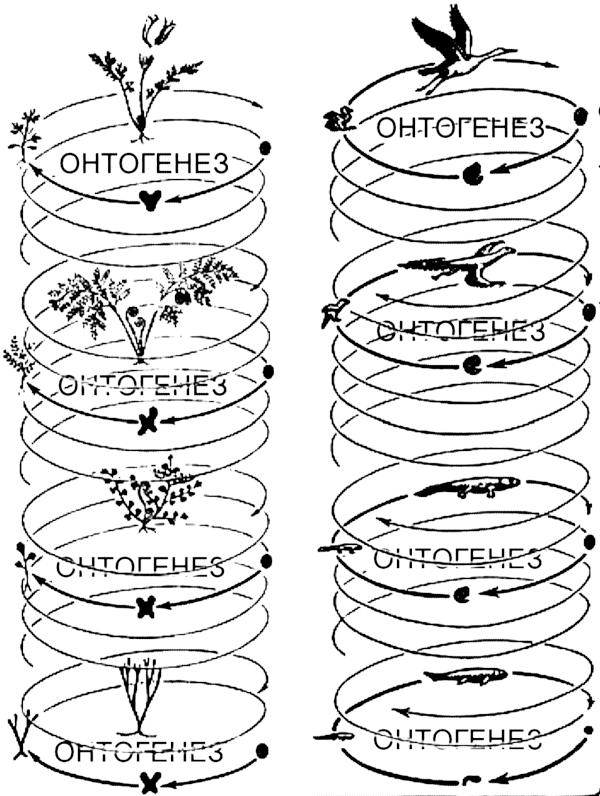
Fig. I-5.1. Organisms are not static structures. Each of them is part of the process of reproduction of a certain life cycle. Available to our observation are those processes that proved to be stable (according to Walter Zimmerman's scheme)
If we observe a certain organism, we see only one stage of a prolonged process. And the matter is not only that this organism arose during ontogenesis; this ontogenesis is part of a prolonged process during which the ontogeneses of the ancestors of this organism ensured the appearance of ontogeneses similar to them. We are looking at some creature, let us say, a frog; it seems to us that we see a relatively stable structure, but in reality we see one of the stages of the evolution of a huge number of life cycles, sequences of ontogeneses, each of which ensures the development of eggs into tadpoles, tadpoles into frogs that form new sex cells. The fact that we are looking at a frog indicates that the process of self-reproduction of ontogeneses is stable, one that ensures its repetition with the preservation of its unique features.
"What is called structure is a slow process of great duration; what is called function is a quick process of short duration" (Ludwig von Bertalanffy)
According to the above, classical Darwinian selection can also be described as follows. Among variable units capable of reproducing similar to themselves, over time, those that are more stably preserved and reproduced remain. Natural selection is one of a series of examples of the displacement of unstable processes by stable ones.
As we established when considering the phenomenon of human creativity, the units of selection for stability may be not only separate systems, but also certain states of one system. Of course, the human brain is not the best system for analyzing such processes; they may proceed without any goal-setting. Thus, possibly, it is precisely in this manner that the stability of processes occurring in the biosphere is ensured (more in Section II-3).
One of the most prominent scientists, a classic of thermodynamics, Ludwig Boltzmann (1844–1906), pointed out that the concept of natural selection has a very broad physical meaning. The second law of thermodynamics, to the study of which Boltzmann made an outstanding contribution, can, among other things, be formulated as follows. Open systems spontaneously transition into more stable (more probable) states. One of the consequences of such a formulation of the second law of thermodynamics may seem like a quite simple idea that corresponds well to common sense: processes that stably maintain their state and are capable of spreading displace unstable and less capable of spreading processes. An example of the spread of a more stable process at the expense of a less stable one may be the competitive displacement of a less adapted population by a more adapted one.
The above allows formulating the principle of natural selection sensu lato (in the broad sense): more stable processes (those that with higher probability preserve, restore, or spread their state) displace unstable ones. One of many consequences of this phenomenon is the purposefulness of biological systems studied by ecology.