
Ecology: Biology of Interactions. I-04. Structure of Ecology and its Place Among the Branches of Biology
In this course, ecology is divided into general and special, and within general ecology branches are distinguished that correspond to different levels of biosystem organization.
I-4. Structure of Ecology and its Place Among the Branches of Biology
Knowledge of some principles frees one from the need to know many facts.
Claude-Adrién Helvétius
In this course, it is customary to divide ecology into general and special, and also to distinguish within general ecology branches corresponding to different levels of biosystem organization. In general, the structure of ecology is understood here as follows:
General ecology:
— Autecology (= physiological ecology, = factorial ecology) — ecology of organisms;
— Synecology — ecology of supra-organismal systems:
— Population ecology (= demecology);
— Biocenology (= ecology of communities);
— Biogeocenology (= ecology of ecosystems, ecosystemology);
— Biospherology.
Special ecology (ecology of particular groups of organisms):
— Plant ecology;
— Fungal ecology;
…
— Animal ecology;
…
— Human ecology (= social ecology).
It must be noted that this is just one of the possible ways of dividing ecology into branches. Even authors who treat ecology as a biological science often consider it in a different scope. This especially concerns those who give the concept ‘ecology’ a different meaning. Naturally, human ecology cannot in all cases be considered as part of animal ecology (the general and unique features of our species are discussed in more detail in Section VI).
As you can see, general ecology is distributed among branches depending on the level of biosystems it examines. Accordingly, in educational courses this sequence of topics can be considered either in ascending order (characteristic of many courses in the post-Soviet space), or in descending order (more characteristic of American courses). This difference is schematically shown on Fig. I-4.1, A. 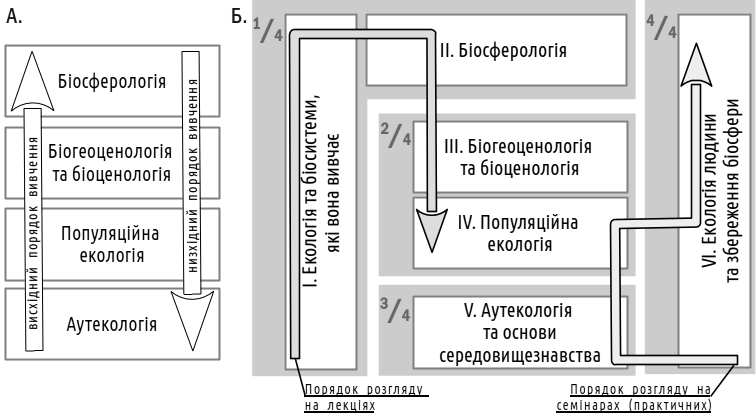
Fig. I-4.1. Possible order of considering different branches of ecology. A. Comparison of ascending and descending order. B. Logic of the course structure adopted at the Biology Faculty of V.N. Karazin Kharkiv National University
Both ascending and descending orders of studying ecology have their advantages and disadvantages. In general, there is no single ‘correct’ order for considering any section of educational material. A particular field of knowledge can be compared to a multidimensional space, and the order of considering individual topics — to a route through this space. One must start somewhere without familiarity with everything else, and return to some things again… This textbook was created at the Department of Zoology and Animal Ecology of V.N. Karazin Kharkiv National University, based on the tradition of teaching ecology that has developed here over recent decades. The relatively established logic of the ecology course (‘bioecology’), in which this textbook is used, is shown in Fig. I-4.1, B. The course consists of four ‘quarters’, between which six sections are distributed. Four sections are distinguished by the level of biosystems they consider, and two (the first and the last) — by a different principle. The lecture material is organized primarily in descending order, while the material considered in practical or seminar classes — in ascending order.
Now that we have examined the subsystems of ecology (the parts into which it can be divided), we can consider its supersystem (the whole of which ecology is a part). As already noted, we consider ecology as a biological science, i.e., as part of biology.
Biology (apart from its division into parts by levels of biosystems) can be divided into parts in three more relatively independent dimensions (Fig. I-4.2): on one hand — by the object of study (zoology, botany, microbiology, etc.), on the other — by method (molecular biology, biochemistry, genetics, etc.), and on the third — by the approach that defines the problems examined: morphological (describes structures), physiological (describes processes), ecological (describes the relationship with the environment) and evolutionary-historical (describes the prehistory of the system and the causes of its changes). Examining structure, function, environmental interactions, and prehistory are four interrelated directions of studying any system that cannot be reduced to one another. The explanatory value of ecology lies in the fact that it answers the question ‘what for?’, and in combination with the evolutionary-historical approach — ‘why?’ (rather than ‘what?’ and ‘how?’).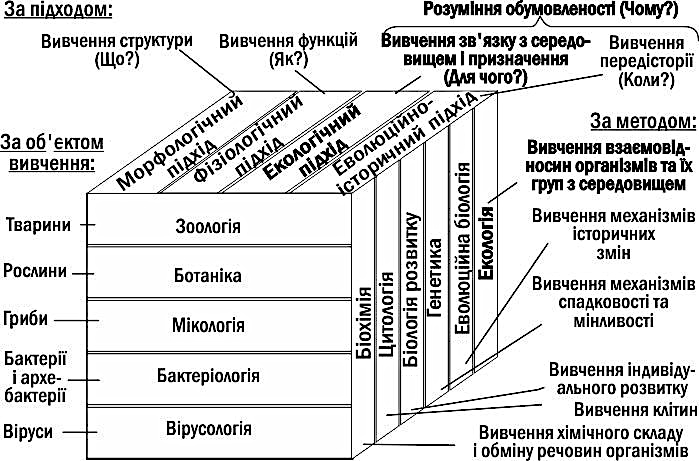
Fig. I-4.2. Different ways of dividing biology into branches
From this perspective, it becomes clear that the ecological approach can be applied not only to studying systems traditionally examined within ecology (from organism to biosphere), but also to any other systems. An ecological examination of a mitochondrion involves studying its purpose and interactions with its intracellular environment. In general, the order of the main approaches corresponds to the logic of investigating any object. Study usually begins with a description of morphology (what it is made of and how), moves to physiology (how it works), and then to ecology (what it is for) and evolution (why it is so).
Morphological study of biosystems is largely reductionist, i.e., it shifts attention from the properties of the system to the properties of its parts (Latin reductio — return, pushing back). To describe a complex structure, one must dissect it into parts… The physiological approach is partly reductionist and partly holistic, considering the system as a whole (Greek holos — whole). The reason for the shift to holism is that studying functions often requires a holistic examination of the object, taking into account the interaction of its parts. The ecological approach is holistic in its essence, and the system being studied is considered not merely as a whole, but as part of a higher-level system. Finally, the evolutionary-historical approach inevitably places the object under study in a broad perspective. The evolutionary-ecological approach can be regarded as something interconnected; it is precisely this that opens up the possibility of understanding the specific features of an object.