
Ecology: Biology of Interactions. III-01. Ecosystems and Biogeocenoses
An ecosystem is “a system composed of organism complexes together with the physical factors of their environment, i.e., habitat factors in the broad sense.”
Part II. ECOSYSTEMS. POPULATIONS
Section III. Biogeocenology and community ecology
III-1. Ecosystems and biogeocenoses
Ecology studies different levels of biosystems—from organismal (and even lower) to biospheric. But the most characteristic level for the biological science of interactions is the ecosystem level. As noted earlier, life on Earth had to arise as separate ecosystems. Matter cycling and energy transformation occur in ecosystems; ecosystems generate the set of ecological niches to which organisms adapt. Even the biosphere, despite its specificity, is also an ecosystem—just a very large one that encompasses all surface layers of our planet.
A key initial step is clarifying terms. In this part of ecology there is terminological overlap between two close concepts: “ecosystem” and “biogeocenosis” (Fig. III-1.1). The former term is older and was introduced by the American ecologist Arthur Tansley.
Ecosystem: “a system resulting from interaction of organism complexes with the complex of physical factors of their environment, i.e., habitat factors in the broad sense” (A. Tansley).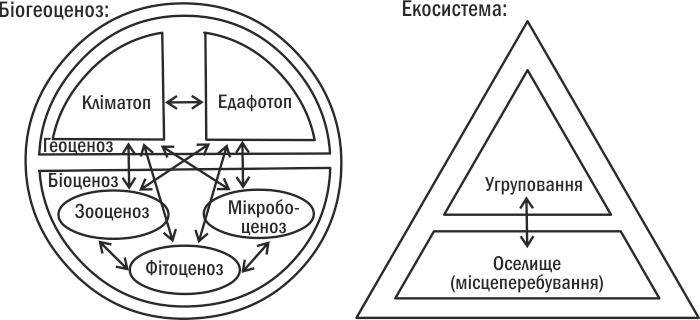
Fig. III-1.1. Comparison of biogeocenosis and ecosystem structure
Developing Tansley’s approach, we can define an ecosystem as a set of living organisms and their environment within which matter cycling and transformation of energy flow occur. An ecosystem includes a community (living components) and habitat/biotope (nonliving components).
The concept of biogeocenosis was introduced by V.N. Sukachev. It emerged from studies of plant communities and from the historical context of Soviet biology. Sukachev developed the concept using the term “biocenosis” (19th century).
[... truncated]