

Ecology: Biology of Interactions. II-09. Biogeochemical Cycle of Phosphorus
The phosphorus cycle is much less regulated than the just-considered carbon and nitrogen cycles because phosphorus lacks an exchange reservoir in the atmosphere. Phosphorus is the primary element that controls the productivity of aquatic communities. In the experiment with pond halves, where one of them...
II-9. Biogeochemical Cycle of Phosphorus
The P-cycle of phosphorus (Fig. II-9.1) is much less regulated than the carbon and nitrogen cycles just discussed, because phosphorus lacks an exchange reservoir in the atmosphere. Phosphorus is the main element controlling the productivity of aquatic communities. The role of phosphates in these communities was demonstrated in an experiment with pond halves, where sucrose and nitrates were added to one part separated by a plastic partition, and phosphates were added to the other as well. The second half bloomed, the first did not. The washout of phosphates from fields into water bodies leads to their eutrophication (increase in "forage capacity" as opposed to oligotrophy — "low forage capacity"), which can lead to their swamping. In naturally eutrophic water bodies (in which a large proportion of biogenes and organic matter are autochthonous), communities efficiently utilize production. In eutrophication resulting from external influence (when biogenes and organic matter are allochthonous), an excess of organic matter may arise, the decomposition of which will lead to the creation of anaerobic conditions, release of toxic decomposition products (hydrogen sulfide, ammonia), destruction of the community, and rapid swamping.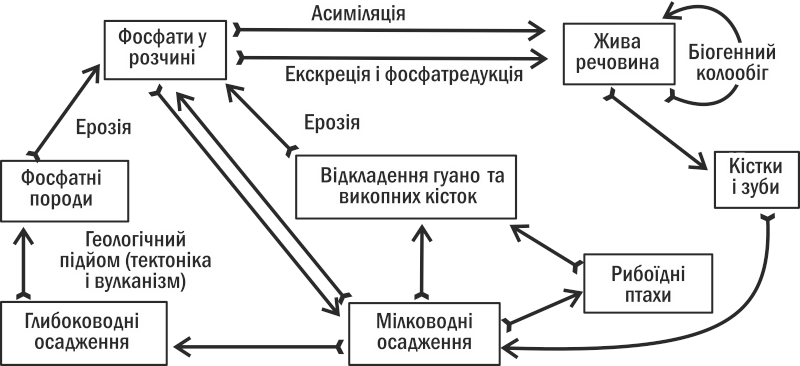
Fig. II-9.1. Global Phosphorus Cycle