
Ecology: Biology of Interactions. II-10. (Supplement) Evolution of the Universe, the Solar System, and Earth
All known history of the Universe is a history of expansion. In the course of that expansion, elementary particles, hydrogen atoms, and stars formed by gravity appeared within it.
II-10. (Supplement) Evolution of the Universe, the Solar System, and Earth
“So long as you feel stars as something ‘above you,’ you have not yet acquired the gaze of one who knows.”
Friedrich Nietzsche
In describing the origin and development of the Universe, science shows both strength and weakness. We have detailed descriptions of cosmic evolution corresponding to different theories, using very complex mathematical apparatus; the described events seem fantastic. Yet none of the theories is fully convincing, and further research continues to produce new, often paradoxical discoveries.
The Universe is approximately 13.8 billion years old (Fig. II-10.1). It originated in the so-called Big Bang — an event beyond everyday intuition. This event resulted not only in the appearance of the Universe but also in the emergence of space and time (thus questions about what is “outside” the Universe or what was “before” it are logically inconsistent).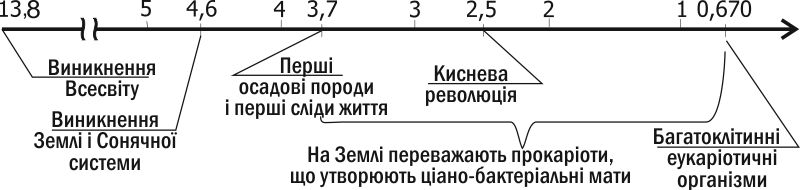
Fig. II-10.1. Some stages of the history of life on Earth and in the Universe
What awaits the Universe in the future remains an open question. Over time (very different across models), it will cease to be suitable for life. It may recollapse, degrade in endless expansion, or transform — current choices still reflect scientists’ intuitions more than definitive data. At least, the essence of the current cosmic stage is the existence of stars and galaxies.
The known history of the Universe is the history of its expansion. During this expansion, elementary particles, hydrogen atoms, and stars assembled by gravity emerged. In stars, matter is compressed and heated enough for thermonuclear fusion reactions. Thus, the most widespread thermonuclear reaction in the Universe is the formation of helium nuclei from hydrogen nuclei. Fusion of nuclei of elements in roughly the first half of the periodic table (up to iron) releases energy. This continuous energy release counteracts stellar contraction. Any star (including our Sun) balances gravitational compression and expansion driven by thermonuclear energy — effectively balancing on the verge of thermonuclear explosion.
Stars that burn through hydrogen contract further and may start helium fusion.
How do elements in the second half of the periodic table arise? Sometimes stellar contraction triggers reactions that sharply increase energy output: such a star explodes as a supernova. Supernova material is ejected with enormous energy. Heavy-element synthesis occurs through high-energy nuclear collisions, analogous in principle to accelerator experiments.
“Stars are a mechanism, a means of evolution, whose result is heavy elements” (V. Snitnikov, V. Parmon, 2004).
When humanity derives energy from fission of uranium, it taps energy accumulated in supernova explosions.
Thus, enough time had to pass for stars to be born and die before diverse elements appeared in the Universe. The Solar System, Earth, and even our bodies contain material processed through dead stars.
Earth (and the Solar System) is about 4.6 billion years old. The Sun and planets formed from a gas-dust cloud — debris of earlier stars. Nuclear transformations in previous stars are the cause of Earth’s chemical diversity that makes life possible.
Today, the Sun is roughly mid-life. In about 5 billion years, it will first expand roughly to Earth’s orbit, then contract and finally explode; new stars will arise from resulting matter.
Rocks preserved from Earth’s earliest formation are unavailable, but Earth’s age can be inferred from meteorites: fragments of Solar System material not incorporated into planets. The most common meteorites are stony-iron. Density-driven differentiation in early Earth moved heavier “iron” inward and lighter “stone” outward, releasing substantial energy and strongly heating the planet. Eventually Earth acquired a structure like today’s: a core surrounded by viscous mantle, with crust floating on top. Lithospheric plate movement began, mountains formed by collisions, and sedimentary rocks formed from erosion and transport by water and air.
Earth’s surface cooled below 100°C around 4 billion years ago, enabling ocean formation. For about another 800 million years, the ocean remained very hot (>90°C). The oldest known minerals are ~4.2 billion years old but not sedimentary. The oldest sedimentary rocks from the Isua formation in Greenland are ~3.8 billion years old and already contain traces of life (biogenic carbon particles). This means life appeared on Earth as soon as conditions became at least somewhat suitable. The history of life on Earth began in boiling water!