VI. Class Aves-08. Excursions with Tetyana Atemasova. Forest Birds
A presentation by Tetyana Andriivna Atemasova dedicated to forest birds
Дмитро Шабанов
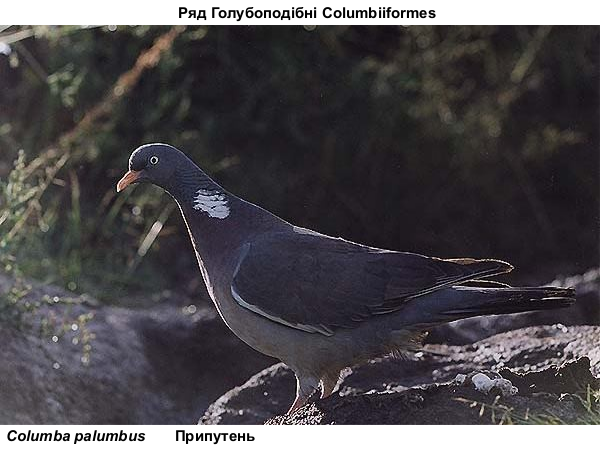
Ornithological excursions to the forest-steppe oak woodland and pine forest Forest-steppe upland oak woodland The upland oak woodland surrounding the biological station is rich in bird life. In the crowns of large deciduous trees one frequently hears a low, unhurried call repeated several times in succession: "OOB-OOB-OOB-OOB-OOB". This is the display call of the Common Wood Pigeon (Columba palumbus). It can now be heard more often; in some regions of western Ukraine it has become a common urban bird. Common Wood Pigeon
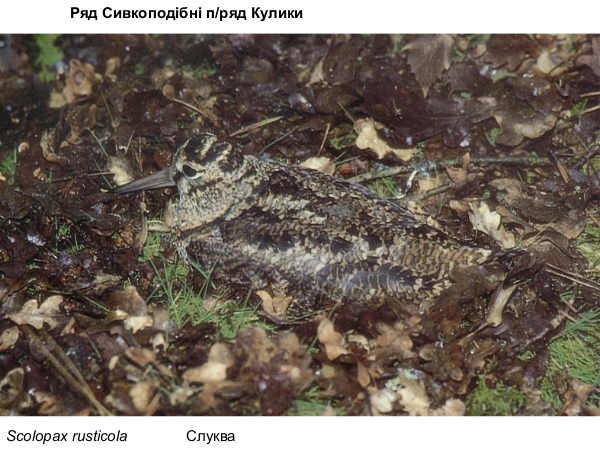
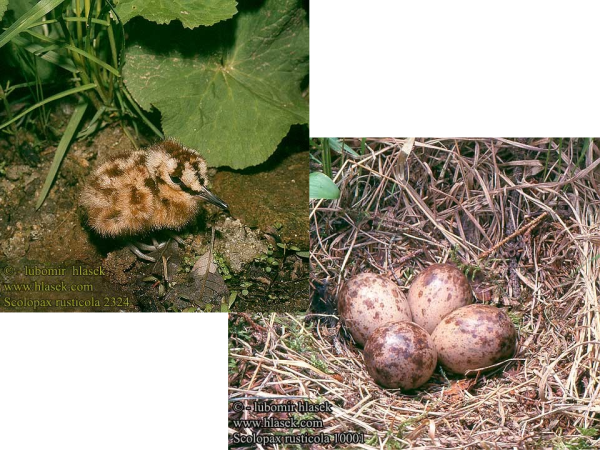
In the forest interior, on the ground (if one is fortunate), one may observe the nest of the Eurasian Woodcock (Scolopax rusticola). During the nesting period it is inconspicuous, owing to its cryptic coloration that matches the forest litter. In spring, however, during the roding display, woodcocks gather in large flocks at the edges of oak woodlands and perform courtship flights, producing a characteristic grunting call in the air.
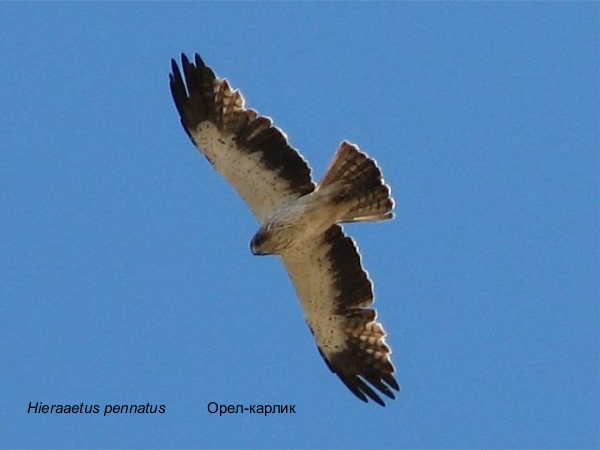
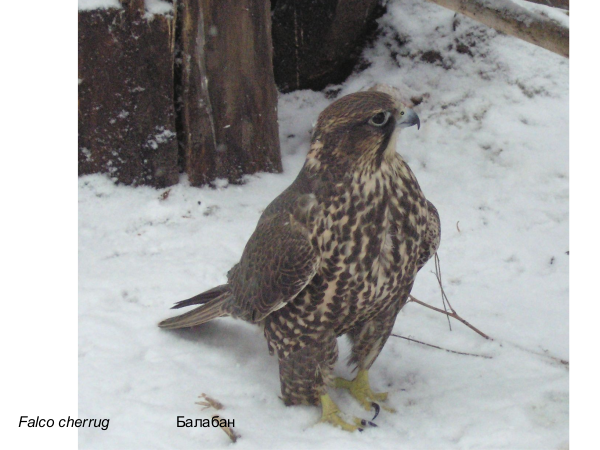
Two raptor species characteristic of the forest-steppe zone of the European sector — the Booted Eagle (Hieraaetus pennatus) and the Saker Falcon (Falco cherrug) — are now extremely rare. Over recent decades their populations have declined sharply, and both species are currently in need of special conservation measures. The Saker Falcon typically nests at height in old Carrion Crow nests and occasionally colonises Grey Heron breeding colonies. It is most often detected by its voice — a loud, somewhat nasal and drawn-out "gyak, gyak ...". The Booted Eagle still persists in the upland oak woodland massif. During courtship displays, eagles roll in the air, accompanying their flight with melodious high-pitched calls. The plumage coloration of the Booted Eagle varies considerably among individuals — birds of both pale and dark morphs may be encountered near a single nest.
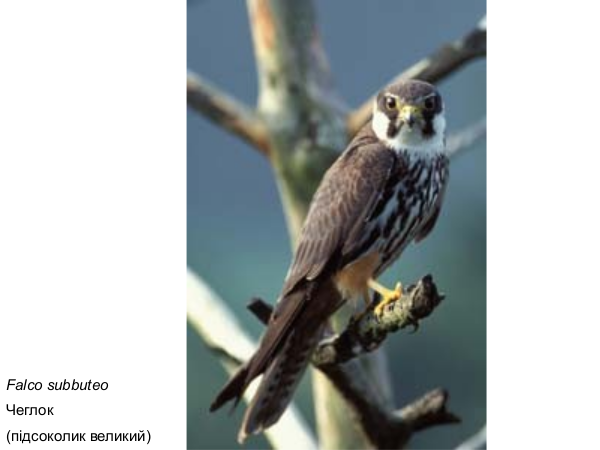
The Eurasian Hobby (Falco subbuteo) is a strictly forest falcon, nesting in corvid nests and hunting small passerines caught in flight.
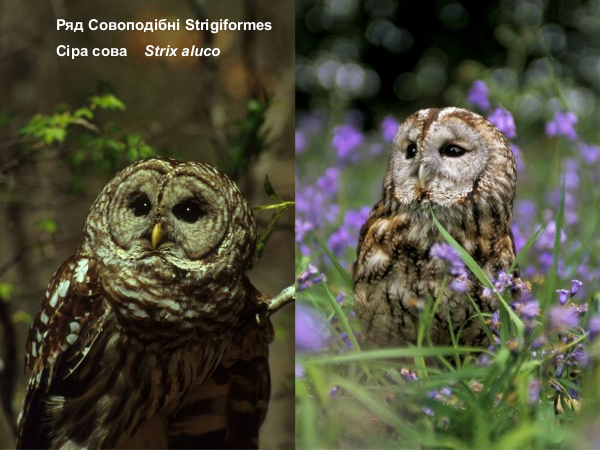
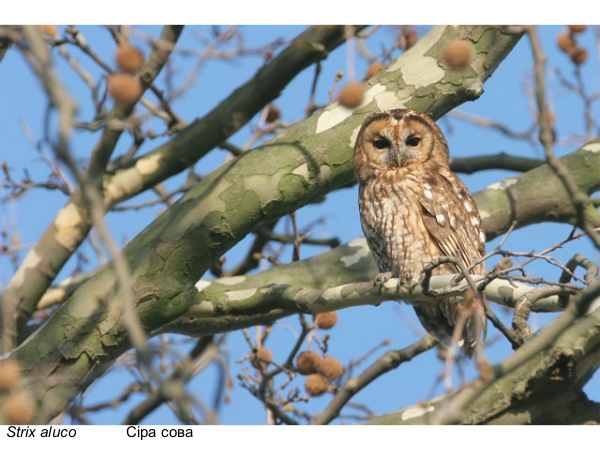
At night the oak woodland resonates with the territorial call of the Tawny Owl (Strix aluco) — the male's call is more prolonged, while the female's is short, resembling a "comma". Similar but harsher calls are uttered by juvenile owls. The Tawny Owl is a typical inhabitant of oak woodlands, though it also occurs in pine forests. It occupies tree cavities and, more commonly, semi-cavities (fracture points in trees where the wood has become soft and rotten). It feeds on murine rodents, shrews, and birds (mostly juveniles), hunting at dusk along woodland edges. Until September, owl family groups remain together, with adults delivering food to the young.
Tawny Owl
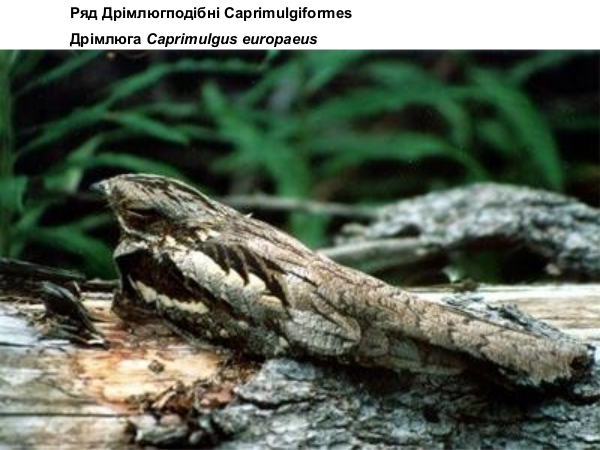
The European Nightjar (Caprimulgus europaeus) is another species whose song is heard at night. It occurs most frequently in pine forests but is also present in the oak woodland. It constructs its nest on the ground in a shallow depression. It hunts insects over forest clearings at night and flies silently, possessing the same soft plumage as the owl.
European Nightjar
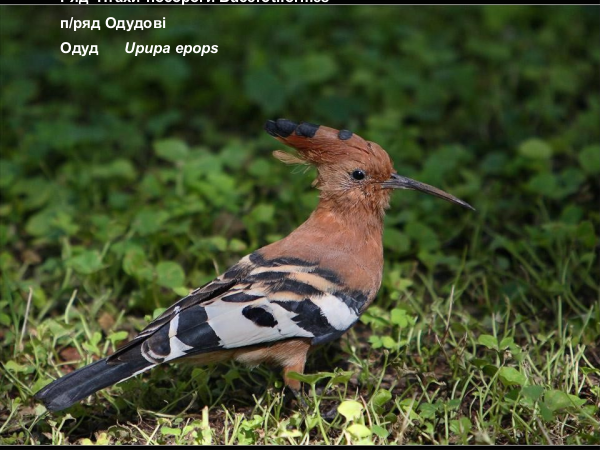
At the edges of the forest one encounters the Eurasian Hoopoe (Upupa epops) — a bird remarkable for its vivid patterned plumage, its conspicuous crest which it continuously lowers and raises, and its long, curved bill. The Hoopoe's song is a rapidly repeated series of "oo-oo-oo-oo". It is a low whistling sound, resembling the tone produced by blowing across the mouth of a test tube. The Hoopoe may nest in a tree cavity or in a burrow. The bird becomes conspicuous when foraging along forest tracks.
Eurasian Hoopoe
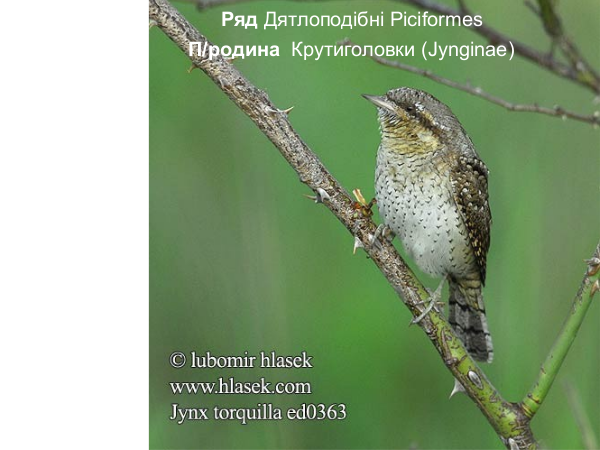
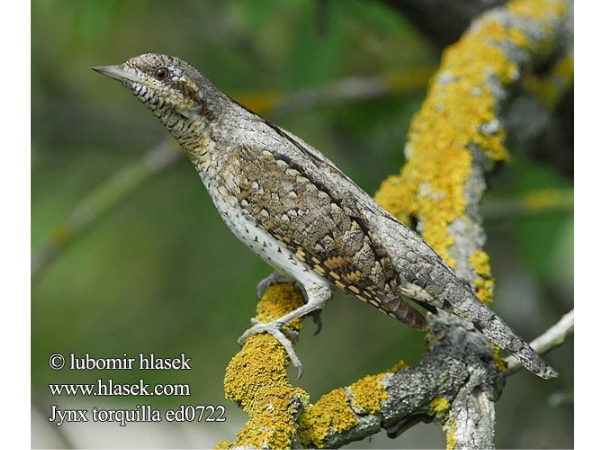
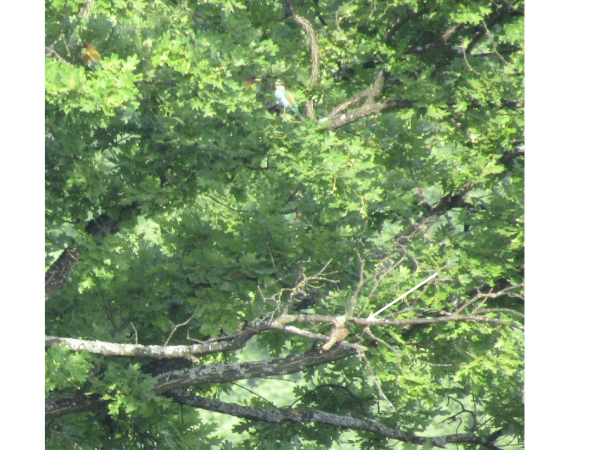
The woodpeckers (order Piciformes) are quintessential forest inhabitants. The sole migratory member of this order in the region is the Eurasian Wryneck (Jynx torquilla). It utters a rapid, high-pitched call: "kya-kya-kya-kya". Unlike other woodpeckers, it does not excavate its own cavity, relying instead on old woodpecker holes. Its plumage is cryptic; concealment is achieved not only through coloration but also through its posture — it perches along a branch, stretching its neck, and may even hiss and sway its head.
Eurasian Wryneck
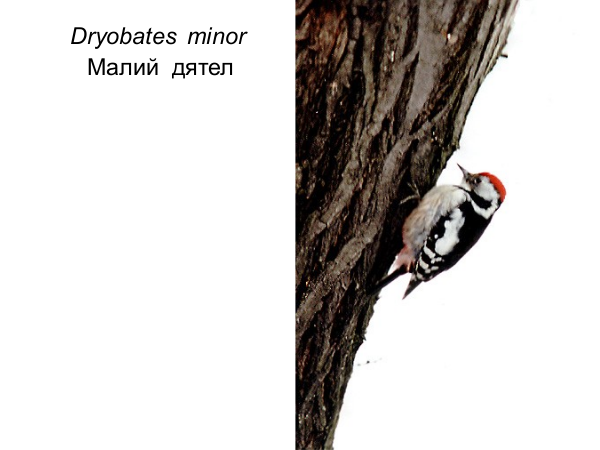
The Middle Spotted Woodpecker (Dendrocoptes medius) is encountered primarily in oak woodlands. It is the most "silent" of the woodpeckers, producing no spring drumming. Its call — "keek-keek-keek..." — is heard more often than the bird is seen. Among the woodpeckers, in addition to the Middle Spotted, the Great Spotted (Dendrocopos major) and the Lesser Spotted (Dryobates minor) also inhabit oak woodlands. All three differ in head coloration and body size.
Middle Spotted Woodpecker
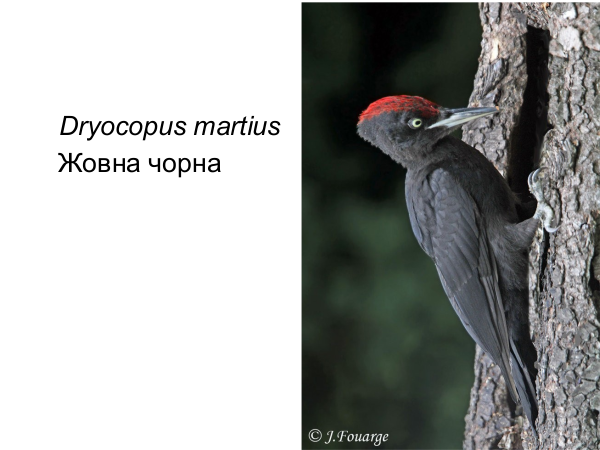
In aspen and black poplar stands along the river one may hear the Grey-headed Woodpecker (Picus canus). In recent years a new species for this locality has appeared — the Black Woodpecker (Dryocopus martius), a taiga-origin species. In spring, from March onward, one can hear the courtship "drumming" of woodpeckers, as birds select a dry resonant branch and loudly announce their presence. Each year a woodpecker pair excavates a new cavity. Old cavities are subsequently occupied by tits, nuthatches, flycatchers, and other hole-nesting species. A freshly excavated woodpecker cavity is typically distinguished by a pale ring of fresh wood around the entrance hole.
Grey-headed Woodpecker
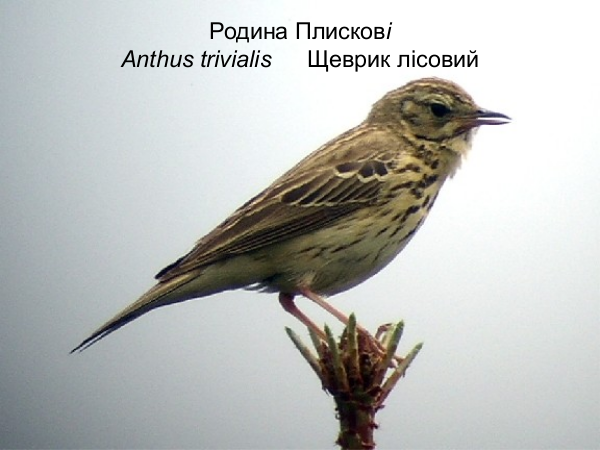
Along woodland edges two further species occur whose Ukrainian names include the word "forest", though neither penetrates far into the interior — the Tree Pipit (Anthus trivialis) and the Wood Lark (Lullula arborea). Both typically nest on the ground in a shallow depression at the woodland edge, lining the nest with horsehair and grass. They perform their display flights and sing in the air over the woodland edge.
Wood Lark
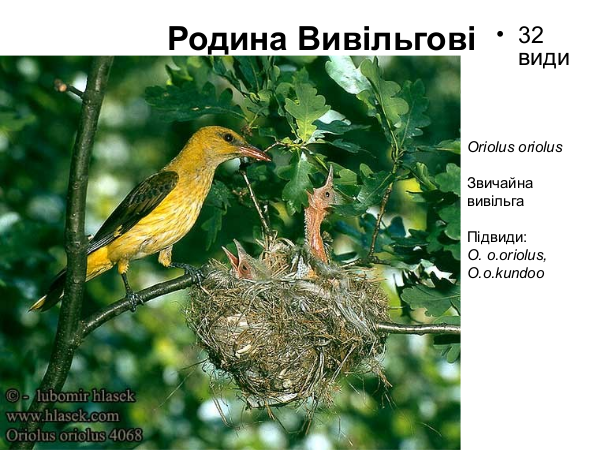
A loud fluting whistle — "filioo" or "fiulioo-fyoo" — is heard throughout the excursions. This is the song of the Eurasian Golden Oriole (Oriolus oriolus). It frequently accompanies its song with a loud cry resembling the mewing of a cat. This contact call is produced when the bird is alarmed; however, when disturbed near the nest and mobbing a predator, the Golden Oriole modifies the call into a more prolonged "yarrrr". The nest is attached to the terminal branches, woven around the branch tips, forming a grass basket that swings freely yet supports a full brood of nestlings. Mammalian predators are unable to reach such a nest.
Eurasian Golden Oriole
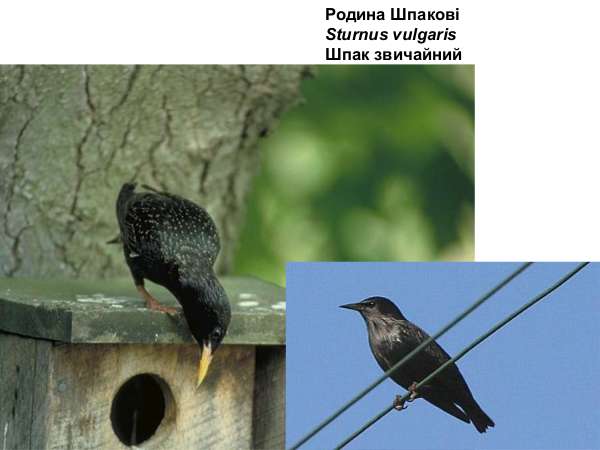
Oak cavities are also used extensively by Common Starlings (Sturnus vulgaris), which raise two broods of 3–4 young per summer.
Common Starling
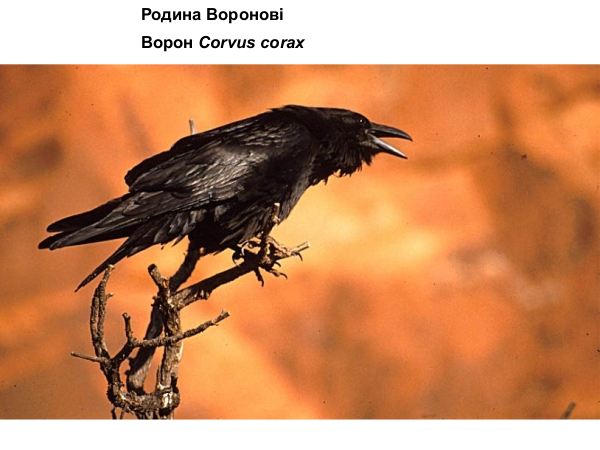
The Common Raven (Corvus corax) — a strictly forest bird and the largest member of the order Passeriformes — has in recent years been appearing with increasing frequency in urban green spaces. It constructs nests in trees, returning to and enlarging them annually. Such nests may subsequently be occupied by raptors — Booted Eagles, Common Buzzards, and Long-legged Buzzards. Young ravens fledge early in spring, are fed by the parents for up to two months, and only in June become fully capable of flight. At this time one may observe and hear adult birds accompanying two or three juveniles.
Common Raven
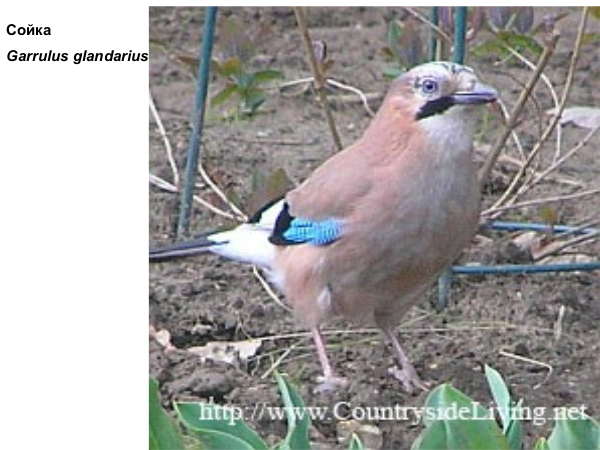
Another corvid associated with forests is the Eurasian Jay (Garrulus glandarius). It inhabits predominantly oak woodlands, constructing small dense nests in trees that are later used by other birds (falcons, Long-eared Owls, buzzards). In urban environments the Jay frequents parks with mature trees.
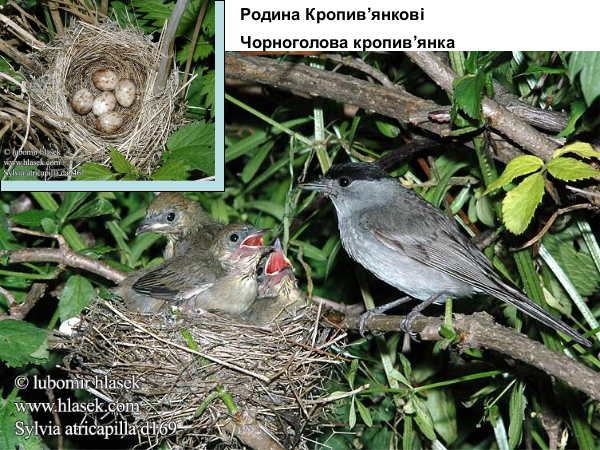
Shrubs in the understorey serve as nesting sites for the Blackcap (Sylvia atricapilla) — the only warbler of the genus that inhabits the forest interior. The remaining Sylvia warblers — the Common Whitethroat (Sylvia communis), the Garden Warbler (Sylvia borin), and the Lesser Whitethroat (Sylvia curruca) — occupy the forest margins and scrub. The Barred Warbler (Sylvia nisoria), named for its barred underpart pattern and the yellow irides characteristic of males, also occurs here. It keeps to slopes overgrown with blackthorn, wild cherry, and other shrubs. Its song resembles the babbling of the Garden Warbler but contains rattling phrases. Like the Common Whitethroat, this species frequently sings in flight. On shrubs, Sylvia warblers construct their nests — tall, deep cup-shaped structures inlaid along the rim with spider egg-cocoons.
Blackcap
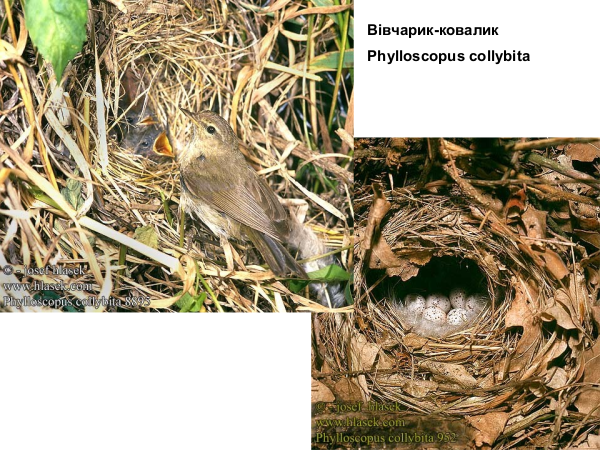
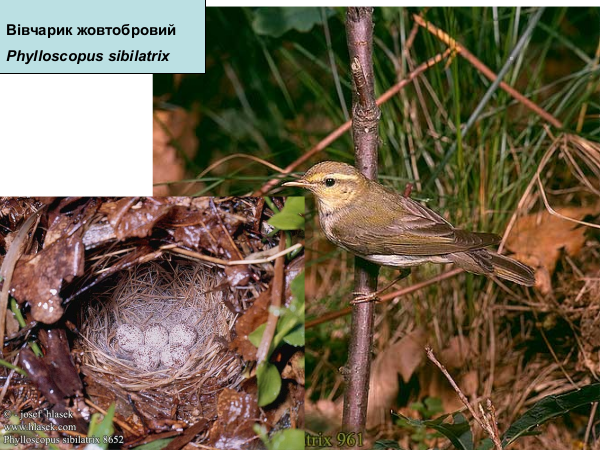
Among the leaf warblers (Phylloscopus) in the oak woodland, the Common Chiffchaff (Phylloscopus collybita) and the Wood Warbler (Phylloscopus sibilatrix) are the most common. The song of the latter is a rich, prolonged trill that begins with separate ringing notes, the whole phrase sounding like "tsip-tsip-tsiptsiptsip-sirrrrr". The Wood Warbler frequently sings in flight, moving between trees at low altitude. In addition to its song, the male continuously utters a plaintive whistle: "tyu, tyu, tyu-tyu-tyutyutyu". The Common Chiffchaff continues to be heard in the oak woodland until autumn: "tyt-tiit-tyt-tiit-tin-ton...". In total, the song of this species encompasses up to 43 distinct elements. Both warblers nest on the ground; the nest is a side-entrance domed cup lined inside with down.
Common Chiffchaff
Special attention should be given to the Wood Warbler (Phylloscopus sibilatrix), which is very common in oak woodlands. It resembles the Wood Warbler externally. The greenish-yellow plumage renders it inconspicuous among foliage, but its loud voice eventually enables one to locate it. The diversity of borrowed sounds in its song is remarkable: at one moment the song of a Golden Oriole or a Wood Lark rings out, then the anxious call of the Golden Oriole, then a rapid, sharp "key-key-key" of a Common Kestrel, or the battle cry of swallows.
Wood Warbler
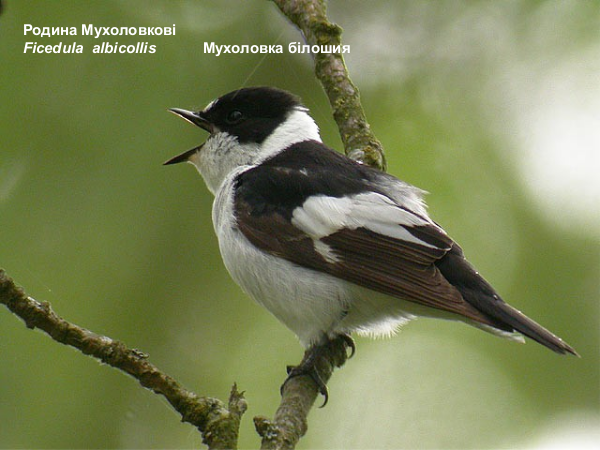
The Collared Flycatcher (Ficedula albicollis) closely resembles the European Pied Flycatcher (Ficedula hypoleuca) in appearance, habits, and song. It sings at a slightly higher pitch and blends notes more smoothly. Only the black-and-white males are visually conspicuous. It nests in tree cavities and nest boxes. It forages for insects on tree trunks and lateral branches.
Collared Flycatcher
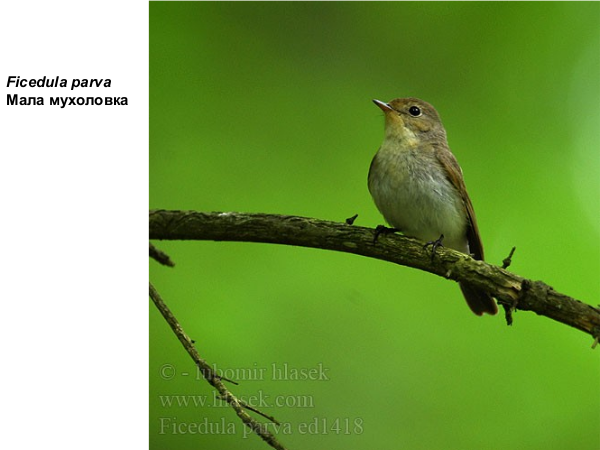
The Red-breasted Flycatcher (Ficedula parva) sings in damp ravines within the oak woodland. It nests openly, on tree stumps.
Red-breasted Flycatcher
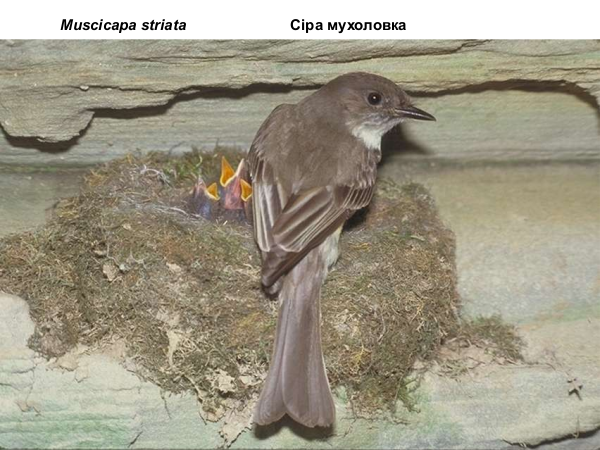
The Spotted Flycatcher (Muscicapa striata) has a short, inconspicuous song. It can frequently be observed during foraging — it is one of the few species that catches insects in flight. The bird perches on an isolated branch at the edge of a woodland stand, watching for prey. It suddenly launches into the air, seizes an insect, and returns to its perch. The nest is open at the top but is situated beneath some overhang — natural or artificial.
Spotted Flycatcher
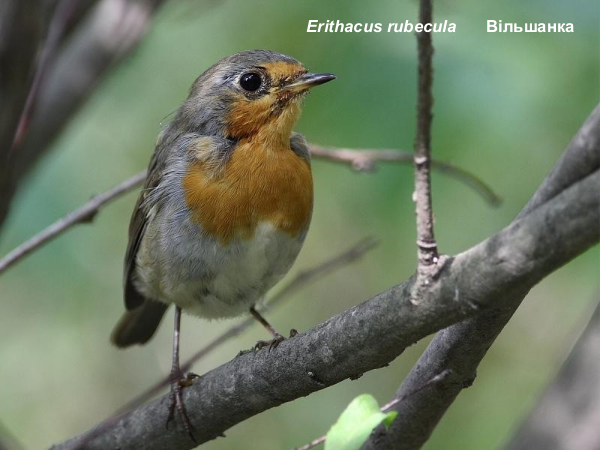
European Robins (Erithacus rubecula) are abundant in the oak woodland — small birds with an entirely red breast and a ringing song with many whistled phrases. Robins nest in the ground stratum — in piles of brushwood and leaf litter, beneath fallen trees. They may also occupy semi-open nest boxes.
European Robin
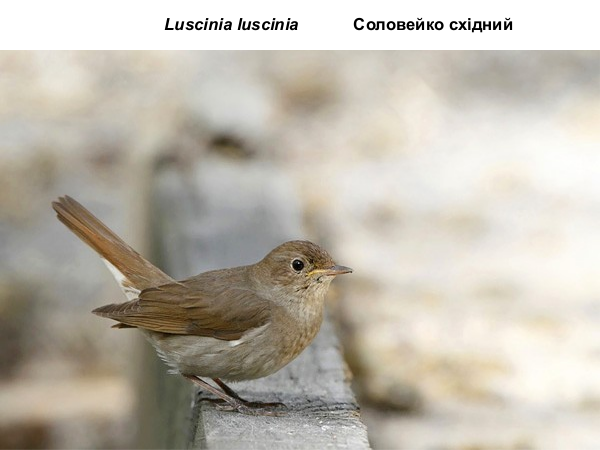
At woodland margins, beneath strips of scrub, the Common Nightingale (Luscinia luscinia) constructs its ground nest. The male typically perches on a shrub, announcing that the territory is occupied, while the female incubates the clutch in a shallow ground depression. The nightingale's song has been the subject of research by numerous European ornithologists — it is composed of a basic "programme" and elements that birds learn from one another. The song shows regional variation.
Common Nightingale
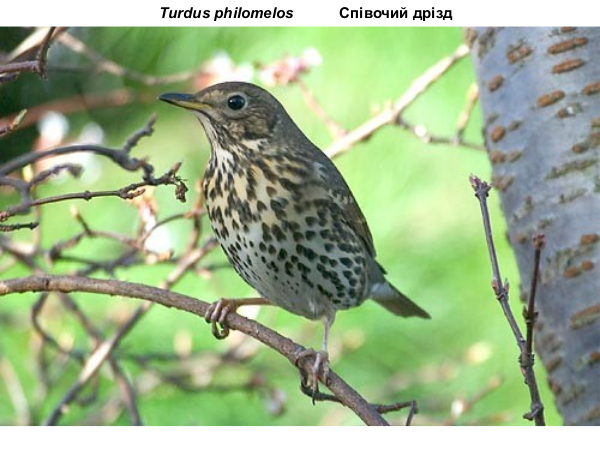
On excursions in the forest-steppe oak woodland the songs of the Song Thrush (Turdus philomelos) and the Eurasian Blackbird (Turdus merula) are heard constantly; both nest in the arboreal layer — the Blackbird lower, the Song Thrush mostly from 1 m upward to the canopy top. The Blackbird constructs a nest plastered with mud and lined with grass, though this may vary in different climatic zones. The Song Thrush nest invariably has a hard, cardboard-like inner lining on which the eggs rest; the bird plasters the cup with wood-rot debris moistened with saliva. On leaving the nest, young thrushes move actively through the forest litter, searching for food — molluscs, large earthworms, and similar invertebrates.
Eurasian Blackbird
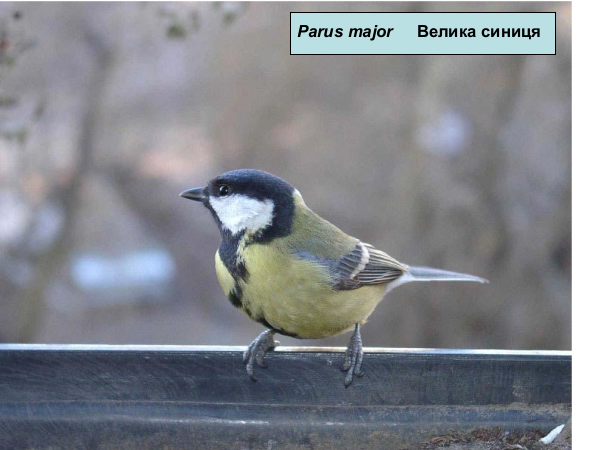
The Great Tit (Parus major) is very common in oak woodlands; the Eurasian Blue Tit (Cyanistes caeruleus) and the Willow Tit (Poecile montanus) also occur — all are hole-nesting species.
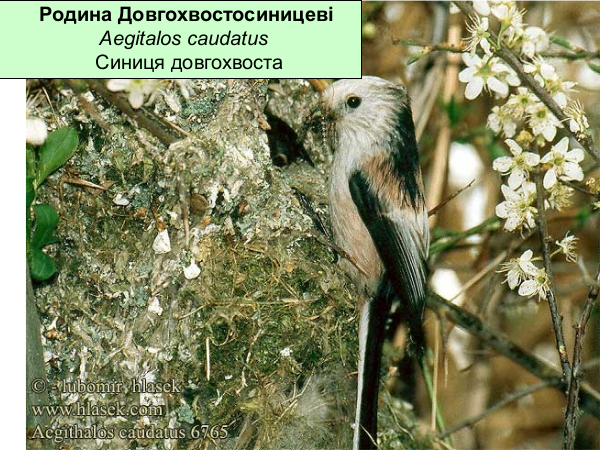
The Long-tailed Tit (Aegithalos caudatus) occurs in both the oak woodland and the pine forest. It constructs a spherical nest, weaving lichens and moss gathered from surrounding trees into its walls.
Willow Tit
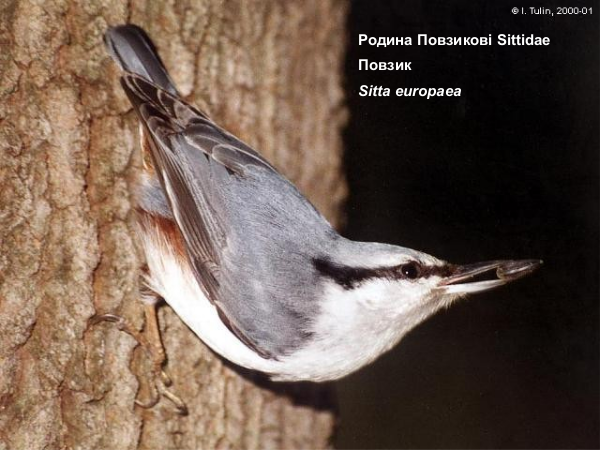
In certain forest sectors Eurasian Nuthatches (Sitta europaea) occur in considerable numbers; their excited chattering voices are heard and the birds themselves are visible, hopping along trunks in all directions, even head-downward.
Eurasian Nuthatch
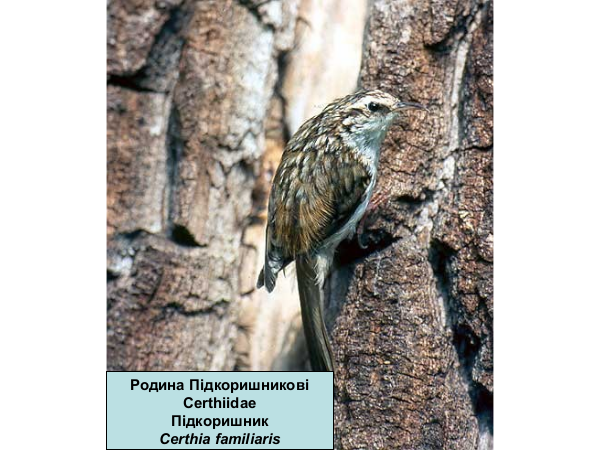
The Eurasian Treecreeper (Certhia familiaris) also stays mainly on trunks — a cryptically coloured, greyish bird with a long, slender, decurved bill, with which it extracts larvae and insects from beneath bark (even in winter). It nests behind loosened bark, constructing a nest of plant down.
Eurasian Treecreeper
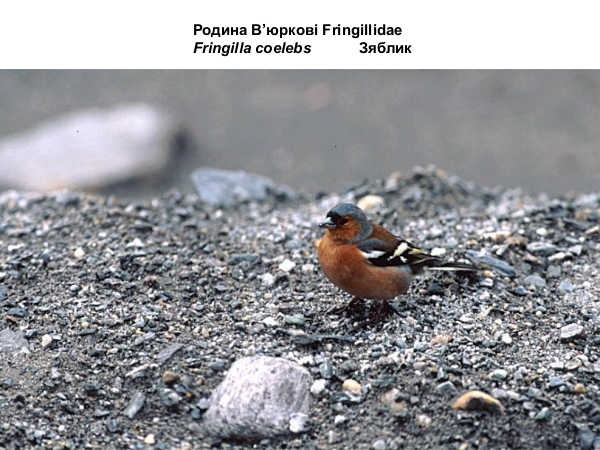
The Common Chaffinch (Fringilla coelebs) is one of the most abundant species across our forests — oak woodlands, pine forests, alder groves, black poplar stands, and so on. It may nest in roadside shelter belts and in extensive forest massifs alike. The nest is built in the arboreal layer at a trunk fork, with lichen inlaid into the outer walls. The Chaffinch's song is a complex combination of elements, each repeated several times, concluding with a terminal flourish. It has been demonstrated that the song varies between regions, forming distinct regional dialects.
Common Chaffinch
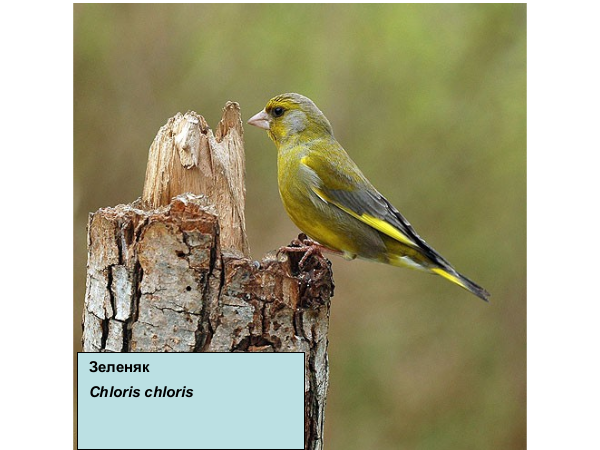
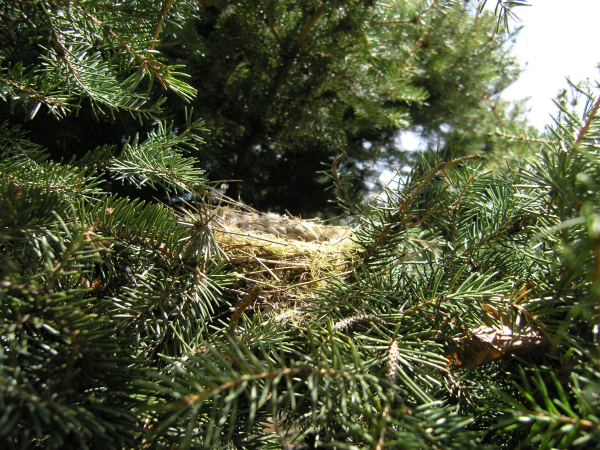
Throughout summer in the oak woodland and at woodland edges the characteristic song of the European Greenfinch (Chloris chloris) can be heard — a babbling phrase ending with a drawn-out "vzh-zh-zh-ik". The Greenfinch is a resident bird, nesting predominantly on conifers (spruce, thuja, fir), though it prefers shrubs — raspberry, currant — for the second brood, invariably lining the nest cup with its own down.
European Greenfinch
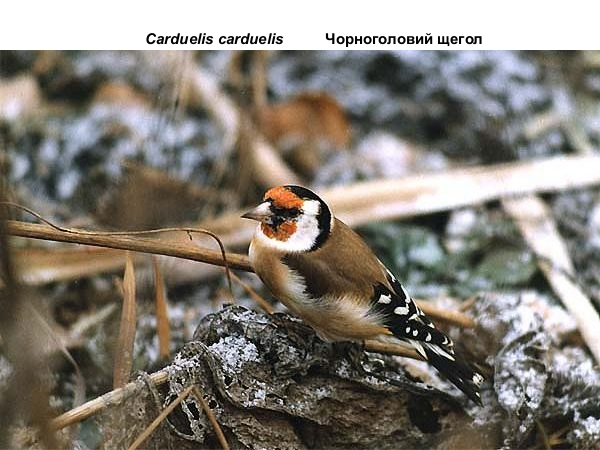
In the tree canopy — frequently along the woodland edge from June onward — one may observe the European Goldfinch (Carduelis carduelis), a vividly coloured bird with a red face and black-and-yellow wing panels. It nests in trunk forks of short trees at the woodland margin, lining the nest with a thick layer of down. From mid-summer it becomes more conspicuous as it adopts a nomadic lifestyle.
European Goldfinch
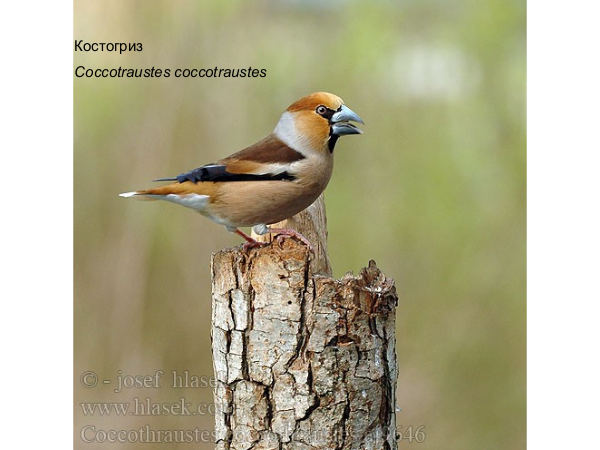
The Hawfinch (Coccothraustes coccothraustes) is harder to observe even after the breeding season, as it frequents the upper third of the tree canopy. Only in winter, when it forms large mixed flocks with other finches, do Hawfinches stand out by their stout build and massive bill.
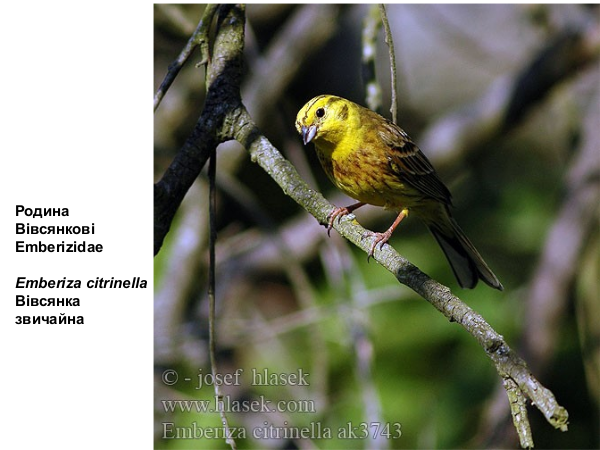
The Yellowhammer (Emberiza citrinella) occurs exclusively at woodland margins, nesting on the ground in a shallow depression that it tightly weaves with grass stems and lines with down.
Yellowhammer
Pine Forest
Pure young pine stands support relatively few bird species. This is attributable to the ecological uniformity of such forests, which are typically even-aged plantations lacking understorey shrubs and regeneration. Among songbirds, the Common Chaffinch is the most conspicuous. This bird nests wherever even a small grove of trees exists. Rapidly, within 2–3 seconds and in a single breath, the Chaffinch delivers its trill, concluding it sharply with the so-called terminal flourish; sometimes it adds a brief "ki" sound, as if posing a question. One song follows another. In one hour a Chaffinch may sing more than 400 songs.
Where nest boxes have been erected in pine forest, the Collared Flycatcher should be present, and the European Pied Flycatcher less commonly. Also characteristic of pine stands are the Common Chiffchaff and the Wood Warbler, the Long-tailed Tit, the Great Tit, the Blue Tit, and the Willow Tit. At the margins of pine forests, common species include the Tree Pipit and the Yellowhammer, whose simple yet very pleasant song rings out like a little bell: "zin-zin-zin-zin-zin-zin-say-zee".
The Eurasian Nuthatch is a very numerous bird in pine forest; it nests in old woodpecker cavities, reducing the entrance diameter by plastering it with clay. It runs along trunks with equal ease both upward and head-downward.
Garden Warblers and Wood Larks occur along the edges of pine forest massifs where scrub typically grows. The Tree Pipit is likewise heard along the woodland edge in these situations.
In pine stands where trees are older and may harbour cavities, birds are significantly more numerous. Species diversity of the avifauna increases further if at least a few deciduous trees and shrubs are interspersed among the primary forest-forming species. Among hole-nesters inhabiting pine stands, the Great Spotted Woodpecker and the Lesser Spotted Woodpecker should also be mentioned, as well as the Eurasian Wryneck. In a pine stand with deciduous inclusions (birch copses), another species appears — the Middle Spotted Woodpecker.
Among corvids in the pine forest, the Common Raven may be encountered, frequently soaring above the forest with its call "kruck-kruck". It is the largest member of the family. Its breeding season begins as early as February, and by early June juveniles are already flying with the adults. The most striking corvid, the Eurasian Jay, also occurs in pine forest. Like all corvids, it is omnivorous. Also characteristic of coniferous forest are the Song Thrush and the Eurasian Blackbird. By early summer the thrushes have juveniles from second broods that forage in the forest litter and may be observed there.
The Eurasian Hoopoe also willingly nests in pine tree cavities. Its call "upoo-poop" carries far. Occasionally it is noticeable on a forest track, using its very long, curved bill to collect insects from the ground or extract them from crevices.
The European Nightjar is also typical, though its song must be listened for at night on a dedicated nocturnal excursion.
The Common Kestrel (Falco tinnunculus) occupies old crow nests. Near the nest the Kestrel is very conspicuous. Male and female fly rapidly about, accompanying their flight with a sharp, rapid call "klee-klee-klee-klee-klee ...". When hunting over open ground, the Kestrel characteristically hovers stationary in the air. In recent times this falcon has moved into cities.
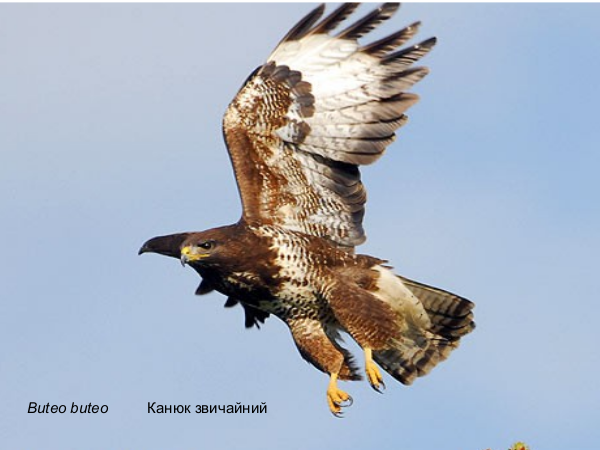
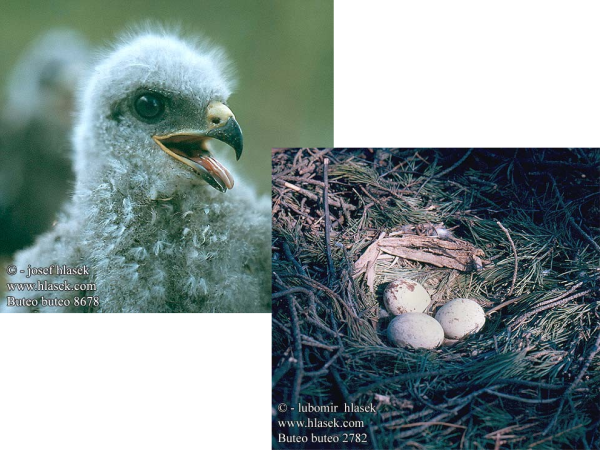
The Common Buzzard (Buteo buteo) also nests in pine forests among the raptors present.
Deep in the forest, on the ground (if you’re lucky), you can see the nest of a wood snipe – the Eurasian woodcock. During the nesting period, it is inconspicuous because it has cryptic coloration – matching the colors of the forest floor. But in spring, during courtship, woodcocks gather in large flocks on the forest edges of oak groves and perform mating flights, “croaking” in the air. Two species of birds of prey, characteristic of the forest-steppe zone of the European part – the lesser spotted eagle and the saker falcon – are now a great rarity. In recent decades, their numbers have sharply decreased, and they now require special protection. The saker falcon usually nests high up, in old crow nests, and sometimes settles in colonies of grey herons. Most often, the saker falcon is identified by its voice – a loud, somewhat nasal and drawn-out “gyak, gyak…”. The lesser spotted eagle is still found in the forest massif of the upland oak grove. During mating rituals, eagles tumble in the air, accompanying their flight with melodious high-pitched calls. The plumage coloration of the lesser spotted eagle varies considerably individually – near one nest, birds of light and dark morphs can be found. The hobby – a purely forest falcon, nests in the nests of corvids, preys on small passerines, which it catches in flight. At night, the call of the grey owl echoes through the oak grove – the male’s is more drawn-out, and the female’s is short, like “kom”. Similar, hoarser calls are made by young owls. The grey owl is a typical inhabitant of oak groves, although it is also found in pine forests. It occupies tree hollows, and more often – semi-hollows (places where trees have broken, where the wood is rotten and decayed. It feeds on mouse-like rodents, shrews, birds (mostly young) – it hunts at dusk along the forest edges. Until September, the owl broods stay together – adult birds bring food to the young. Grey owl
The nightjar is another species whose song can be heard at night. It is most common in pine forests, but also occurs in oak groves. It builds its nest on the ground, in a hollow. It hunts insects at night in forest clearings; it flies quietly because it has soft plumage like an owl. Nightjar
At the forest edges, the Eurasian hoopoe is found – a bird notable for its colorful appearance, a huge crest that it constantly lowers and raises, and a long, curved beak. The hoopoe's song sounds like a quickly repeated “oo-oo-oo-oo” several times. It is a low whistle, similar to the sound produced when blowing into a test tube. The hoopoe can nest in both a hollow and a burrow. The bird becomes noticeable when foraging along forest paths. Eurasian hoopoe
Typical forest dwellers are woodpeckers. The only species in the order Piciformes that is migratory is the Eurasian wryneck. It emits a frequent high-pitched call “kya-kya-kya-kya”. It does not build nests itself, unlike other woodpeckers. It uses old woodpecker holes. Its coloration is cryptic, and it is camouflaged not only by its color but also by the posture it adopts when sitting along a branch and stretching its neck. It can even hiss while doing so, swaying its head. Eurasian wryneck
The middle spotted woodpecker is mostly found in oak groves. It is the “quietest” of the woodpeckers, it does not produce the spring “drumming”. Its call “kik-kik-kik-kik…” is heard more often. Besides the middle spotted woodpecker, the great spotted woodpecker and the lesser spotted woodpecker also inhabit oak groves. They all differ in head coloration and size. Middle spotted woodpecker
Great spotted woodpecker
Lesser spotted woodpecker
In aspen and black poplar stands along the river, the grey-headed woodpecker can be heard. Recently, a new species for this area has appeared – the black woodpecker. It originates from the taiga. In spring, from March, the courtship “song” of woodpeckers can be heard – a “drum roll”, when the bird chooses a dry branch that resonates well and loudly announces itself. Each year, a pair of woodpeckers excavates a new hollow. Tits, nuthatches, flycatchers, etc., settle in old hollows. A new woodpecker hollow usually has a light ring of fresh wood around the entrance. Grey-headed woodpecker
Black Woodpecker
Two more species, whose names contain the word “forest”, are found at the forest edges, but they do not go deep into the forest – the wood pipit and the wood lark. They usually nest on the ground, in a hollow at the forest edge, lining the nest with horsehair and grass. They court at the forest edge, singing in the air. Wood lark
Wood pipit
The loud flute-like whistle “filiu” or “fiu-liu-fiu” can constantly be heard on excursions. This is the Eurasian golden oriole singing. It often accompanies its song with a loud cry resembling a cat’s meow. This call is made by the bird when agitated, but when alarmed near the nest and driving away a predator, the golden oriole modifies its cry into a longer “yarrrr”. The bird builds its nest on the terminal branches, weaving them into the edge of the nest. A grass basket is formed, which swings and at the same time supports the brood of chicks. Predatory mammals cannot reach such a nest. Eurasian golden oriole
Numerous starlings also nest in the hollows of oaks. They raise 3-4 chicks twice a summer. Common starling
A purely forest bird, the largest in the order Passeriformes, the common raven – has recently been found more and more often in urban green spaces. It builds nests in trees, using them every year by adding to them. Such nests can be used by birds of prey – lesser spotted eagles, common buzzards, steppe eagles. In the raven’s nest, chicks appear in early spring, are fed by parents for up to 2 months, and only in June become capable of flight. During this time, adult birds can be seen and heard accompanying 2-3 young. Common raven
Another corvid species associated with forests is the Eurasian jay. It mainly inhabits oak groves, builds small, dense nests in trees, which are later used by other birds (falcons, long-eared owls, buzzards). In cities, the Eurasian jay stays in parks with old trees. Bushes in the undergrowth are nesting sites for the blackcap – the only warbler that lives deep in the forest. The rest are at the edges of the forest massif, in bushes: the garden warbler, the common whitethroat, and the lesser whitethroat. Here you can also find the barred warbler, named for its barred-and-streaked coloration on the underside of its body and the yellow eye color characteristic of males. It stays on slopes overgrown with blackthorn, wild cherry, and other shrubs. Its song resembles the babbling of the garden warbler but contains trilling passages. Like the garden warbler, this bird often sings in flight. Warblers build nests in bushes – tall, deep cup-shaped structures, inlaid around the edge with spider egg sacs. Blackcap
Among the leaf warblers in the oak grove, the most common are the icterine warbler and the barred warbler. The song of the latter is a sonorous, prolonged trill, starting with individual ringing calls. The entire melody sounds like “Tsip-tsip-tsip-tsip-sirrrr”. The barred warbler often sings in the air, flying from one tree to another at a low altitude above the ground. In addition to its song, the male constantly emits a plaintive whistle “tyu, tyu, tyu-tyu-tyutyu”. The icterine warbler can be heard in the oak grove until autumn: “tyut-tiit-tyut-tiit-tin-ton…”. In total, this bird’s song contains up to 43 elements. Both leaf warblers nest on the ground; the nest is a cup-shaped structure lying on its side, lined inside with down. Icterine warbler
Special attention should be paid to observations of the melodious warbler, very common in oak groves. Externally, it resembles the barred warbler. Its greenish-yellow plumage makes it inconspicuous among the leaves, but its loud voice allows its location to be finally determined. The song is striking for its variety of borrowed sounds: sometimes the song of the golden oriole or the wood lark is heard, then the agitated cry of the golden oriole, then the rapid and sharp “kay-kay-kay” of the common kestrel or the battle cry of swallows. Barred warbler
The collared flycatcher is extremely similar to the spotted flycatcher in both appearance and habits, including its song. It sings only slightly higher and merges the sounds more with each other. Only the black-and-white males are noticeable externally. It nests in hollows and artificial nest boxes. It searches for food – insects – on the trunk and side branches. Collared flycatcher
The Red-breasted Flycatcher sings in damp ravines within oak forests. It nests in the open, on stumps. Red-breasted Flycatcher
The Spotted Flycatcher has a short, indistinct song. It can often be seen hunting – it is one of the few species that catches insects in flight. The bird sits on a separate tree branch at the edge of the forest, waiting for prey. Suddenly, it flies into the air, catches an insect, and returns to its perch. The nest is open at the top but is located under some overhang – natural or artificial. Spotted Flycatcher
Robins are numerous in oak forests – birds with a completely red breast, a melodious song with a lot of whistling. Robins nest in the ground layer – in piles of brushwood, leaves, under fallen trees. They can occupy semi-open artificial nest boxes. Robin
Along forest edges, under a strip of bushes on the ground, the Common Nightingale builds its nest. The male usually sits on a bush, announcing that the territory is occupied, while the female incubates the clutch in a hollow on the ground. The nightingale's song is the subject of research for many European ornithologists – it is divided into a basic 'program' and elements that birds learn from each other. The nightingale's song has regional variations. Common Nightingale
During excursions in the forest-steppe oak forest, the songs of the Song Thrush and the Blackbird are constantly heard; both nest in trees – the Blackbird lower, and the Song Thrush mostly from 1 meter to the top. The Blackbird has a nest smeared with soil and lined with grass, but this can look different in different climatic zones. The Song Thrush's nest always has a layer of hard, cardboard-like material on which the eggs lie. The bird smears the nest with wood dust moistened with saliva. When leaving the nest, young thrushes actively move through the forest litter, searching for food – mollusks, large worms, etc. Blackbird
Song Thrush
Great Tits are very common in oak forests, Blue Tits and Marsh Tits are also found – these are cavity-nesting birds. Long-tailed Tits are found in both oak forests and pine forests. They build a spherical nest, weaving lichens and moss from surrounding trees into its walls. Marsh Tit
Willow Tit
Blue Tit
Great Tit
In some forest areas, nuthatches are found in large numbers; their agitated, babbling calls are heard, and the birds themselves are seen hopping on trunks in all directions, even head-down. Nuthatch
The Treecreeper also mainly stays on the trunk – a cryptically colored grayish bird with a long, thin beak. With it, it extracts larvae and insects from under the bark (even in winter). It nests under peeling bark, building a nest from plant down. Treecreeper
The Chaffinch is one of the most numerous species in our forests – oak forests, pine forests, alder groves, poplar groves, etc. It can nest in roadside shelterbelts and in large forest massifs. It builds its nest in the tree layer, in the fork of the main trunk, encrusting the nest walls with lichen. The Chaffinch's song, a complex combination of elements, each repeated several times, ends with a 'flourish'. It has been proven that in different regions, the Chaffinch's song has its own characteristics, so-called 'dialects'. Chaffinch
Throughout the summer in oak forests and on forest edges, the characteristic song of the Greenfinch can be heard – a 'babbling' with a final 'zh-zh-zhik'. The Greenfinch is a resident bird, nesting mainly on coniferous plants (spruce, thuja, fir), but prefers to lay a second clutch on bushes – raspberry, currant, always lining the nest cup with its own down. Greenfinch
Above the treetops – often along the forest edge from June onwards, the Eurasian Goldfinch can be seen – a bright bird with a red head and black and yellow wing patches. It nests in the forks of the trunks of low trees on the forest edge, lining the nest with a thick layer of down. From mid-summer, it becomes noticeable as it switches to a nomadic lifestyle. Eurasian Goldfinch
The Hawfinch is harder to spot even after the nesting period, as it is found in the upper third of the tree canopy. Only in winter, gathering in large flocks with other finches, do hawfinches stand out with their massiveness and significant beaks. The Common Bunting is found exclusively along forest edges, nesting on the ground, in a hollow, which it tightly weaves with grass and lines with down. Common Bunting
Pine Forest
Pure young pine stands support relatively few bird species. This is attributable to the ecological uniformity of such forests, which are typically even-aged plantations lacking understorey shrubs and regeneration. Among songbirds, the Common Chaffinch is the most conspicuous. This bird nests wherever even a small grove of trees exists. Rapidly, within 2–3 seconds and in a single breath, the Chaffinch delivers its trill, concluding it sharply with the so-called terminal flourish; sometimes it adds a brief "ki" sound, as if posing a question. One song follows another. In one hour a Chaffinch may sing more than 400 songs.
Where nest boxes have been erected in pine forest, the Collared Flycatcher should be present, and the European Pied Flycatcher less commonly. Also characteristic of pine stands are the Common Chiffchaff and the Wood Warbler, the Long-tailed Tit, the Great Tit, the Blue Tit, and the Willow Tit. At the margins of pine forests, common species include the Tree Pipit and the Yellowhammer, whose simple yet very pleasant song rings out like a little bell: "zin-zin-zin-zin-zin-zin-say-zee".
The Eurasian Nuthatch is a very numerous bird in pine forest; it nests in old woodpecker cavities, reducing the entrance diameter by plastering it with clay. It runs along trunks with equal ease both upward and head-downward.
Garden Warblers and Wood Larks occur along the edges of pine forest massifs where scrub typically grows. The Tree Pipit is likewise heard along the woodland edge in these situations.
In pine stands where trees are older and may harbour cavities, birds are significantly more numerous. Species diversity of the avifauna increases further if at least a few deciduous trees and shrubs are interspersed among the primary forest-forming species. Among hole-nesters inhabiting pine stands, the Great Spotted Woodpecker and the Lesser Spotted Woodpecker should also be mentioned, as well as the Eurasian Wryneck. In a pine stand with deciduous inclusions (birch copses), another species appears — the Middle Spotted Woodpecker.
Among corvids in the pine forest, the Common Raven may be encountered, frequently soaring above the forest with its call "kruck-kruck". It is the largest member of the family. Its breeding season begins as early as February, and by early June juveniles are already flying with the adults. The most striking corvid, the Eurasian Jay, also occurs in pine forest. Like all corvids, it is omnivorous. Also characteristic of coniferous forest are the Song Thrush and the Eurasian Blackbird. By early summer the thrushes have juveniles from second broods that forage in the forest litter and may be observed there.
The Eurasian Hoopoe also willingly nests in pine tree cavities. Its call "upoo-poop" carries far. Occasionally it is noticeable on a forest track, using its very long, curved bill to collect insects from the ground or extract them from crevices.
The European Nightjar is also typical, though its song must be listened for at night on a dedicated nocturnal excursion.
The Common Kestrel (Falco tinnunculus) occupies old crow nests. Near the nest the Kestrel is very conspicuous. Male and female fly rapidly about, accompanying their flight with a sharp, rapid call "klee-klee-klee-klee-klee ...". When hunting over open ground, the Kestrel characteristically hovers stationary in the air. In recent times this falcon has moved into cities.
The Common Buzzard (Buteo buteo) also nests in pine forests among the raptors present.