

Ecology: Biology of Interactions. II-11. (supplement) The Geochronological Scale
To describe the history of Earth's life, one needs a scale that allows describing the corresponding time intervals. How is this history studied? By the sequence of sedimentary rocks. The mutual sequence of rocks is determined by the nature of their deposition and by the composition of fossils contained in them. Groups of organisms that were numerous in the past and o...
II-11. (supplement) The Geochronological Scale
To describe the history of Earth's life, one needs a scale that allows describing the corresponding time intervals. How is this history studied? By the sequence of sedimentary rocks. The mutual sequence of rocks is determined by the nature of their deposition and by the composition of fossils contained in them. Groups of organisms that were numerous in the past and left well-preserved remains (shells, teeth, scales, etc.) are of great importance for determining the age of rocks and are called index fossils. The agreed sequence of rocks of different ages and the corresponding intervals of Earth's history is called the geochronological scale (Table II-11.1).
Table II-11.1. Geochronological Scale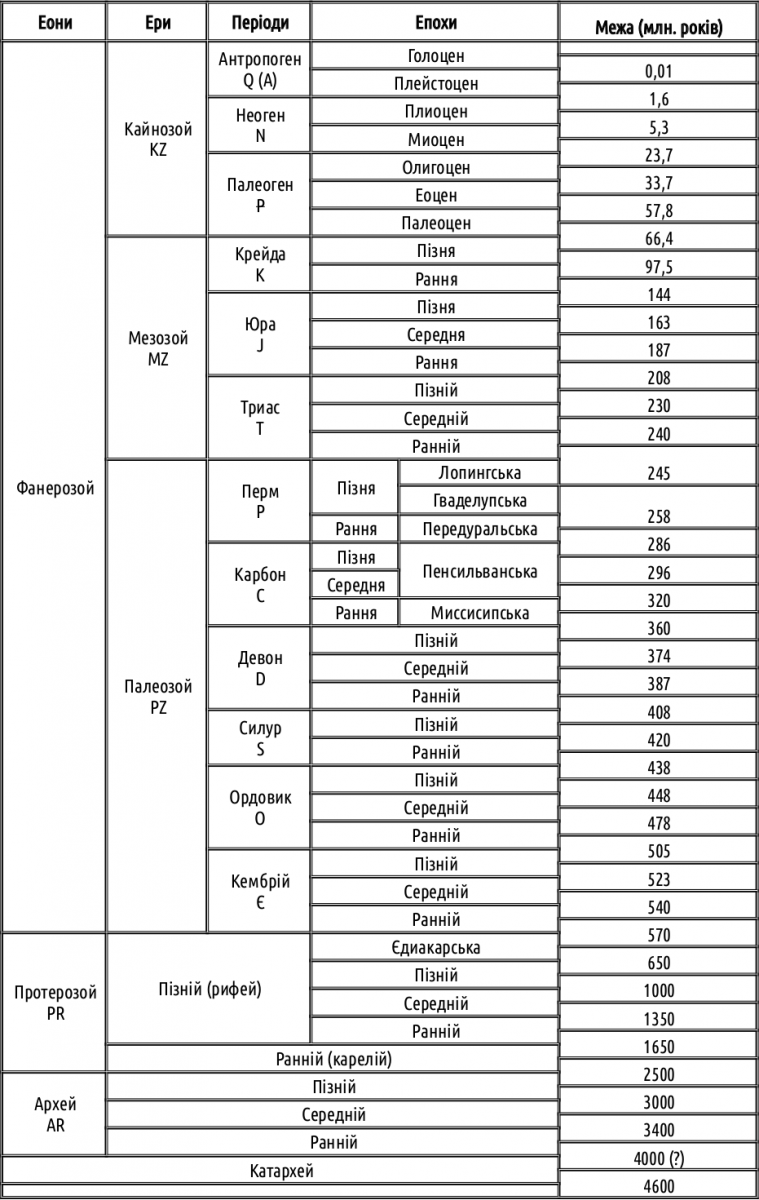
The geochronological scale is the result of the work of many generations of geologists. First of all, it reflects the sequence of time intervals — relative age. In the 20th century, relative datings were supplemented by absolute ones, based on estimating the rate of decay of radioactive elements in the studied rocks.
It should be noted that the relative scale is more precise and informative than the absolute one. For example, both Acanthostega (the earliest known tetrapod) and Panderichthys (a fish very similar to tetrapods but which at the same time could not have been their ancestor) lived in the Upper Devonian. The age of Panderichthys is 378±10 million years, and that of Acanthostega is 360±10 million years. This data is insufficient to confidently assert that Acanthostega lived later. But if it is known that it was found in later (higher-lying) layers, this is sufficient to confidently assert that it is younger, even if the absolute age of the rocks is completely unknown.