
Ecology: Biology of Interaction. I-16. (supplement) Why is the world the way it is? The power of the evolutionary-ecological approach
We give an example of applying the ecological-evolutionary approach to understand why organisms are the way we observe them. The key to explaining the properties of any biosystem lies in considering the features of its relationships with the environment throughout its history. Why does a human have two arms and two legs, rather than resembling a centaur, as in the Menshutkin-Mednikov model experiment?
I-16. (supplement) Why is the world the way it is? The power of the evolutionary-ecological approach
We give an example of applying the ecological-evolutionary approach to understand why organisms are the way we observe them. The key to explaining the properties of any biosystem lies in considering the features of its relationships with the environment throughout its history. Why does a human have two arms and two legs, and not resemble a centaur, as in the Menshutkin-Mednikov model experiment (I-14)? Because the human is an upright-walking representative of the group (superclass) Tetrapoda — Tetrapods. Tetrapods include terrestrial (and secondarily aquatic) vertebrates. Why did vertebrates that came onto land do so on four legs (and not, say, on six like insects)? A detailed answer to this question requires much space, but the logic of it can be laid out briefly here too.
In the era when the body plans of animal phyla were taking shape (the Cambrian period), one of the groups whose descendants are the vertebrates moved to filtering seawater through active swimming. The bottom layers of water at that time (as now) were filtered by representatives of many other animal groups. The rise of filter feeders into the water column not yet filtered by anyone was an effective way of easing competition.
A way of life will be successful if the organism obtains more energy than it expends to obtain it. The energy cost of swimming must be less than the gain that can be obtained from digesting food particles filtered from the water. The most economical way of swimming is the one in which the entire body is used as a paddle, bending smoothly. A flexible cord stretching along the entire body made it possible to store some of the energy spent on bending the body and made swimming more economical. A wave of contractions traveling along the body was provided by segmented muscles.
A way of life can be improved not only by saving energy in swimming, but also by increasing feeding efficiency. Its efficiency can be raised if one consumes not only particles suspended in the water, but also selectively eats aquatic animals (initially small, then larger ones…). That is precisely why some of the active-swimming filter feeders switched to predatory feeding. To catch mobile prey, they had to make their swimming faster and more maneuverable. To provide support for the muscles, cartilage or bones — vertebrae — developed around the notochord in each segment of the body.
Prey hunted by a predator that exceeds it in size tries to escape pursuit through sharp lateral darts. Therefore, the predator needs rudders for swimming. The farther the rudder is located from the body's center, the more effectively its movement will turn the body. Paired fins — the pectoral and pelvic — became such rudders. According to the lateral fold theory (alternative versions also exist), paired fins formed from a skin fold that stretched along the body and was broken up over evolutionary time into separate sections (Fig. I-16.1). The most effective rudders proved to be the anterior sections of such a fold, which became the pectoral fins, and the posterior sections — the pelvic fins (Fig. I-16.2). When the distant descendants of these animals transitioned to life on land, the spine became the body's support — something like a horizontal beam between two bridges — the limb girdles, and the paired fins became limbs. When the descendants of these descendants moved from tree-climbing to bipedal life on the ground, the spine became the vertical support of their body.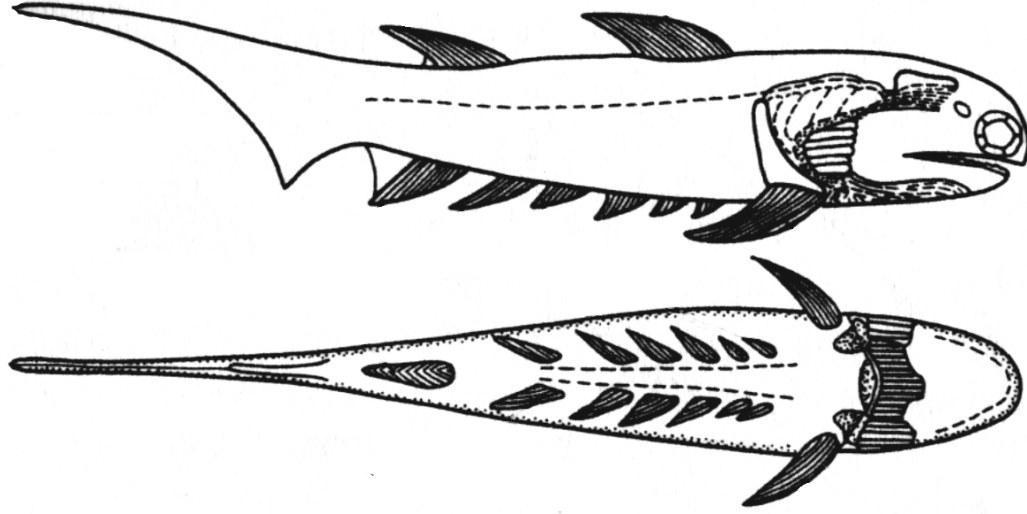
Fig. I-16.1. This Devonian acanthodian (Climatius) retained several pairs of paired fins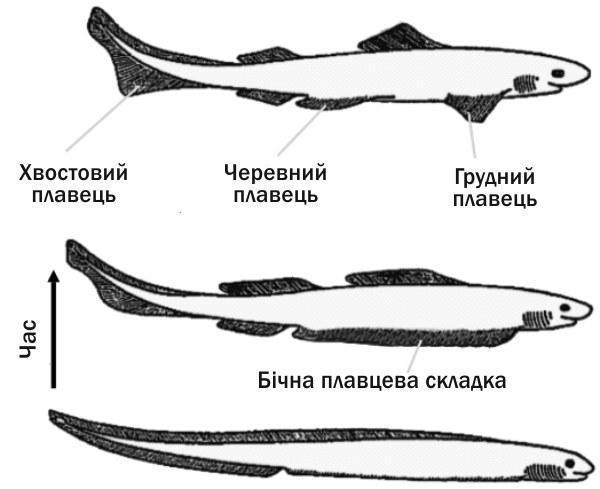
Fig. I-16.2. Development of paired fins from the lateral fold
Note which arguments were used in answering the posed question. They concerned the way of life, the history of development of this group, and its morphological-functional features. Both the history of the group and the features of its structure and functions can be explained only through the consideration of ecological causes related to the specifics of interaction with the environment. The causes of the observed state of biosystems lie in the past!