
Ecology: Biology of Interaction. IV-07. Mutualism and Protocooperation
We noted that mutualism — is an obligate mutually beneficial relationship between populations. How can we establish that certain relationships are obligate? If organisms in mutually beneficial relationships are found in natural conditions only together, this indicates the inseparable nature of their bond...
IV-7. Mutualism and Protocooperation
We noted that mutualism is an obligate mutually beneficial relationship between populations. How can we establish that certain relationships are obligate? If organisms in mutually beneficial relationships are found in natural conditions only together, this indicates the inseparable nature of their bond.
Mutualism is a widespread phenomenon. For example, advanced terrestrial life exists only thanks to mutualistic relationships. The very colonization of land by higher plants occurred through their close interaction with fungi. Traces of mycorrhiza (the etymology of which means something like "fungus-root") have been found on the remains of Devonian plants. Mineral nutrition of land plants is a very complex process, and in many cases it is impossible without fungi. In mycorrhiza, fungal hyphae wrap around plant roots like a sheath, penetrate inside these roots or even inside individual cells. Fungi have a much more efficient mechanism for obtaining minerals than plants, but are limited by a lack of organic matter. Plants transfer some of the organic matter they synthesize to the fungal hyphae, receiving the necessary salts from them.
Endosymbiotic nitrogen fixers, such as Rhizobium bacteria, also participate in mineral nutrition. On the roots of a number of plants (legumes, alder, etc.), special spongy growths are formed, which are populated by bacteria capable of fixing atmospheric nitrogen. Such a process benefits not only the plant itself, which develops nitrogen-fixing nodules, but also other plants, as it leads to enrichment of the soil with Nitrogen.
An important example of mutualism is the relationship between plants and their pollinators. Depending on the degree of connection between two species, their relationship can be classified as either mutualism or protocooperation — depending on whether the plant's connection to its pollinator is inseparable. For example, the honeybee is in protocooperation with a huge number of plants. There are also many cases of very close connection between flowering plants and their pollinators, which are very often reflected in the structural features of flowers (Fig. IV-7.1). 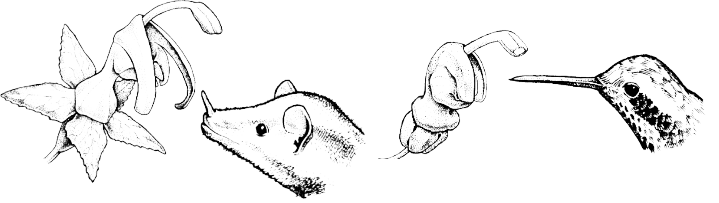
Fig. IV-7.1. 'Intimate' relationships between plants and their pollinators often include morphological adaptations of flowers and feeding organs of pollinators (source, with modifications)
Thus, a developed land plant cover is the result of mutualism between plants and representatives of other groups. But the consumption of plant biomass is also largely associated with similar processes. All herbivorous mammals use, to one degree or another, endosymbiotic microflora of their intestines. In some cases, bacteria capable of breaking down cellulose and synthesizing essential amino acids settle in the hindgut. To benefit from their biochemical activity, rodents and lagomorphs have to eat their own excrement. However, the highest development of endosymbiotic complexes is achieved in ruminant artiodactyls. The stomach of these animals consists of several sections, one of which, the rumen, is essentially a microbiological fermenter — a container for growing microorganisms.
The microflora and microfauna of the rumen of ruminants is very complex and not fully studied. Its essential components include both protozoa (e.g., flagellates and ciliates) and bacteria. The result of this multiple complex's work is the deep processing of cellulose.
An important component of tropical forests, providing rapid decomposition of dead wood and returning the substances that made it up back into the cycle, are termites. The intestines of termites also contain a complex of bacteria and protozoa, and for its efficient operation, termites need to repeatedly eat each other's excrement.
Naturally, mutualism is not only found on land. For aquatic ecosystems, mutualism between animals and various endosymbiotic algae is extremely characteristic. For example, reef-building corals and the largest of mollusks — tridacnas — exist thanks to endosymbionts.
Finally, the classic example of mutualism is lichens — lichenizing fungi. These organisms can only exist in close contact between fungal hyphae and cells of cyanobacteria or algae. Lichenizing fungi have undergone an evolutionary path from parasitizing on photosynthetic organisms to true mutualism.
What organisms can become mutualistic? Necessarily those that differ significantly. If the ecological niches of two populations are similar, i.e., these populations require the same resources, — competition will arise between them. The condition under which mutualism and protocooperation can develop is the difference in niches. Most often, mutualism develops when each member of a pair of species gives the partner a resource that is less valuable to itself, and receives one that is more valuable. The optimal situation is when the waste products of some organisms serve as a resource for others, and vice versa.
As follows from the definition given above (item IV-6), protocooperation is an optional mutually beneficial relationship between two populations. Species linked by these relationships can be found both together and separately.
Probably, protocooperation is much more widespread than commonly thought. These relationships are not limited to the classic school example of 'symbiosis' — hermit crabs placing sea anemones on their shells.
Most often, the boundary between protocooperation and mutualism is very difficult to draw. Which category does insect pollination of flowering plants belong to? If there is deep specialization between certain species, such relationships should be classified as mutualistic. If the same plants can be pollinated by various insects, and those feed on pollen and nectar of various species and can use other food, then we should speak of protocooperation. Sometimes intermediate relationships between these two categories are observed, when one of the species can be found without the other, while the second is entirely dependent on the first in its distribution.
When a phytosociologist (a specialist in plant communities) or a zoogeographer studies the characteristic species composition of certain ecosystems, they register the consequences of protocooperation between many species, without registering their direct causes. The fact that two species occur together more often than separately may be a consequence of their similar environmental requirements, or may reflect the existence of protocooperation between them.
The relationships we have considered may be connected by continuous transitions not only with mutualism, but also with commensalism. In the case of mutually beneficial relationships, the benefit received by two species is by no means always equal. If for one of the species the relationship becomes practically indifferent, they should be classified as a manifestation of commensalism.