
Ecology: Biology of Interaction. IV-08. Commensalism
Commensalism refers to direct or indirect (through the environment) relationships between two populations, from which one — the commensal population — benefits (increases its numbers in response to an increase in the partner's numbers), while the other — the host population — is indifferent to these relationships and does not depend on the numbers of the commensal...
IV-8. Commensalism
Commensalism refers to direct or indirect (through the environment) relationships between two populations, from which one — the commensal population — benefits (increases its numbers in response to an increase in the partner's numbers), while the other — the host population — is indifferent to these relationships and does not depend on the numbers of the commensal. From this definition it follows that the benefit the commensal receives is not associated with any special costs on the part of the host, but is a consequence of its normal activity or vital functions. Most often, commensalism is connected by almost continuous transitions with protocooperation (if the host begins to benefit from its partner) or with parasitism (if the host experiences harm).
Let us consider examples of commensalism, classifying them into four categories (examples are shown in Fig. IV-8.1).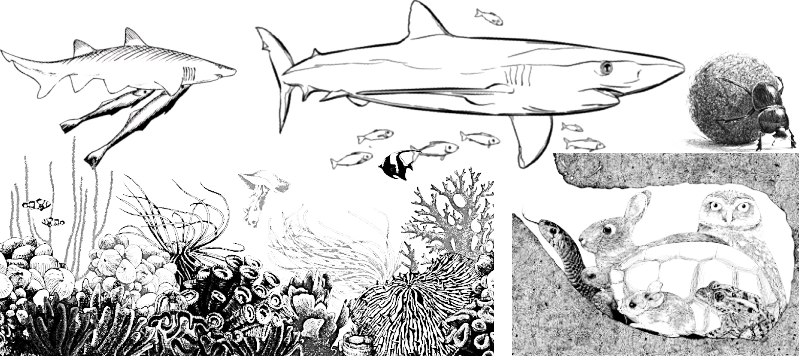
Fig. IV-8.1. Several examples of commensalism (explanations in the text)
Food. The commensal may feed on dead hosts or their parts, as well as on the waste products of their vital activity. Thus, coprophages feed on the droppings of larger animals, and necrophages — on their corpses. Shed skin scales of humans serve as food for various mites living in house dust. Arctic foxes feed on the leftovers of polar bears, and pilot fish — on the leftovers of sharks. Careful study of the relationships between the commensal and the host often shows that the activity of the commensal can have some significance for the hosts. Ungulates have an 'interest' in having the soil surface covered with plants rather than their excrement, while mites in house dust can cause allergic reactions in people. However, with some degree of convention, such relationships are considered commensal.
Shelter and protection. Various darkling beetles, butterflies, frogs, woodlice and many other animals live in the burrows of marmots. In the burrows of North American gopher tortoises, very characteristic communities gather, from snakes to owls. Sparrows build their nests near the nests of eagles and other large birds of prey: those will not allow crows, which raid nests, near their (and thus also the sparrows') clutches. Pipefish hide among the spines of sea urchins. In examples from this very numerous category, the commensal receives from the host precisely a safe shelter.
Dispersal. When moving, animals are capable of carrying on themselves various smaller organisms. Pseudoscorpions (small representatives of the wonderful group of arachnids, some of which live, among other places, in our homes) use flies for transportation. A pseudoscorpion sneaks up to a fly, grabs its leg with its claw, and flies with it to a new habitat. House flies and cockroaches, feeding on our food, carry on their bodies a whole complex of bacteria and fungi. To this same category belongs the phenomenon of piloting — the accompaniment of actively swimming larger animals by smaller ones. The thing is that near a large body moving underwater, turbulence arises, which facilitates the swimming of smaller bodies. Both fish (including the pilot fish that gave their name to this phenomenon) accompanying a shark, and dolphins swimming alongside a fast ship, use this effect. Unlike pilot fish, remoras simply attach themselves to larger animals. The phenomenon of zoochory — the transport of plant seeds by animals — is widely known. Sometimes plants 'attract' animals by providing fruits with fleshy parts edible for potential carriers, and sometimes simply use animals by forming clinging or sticky fruits and seeds. Most often the indifference of commensals to the hosts carrying them is conditional, since it involves some excess costs for transportation or cleaning the surface of their body.
Habitat modification. Most often, the relationships between species that transform their habitat and those that 'benefit' from these changes are not considered as examples of commensalism, although these relationships can also be classified in this category. For example, all specialized components of the flora and fauna of coral reefs, except those connected to corals by exploitation or competition relationships, are commensals of corals, and a multitude of characteristic species of oak forests — commensals of oaks.