Ecology: biology of interaction. I-19. (supplement) Dual-level selection scenarios: Invisible hand, Invisible foot, Invisible head
We will use the concept of the Invisible Hand (© Adam Smith) for cases of optimization consistency at higher and lower levels. In case of contradiction between levels, we will speak of the Invisible Foot (© Herman Daly) in case of victory of the lower level and the Invisible Head in case of victory of the higher lev...
I-19. (supplement) Scenarios of Two-Level Selection: Invisible Hand, Invisible Foot, Invisible Head
Thus, every person endeavors, as far as possible, to employ his capital in support of domestic industry <...>. He generally, indeed, neither intends to promote the public interest, nor knows how much he is promoting it <...> he intends only his own gain, and he is in this, as in many other cases, led by an invisible hand to promote an end which was no part of his intention.
Adam Smith
Air and water are freely used by all, and the result is competitive, wasteful exploitation — what biologist Garrett Hardin calls "the tragedy of the commons," what welfare economists call "external diseconomies," and what I like to call the "invisible foot." Adam Smith's invisible hand inadvertently directs private interest to serve the common good. The invisible foot causes private interest to trample the common good into the ground.
Herman Daly
We have established that the architect of the Universe is natural selection in its broadest sense (paragraph 1.5). As a consequence of this principle, which is closely connected with the Second Law of Thermodynamics, more stable processes (those that with higher probability preserve, restore, or spread their state) displace unstable ones.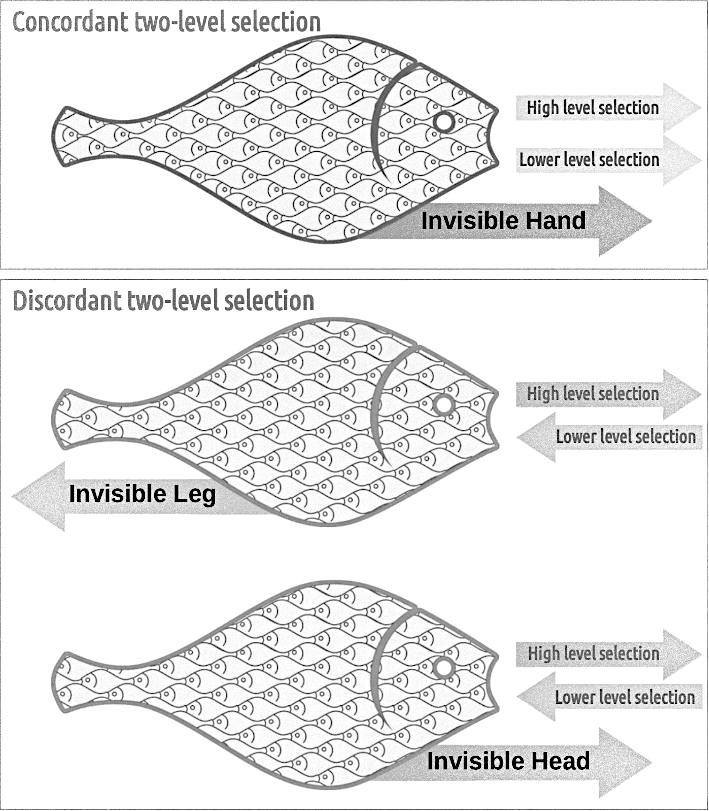
Fig. I-19.1. Metaphors of the Three Scenarios of Two-Level Selection