
Ecology: Biology of Interaction. II-07. Biogeochemical Cycle of Nitrogen
The BGC cycle of Nitrogen is more complex than the Carbon cycle. It is also extremely important for living organisms. Although nitrogen is more abundant in the atmosphere than other gases, its incorporation into living matter is a far more complex task than the fixation of Carbon from carbon dioxide during photosynthesis. The most accessible form of Nitrogen for plants...
II-7. Biogeochemical Cycle of Nitrogen
The BGC cycle of Nitrogen (Fig. II-7.1) is more complex than the Carbon cycle. It is also extremely important for living organisms. Although nitrogen is more abundant in the atmosphere than other gases, its incorporation into living matter is a far more complex task than the fixation of Carbon from carbon dioxide during photosynthesis. The most accessible form of Nitrogen for plants is ammonia and nitrates, but ammonia is toxic in large quantities, while nitrates are not. The forms in which Nitrogen is used in organic compounds are reduced forms, so the assimilation of ammonia requires fewer transformations. Both forms are very easily leached from soils, especially nitrates, because under neutral and alkaline conditions ammonium binds to certain clay substances. When detritus breaks down, reduced Nitrogen is released. Urea is also hydrolysed to ammonia by soil bacteria. Nitrification is carried out by bacteria such as Nitrosomonas, which convert ammonium to nitrite; conversely, bacteria such as Nitrobacter convert nitrites to nitrates.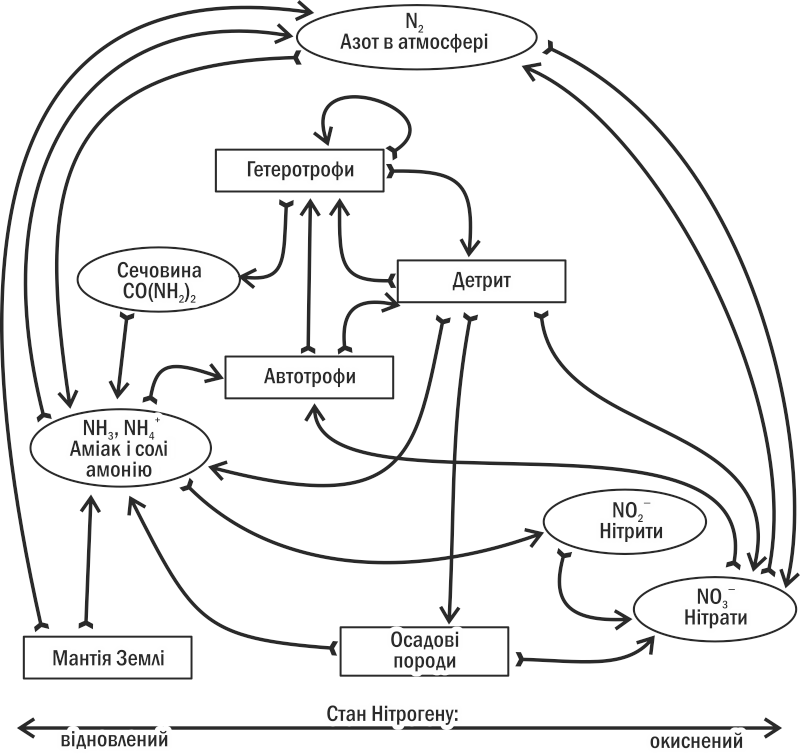
Fig. II-7.1. Global Nitrogen cycle
Nitrite is a frequent intermediate stage in transitions from the reduced form to the oxidised form and in the reverse direction. An excess of nitrates in food is a dangerous consequence of excessive nitrogen fertilisation of soils. During assimilation, nitrates are reduced, passing through the stage of toxic nitrites.
Denitrification is a multi-stage process that proceeds through nitrite and nitrous oxide (N₂O) to molecular nitrogen. The bacterium Pseudomonas obtains the oxygen it needs through this process when there is no oxygen in the soil! Denitrification can also occur without the participation of living organisms. Free-living bacteria include Azotobacter (aerobe) and Clostridium (anaerobe), symbionts of legumes (Rhizobium bacteria), actinomycetes (symbionts of many plant groups, for example, alder), and cyanobacteria Anabaena and Nostoc, all of which are nitrogen-fixing organisms.
The enzyme that fixes Nitrogen is nitrogenase. Its operation requires significant energy expenditure: approximately 10 g of glucose per 1 g of fixed Nitrogen.
Nitrogen can also be fixed by abiogenic means (independently of organisms). For example, during a lightning strike, temperatures in the lightning channel are so high that molecular nitrogen in the atmospheric air through which the electrical discharge passes is oxidised by oxygen.
Since on many soils agricultural plants suffer from nitrogen deficiency, humans intensively produce nitrogen fertilisers, carrying out the industrial fixation of atmospheric nitrogen. Industrial Nitrogen fixation approximately equals natural abiogenic fixation.