
Ecology: Biology of Interaction. IV-11. Parasitism and Parasitoidism
For a parasite, the host is like an island. How to get from one island to another? One solution is to produce and release a multitude of offspring (eggs, larvae, etc.) into the environment, hoping that at least some of them will be lucky enough to reach their «destination». The second solution...
IV-11. Parasitism and Parasitoidism
True parasites (in the sense explained in item IV-9) are very closely associated with their hosts. The parasite lives inside the host's body or is closely attached to its surface. The host serves as the environment or its most important component for parasites. Usually, during their life (or a stage of the life cycle), a parasite is associated with a single host. To use the host, the parasite does not need to kill it at all (sometimes the host dies, but this is not a necessary condition for its use).
The result of the parasite's environment consisting of individual host organisms is the presence in parasites of specific devices for infecting new hosts. For a parasite, the host is like an island. How to get from one island to another? One solution is to produce and release a multitude of offspring (eggs, larvae, etc.) into the environment, hoping that at least some of them will be lucky enough to reach their 'destination'. To estimate how many eggs parasites produce, we can compare parasites with their free-living relatives. Thus, female soil roundworms produce a few hundred or even dozens of eggs during their lifetime, while female human roundworms (intestinal parasites) — 50–60 million!
The second solution that allows parasites to colonize new hosts is to use some other organisms to jump from host to host. Complex life cycles arise, in which sexual reproduction of the parasite occurs in the definitive host, and intermediate stages, including those capable of asexual or parthenogenetic reproduction, live in intermediate hosts.
The host serves as both an energy source and an environment for the parasite. The consequence of this is that parasitic species over time undergo a much deeper restructuring of their body structure than, say, predators. Such restructuring may involve serious simplification of some organ systems and, on the contrary, improvement of others.
One of the vivid examples of simplification of parasite structure is the barnacle Sacculina (Sacculina carcini), a distant relative of acorn barnacles (Fig. IV-11.1). If not for the larval stage characteristic of barnacle crustaceans, it would be impossible to guess the systematic affiliation of the adult animal from its structure. The adult Sacculina is a formless sac of reproductive products hanging under the abdomen of a crab and receiving the necessary nutrients through root-like outgrowths that penetrate the entire body of the host.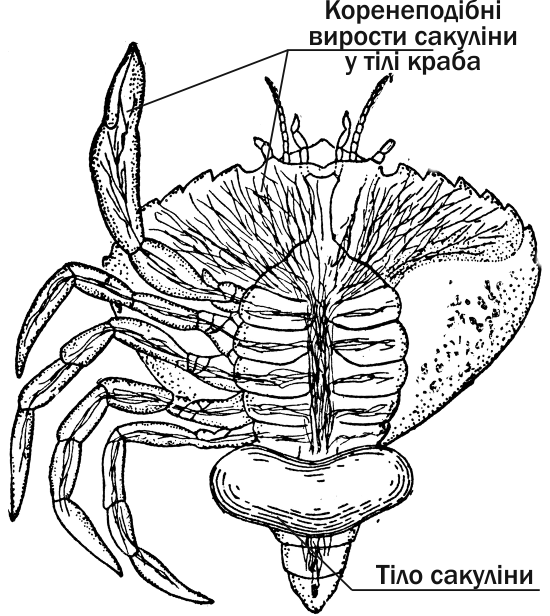
Fig. IV-11.1. Sacculina (Sacculina), a parasitic barnacle crustacean, in the body of its host — a crab. The sac-shaped body of the parasite, devoid of limbs, intestine and even traces of the segmentation characteristic of arthropods, is located under the abdomen of the crab, and its outgrowths penetrate the entire body of the host. Drawing from the book by Ernst Haeckel 'Art Forms in Nature' (1904)
Most often, specialized parasites quite effectively 'break' the defense systems of their hosts. This is related to the different efficiency of selection: for the parasite, overcoming the host is a matter of life and death, while for the host it is only a problem of saving certain resources. It can be said differently: all the ancestors of any parasite successfully broke through the defenses of their hosts (otherwise they would not have left offspring), while many ancestors of any host fed a certain number of parasites. The result of this is that specialized parasites could often destroy their host. However, such a strategy is disadvantageous: by destroying all hosts, the parasite would destroy its own living environment. Evolutionarily old parasites, well adapted to their hosts, usually cause mild diseases. However, if parasites were to completely stop exploiting their hosts, they would not be able to reproduce and infect new organisms. The optimal strategy for a parasite most often is to intensively exploit some individuals of the host population (weak, old, sick, as well as representatives of other species besides those with which the parasite is closely associated), and to exploit the remaining individuals weakly. An adaptation for implementing such a strategy is the ability of the parasite to exist in two phases: an active phase and a dormant phase. The transition to the active phase may be triggered, for example, by hormonal changes in the host's body (its prolonged severe stress).
Most often, the most dangerous parasites are those that have transferred to a new host species and do not have adaptations for preserving their lives. Thus, the most dangerous human epidemics are caused by plague (a bacterium that parasitizes rodents), influenza (a virus that parasitizes birds), HIV (a virus that came to humans from other primates), coronavirus SARS-CoV-2 (the causative agent of COVID-19, which was obtained from some other species of animals), and many other 'arrived' parasites. Such parasites have not yet had time to sufficiently hone the adaptations that allow them to exploit the host and preserve its numbers.
Very illustrative results were obtained in experiments in which a culture of house flies and parasitoid wasps that exploit them were raised together (Fig. IV-11.2). If flies and wasps that had not previously contacted each other were placed together, sharp fluctuations in the numbers of both species were observed in the experimental setup. If two interacting species were raised together for two years, their numbers remained quite stable. This result reflects the adaptation of the two interacting populations.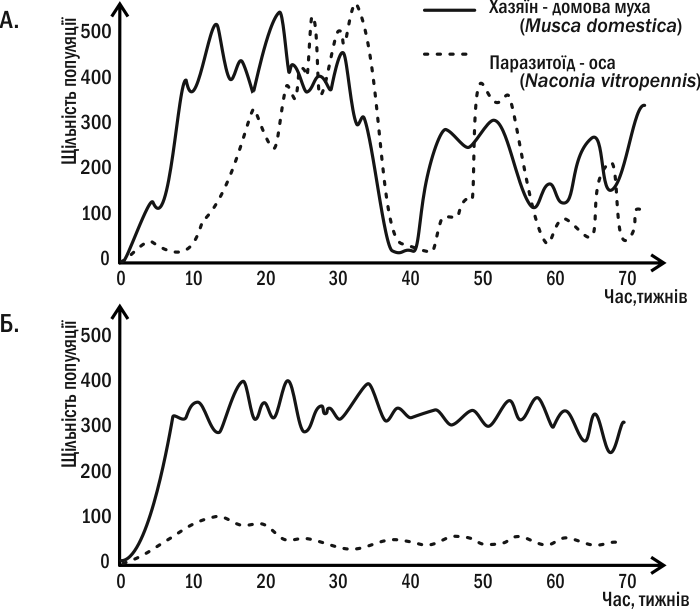
Fig. IV-11.2. Adaptation of host and parasitoid to each other. The graphs show the population dynamics of two insect species raised in an experimental setup of 30 interconnected chambers. A. Cultures of host and parasitoid had not previously contacted each other. B. Cultures of host and parasitoid were raised together for two years