
Ecology: The Biology of Interaction. V-07. Shelford's Principle of Tolerance and Concepts Describing Tolerance
V-7. Shelford's Principle of Tolerance and Concepts Describing Tolerance
And so the craftsman fears his craft,
for he knows a host of dreadful words.
(Proverb; author unknown)
Which of the resources turns out to be limiting is determined by Liebig's law of the minimum. However, not only resources can be limiting — conditions can be as well! What rules govern their action?
In 1913, the American ecologist Victor Shelford put forward the principle of ecological tolerance (endurance). According to this rule, for each factor there exists a range of ecological tolerance bounded by lower and upper cardinal (critical) points, within which zones of suppression and well-being can be distinguished. Unfavourable (and limiting) conditions can include both high and low values. Therefore, the organism's response is zero at both excessively low and excessively high values of a condition important to it (Fig. V-7.1).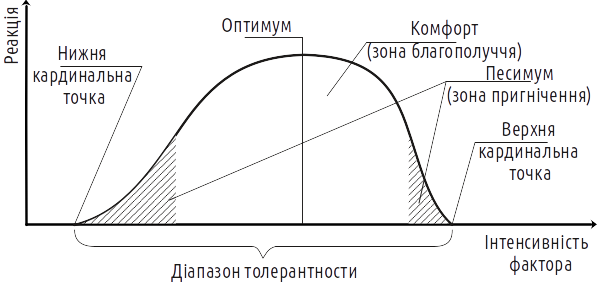
Fig. V-7.1. The response of an organism to the value of an ecological factor (condition) — explanation of Shelford's tolerance rule
Shelford's principle can be stated as follows. Among the values of any given condition there is a certain tolerance range — the interval within which a given organism can exist. The optimal value of the condition lies within this range. The further the value of the condition deviates from the optimum, the greater its adverse effect on the organism. The limiting condition turns out to be that condition, significant for the organism, whose value deviates most from the optimum.
Liebig's law and Shelford's principle can be regarded as components of the rule of the limiting factor. F. Clements and W. Shelford advanced in 1939 the concept of the primary cycle (as many basic cycles occur, for example cell divisions, as the full complement of resources allows and as other factors permit). A. Thienemann proposed in 1942 the rule of the weakest link in the chain ("an organism is no stronger than the weakest link in the chain of its vital requirements"). It should not be forgotten that many phenomena influencing which factor turns out to be limiting are not accounted for in these generalisations. These include, in particular, the probabilistic nature of many interactions, the phenomenon of biological compensation, the complex nature of the interrelationships between factors, and the manifestation of population and ecosystem regulatory mechanisms.
Different organisms differ both in the breadth and in the specific values of their tolerance ranges. The breadth of the tolerance range is indicated by the prefix "eury-", and narrowness by "steno-". Adaptation to high values of a given factor is indicated by the prefix "poly-", and to low values by "oligo-". Thus, with regard to temperature, organisms can be classified as eurytherms, stenotherms, oligotherms and polytherms. The copepod Copilla mirabilis cannot tolerate temperatures outside the range of 23–29°C, while Gmelin's larch (Larix gmelinii) can withstand temperature fluctuations from +30°C to –70°C.
The root "-haline" is used in terms describing tolerance to salinity, "-oxybiontic" to the oxygen content of water, "-hygric" to moisture, and so on. With regard to overall breadth of ecological niche, eurybionts and stenobionts may be distinguished. For example, the brown trout (stream trout, Salmo trutta) is a stenooxybiontic and polyoxybiontic species, while the crucian carp (Carassius carassius) is a euryoxybiontic one. The hooded crow (Corvus cornix), found in a great variety of habitats, is a eurybiontic species, while the black woodpecker (Dryocopus martius), associated with a strictly defined type of old-growth forest, is stenobiontic.
Tolerance limits differ for different developmental stages of organisms, for different sexes, and for different processes. Aquarium enthusiasts are well acquainted with the generative stenothermy (and more broadly, generative stenobioncy) of many aquarium fish. Keeping adult fish alive is far easier than achieving their reproduction in captivity and keeping the young alive.
The eminent botanist and ecologist Leonty Grigoryevich Ramensky formulated the principle of the individuality of species ecology (more precisely, their uniqueness), according to which each species is characterised by unique requirements specific to its habitat.