
Ecology: The Biology of Interaction. V-08. "Factor Interaction" and Hutchinson's Niche
V-8. "Factor Interaction" and Hutchinson's Niche
As we have already noted, the ecological environment is a single whole, and any organism is simultaneously affected by the entire combination of factors. Similarly, the organism's response to the environment is also a single whole. Naturally, within the organism's response one can identify more and less important components. For example, a person who is cold will spend a significant part of their energy warming their body (shivering, moving intensively, seeking a warm place), while a hungry person will strive to obtain food. Whichever factor is currently most unfavourable will elicit the most pronounced response from the organism.
But what if a person simultaneously feels both cold and a lack of food? It will be harder for them to combat each of these factors! When there is sufficient high-calorie food, it is easier to resist the cold; a person who is cold becomes exhausted from hunger much more quickly than one who is in comfortable thermal conditions. Thus, the organism's responses to these two factors influence each other. It is said that in this case an interaction of two factors is observed.
Note that in the example considered, we were not speaking of the interaction of two factors in their physical sense, but rather of the interaction of the organism's responses to their effects. At the level of linguistic constructions, we once again confirm that for ecology what matters is not the factors in themselves, independently of the organism, but their action on the creature from whose perspective we are evaluating the ecological environment.
Did you know that in a sauna (Finnish bath) with dry air, a person can easily tolerate a significantly higher temperature than in a humid bath? This is related to the fact that in dry air, the surface of the skin, the mucous membranes of the respiratory tract and the lungs are cooled through the evaporation of water from their surface.
When characterising the severity of frost, one can use not only temperature values. Frost is characterised by its harshness, which takes into account both temperature and humidity, as well as wind strength. Even without resorting to such extreme examples, we can observe the interaction of factors such as temperature and humidity (Fig. V-8.1).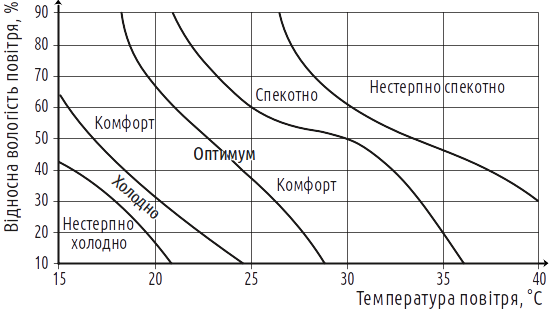
Fig. V-8.1. The response of a lightly dressed person to different values of temperature and air humidity in an enclosed space
Very different factors in their biological nature can interact. In botanical gardens, plants from other climatic zones often grow in open ground. This means the local climate can suit exotic plants! However, in the wild, the same plant species cannot establish themselves. This is because in botanical gardens, gardeners weed the beds, removing competitors of the cultivated species. It follows that the ability to compete against rivals depends on the climate!
The result of factor interaction depends on their specific nature and the mechanisms of adaptation to their adverse effects (Fig. V-8.2), but we can nevertheless name one general rule describing such interaction. Unfavourable values of one factor narrow the tolerance ranges to other factors.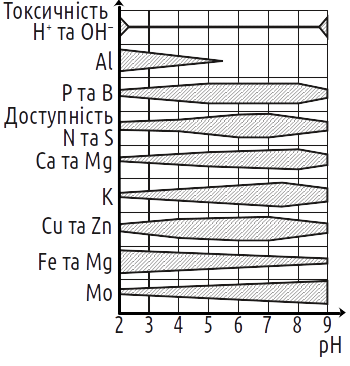
Fig. V-8.2. The effect of pH (acidity) of the soil solution on the availability of various mineral nutrients for plants
The responses to interacting factors may be linked within one or another physiological balance of the organism: water balance, heat balance, energy balance, etc.
Factor interaction can be represented using the concept of the ecological niche according to Hutchinson, proposed in 1957. Up to that point, the concept of the "ecological niche", introduced by J. Grinnell and C. Elton, had been interpreted as pertaining to community ecology. The American ecologist and hydrobiologist George Hutchinson reconceptualised it.
Hutchinson's reasoning was as follows: imagine that as a first step we plot on a linear axis the tolerance range of the species of interest to us, corresponding to some factor. As a second step, we add another axis corresponding to another factor important to this organism, and plot the corresponding tolerance range on this axis. Once we have characterised the tolerance limits for two factors, we add a third, a fourth... — as many as are needed to characterise the main requirements of this species.
As a result of these operations, we obtain a hypervolume (multi-dimensional volume) in factor space, encompassing those combinations of values under which the existence of the species under consideration is possible. We shall call this the ecological niche according to Hutchinson (Fig. V-8.3). A two-dimensional niche could be imagined as a rectangle in a two-dimensional space of two traits, and a three-dimensional one as a rectangular parallelepiped. However, an organism is unlikely to be able to tolerate the simultaneous adverse effects of all three factors at once (the case corresponding to a corner of the parallelepiped). The most favourable conditions for the organism are found somewhere inside the niche, while unfavourable ones are at the edges (Fig. V-8.4). If the factors (more precisely, the responses to them) interact, the actual shape of Hutchinson's niche will be different. The fact that an unfavourable value of one factor narrows the tolerance range to other factors manifests as a "rounding" of the corners of the multi-dimensional niche.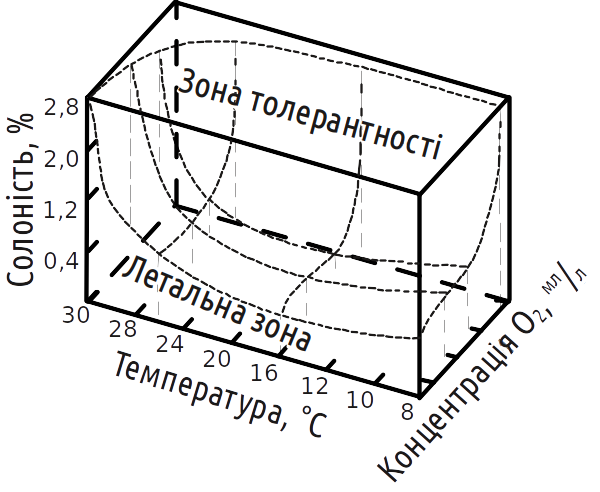
Fig. V-8.3. The ecological niche according to Hutchinson, defined by three factors (temperature, oxygen concentration and salinity) for a lobster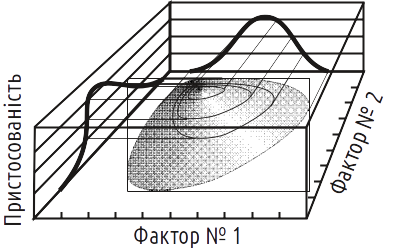
Fig. V-8.4. The space inside the niche is not homogeneous. Shown here is the variation in fitness levels for a two-dimensional ecological niche according to Hutchinson