
Ecology: Biology of Interaction. VI-02. Unique Ecological Features of Humans
VI-2. Unique ecological features of humans
Do you think it is all that simple? Yes, simple. But not at all like that.
Albert Einstein
To identify the unique features of our species, one should compare human populations with the populations of any other animal species ecologically — that is, from the perspective of the exchange of matter, energy, and information.
All animals exist as part of populations — collections of individuals that inhabit certain habitats and exploit their resources. This also applies to cosmopolitan species found throughout the Earth. Humans are not merely a cosmopolitan species but the only global species. Humanity is not simply a collection of individuals of the species Homo sapiens Linnaeus, 1758, but an entity with properties absent in its parts. Try to imagine an analogous concept applied to any other species!
The difference between a cosmopolitan species and a global species lies not in distribution but in the nature of interaction between populations. For example, the grey rat is a cosmopolitan and lives almost everywhere humans do, and even in some additional places. But each rat population exists only thanks to the resources of its own habitat. Empty the storehouse, and the rat population living in it will disappear. Some individuals will perish, others will migrate elsewhere. But two rat populations will never exchange resources with each other.
In which countries were the items that most of us use daily manufactured? Resource exchange between populations is a typical feature of our species. We know various forms of such exchange — from trade to war or even humanitarian aid. Today, it is not n human populations exploiting the resources of n habitats, but a single humanity exploiting the biosphere as a whole.
The well-known Israeli historian Yuval Noah Harari draws attention to the fact that our species is the only one capable of flexible cooperation among large numbers of individuals. There are several mammal species — wolves, elephants, dolphins, chimpanzees, and so on — that are capable of flexible cooperation among small numbers of individuals. There are several social insect species — bees, ants, termites — that are capable of cooperation among very large numbers of individuals, which is not flexible and which enacts innate forms of behaviour. It is our species that combines both these capacities. Clearly, during our emergence, a transition occurred from flexible cooperation in small groups (where all individuals know one another) to similar behaviour within large groups.
Another important feature concerns the nature of the tools humans use. The surface-level feature of our tools is that they are more complex than those of other species. But that is not the main difference. Tools can be divided into two groups: those that function thanks to the energy of the human using them (a shovel), and those that themselves transform energy and resources (an excavator). Between these two categories lies a transitional one — tools that use the energy of other animals (for example, a plough pulled by livestock). The use of the intermediate category is not a unique feature of humans (the extended phenotype, as described by R. Dawkins, of many animal species includes manipulation of other species), while the use of the second category is our unique feature. Its first example was the use of fire.
These two basic features of humans (resource exchange and the use of external energy-transforming processes) were in evidence at least at the level of Homo erectus. Today's global humanity is the logical development of the consequences that follow from these acquisitions.
The maximum ceiling of energy flow transformed by all other animals is determined by current primary production (the quantity of bound solar energy). Humanity has surpassed these limits thanks to yet another unique trait: the use of fossil fuels (primary production from past geological epochs, preserved in the form of coal, oil, gas, etc.) and even nuclear energy (Fig. VI-2.1).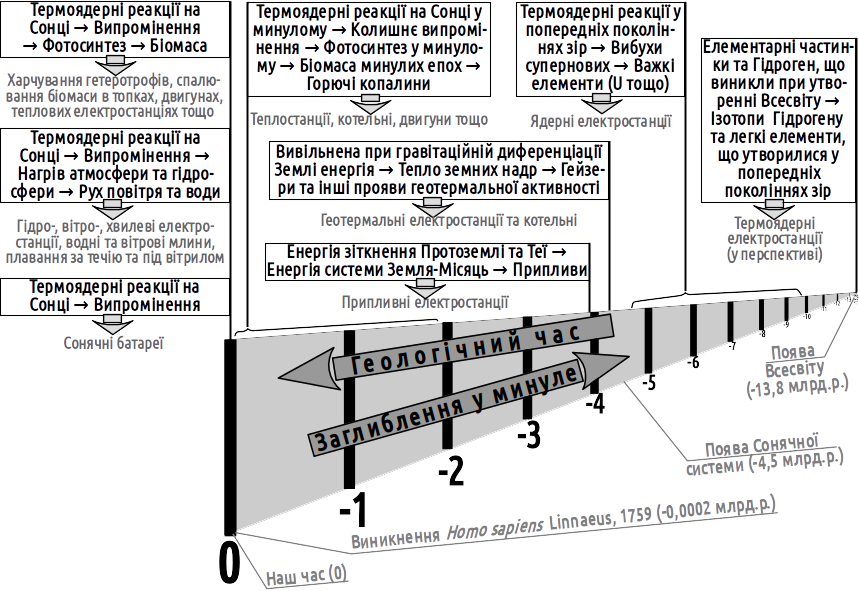
Fig. VI-2.1. By mastering new ways of obtaining energy, humanity transitions from using current solar radiation to 'unlocking' ever older energy sources.
A fundamentally new feature of humans from this perspective is that they sustain their current way of life by exploiting non-renewable resources. For modern humans, this is an inseparable part of their way of life (part of their ecological niche). This makes our existence particularly unstable — the character of humanity's relationship with the environment that has developed in recent decades cannot be sustained over a long period of time. According to a rough estimate, humanity now destroys in a single year as many fossil fuels as were formed over a million years!
All living organisms employ various means of exchanging information, but only in humans has information exchange transcended distance (we are interested in events from the other side of the planet) and time — at least in one direction (we read texts written by long-dead people). This became possible thanks to the emergence of powerful information-transfer channels unrelated to the functioning of our bodies (writing, electromagnetic and optical methods of recording and transmitting data).
The greater part of the energy it uses, humanity transforms not through its own body but by means of the technosphere — a separate part of inanimate nature that possesses many properties of the living (the technosphere is characterised by metabolism, technical evolution, the 'life cycle' of individual units, and so on). The activity of the technosphere is also associated with the release of xenobiotics (substances alien to the living) into the biosphere.
The waste products of technology that enter the biosphere as a result of human activity have an important quality absent from the waste of all other species. Their quantity in the biosphere is not regulated by natural processes. The quantity of any substance entering the biosphere as a result of some natural process is reduced by an oppositely directed process. It could not have been otherwise, since the global system we observe is relatively stable. But humans bring about rapid changes by initiating new processes whose results are not regulated within the biosphere.
The list begun here could be continued, but it cannot exhaust the specific characteristics of humans. Even a few thousand years ago the features listed above were not characteristic of our species, yet it already stood apart among other animals. By virtue of what?