
Ecology:the biology of interactions. VI-01. Humans and other animals
"Quarter" last. HUMANKIND AND ITS FATE
VI. Chapter. Human Ecology and Biosphere Conservation
VI-1. Humans and Other Animals
Is it offensive to humans to be classified as animals? When in everyday life someone is called "like an animal," it is usually meant to show that they act in a manner unworthy of a human. Many of us find the phrase "humans and other animals" impossible or offensive. For example, what would a physiology textbook for biology departments at universities be called? "Human and Animal Physiology!" Such grammatical constructions push us to perceive ourselves as fundamentally different from other animals. These outdated linguistic constructions should be overcome, and the patterns they impose should be discarded.
Is it good or bad that humans are animals? The question posed makes no sense. "Good," "bad" — these are ethical evaluations. They make sense for evaluating situations where choosing different courses of action is possible. The choice of a human who could, say, strike or refrain from it admits moral evaluation; we can evaluate their action as good or bad. Homo sapiens Linnaeus, 1758 is an animal, that is, belongs to terrestrial multicellular eukaryotes that feed on other organisms or their parts, consuming them in the form of separate particles; here no choice exists. By the way, the previous sentence contains the full zoological name of our species, including the surname of the scientist who assigned this name and the year of description. Like other natural facts (that Earth revolves around the Sun, that a water molecule consists of two hydrogen atoms and one oxygen atom, that women differ from men, etc.), this circumstance is neither good nor bad; it simply is the case to the extent that it follows from the scientific worldview.
It should be especially emphasized that the fact under discussion (that humans belong to animals) is also not an attempt to disprove faith. Science and religion are fundamentally different from each other. Science is a way of constructing reliable and practical knowledge based on facts. Strictly speaking, there is no absolute truth in science — there are only conclusions consistent with facts that deserve trust. That our species is one of many animal species is not a postulate but the only explanation that fits well with the entire body of natural facts. Unlike science, religion is based on faith and divine revelation. The main questions for religion cannot be questioned. Since we are interested in science, we will not encroach on the territory of religion and simply note that our conclusions and reasoning pertain to an entirely different domain. One of the greatest thinkers of the 18th century, Wolfgang Goethe, argued that there are always two main questions: "why" and "how," and these questions should not be mixed. The second question belongs entirely to the competence of science; it is precisely this that we deal with in our course.
Genetically, physiologically, biochemically, humans are flesh of the flesh of Earth's fauna (and, more broadly, of the entire biosphere). Today, abundant evidence has been gathered of its gradual emergence during the evolution of life on Earth. The genealogical tree of humans has turned out to be much more complex than it seemed a century ago, since our group developed along several independent branches. For example, 50,000 years ago, at least three (more likely — four or more) species of the genus Homo inhabited Earth (see section VI-22)!
Comparative studies of humans and so-called anthropoid apes conducted recently have shown their exceptional closeness. Until recently, humans and, for example, chimpanzees were placed in different zoological families: humans in the family Hominidae — Humans, and anthropoid apes in the family Pongidae. According to a recent decision by leading primatologists (specialists in studying the order Primates), chimpanzees, gorillas, and orangutans should be placed in the family Hominidae. This fact has not yet been properly realized by society: in the opinion of zoologists, chimpanzees, gorillas, and orangutans are humans! This is compensated by the fact that the name "Hominidae" has begun to be translated not as "Humans" but as "Hominids." On the other hand, Homo sapiens is an ape. Since the 19th century, the order Primates has been divided into two suborders: Prosimians (Prosimii) and Apes (Anthropoidea). We belong to the second group.
Why do we devote so much attention to this question? In studying the world, humans come to know themselves from new perspectives. One of the definitions of ecology that we gave at the beginning of this course was: ecology is the science about the interconnections that ensure the existence of organisms (including humans) and supraspecies systems: populations, ecosystems, and the biosphere. Today, human existence is under threat. If we want to solve the tasks facing us, we should rid ourselves of any prejudices!
With the appearance of a world humanity, Earth's biosphere transitioned into a new state. As becomes clear from what follows, humans have several important differences from other animals, however, strangely, these are not the differences that people usually think of first. To formulate the fundamental differences of humans from other animals, let us first consider those differences that are not fundamental.
Undoubtedly, humans have many important quantitative characteristics. For example, the number of humans (and even domestic animals) is extremely large (Fig. VI-1.1). The number of people exceeds by approximately 100,000 times the normal for the biosphere number of animals of comparable body size! The amount of energy converted by our species is incomparably higher than this indicator for any other species.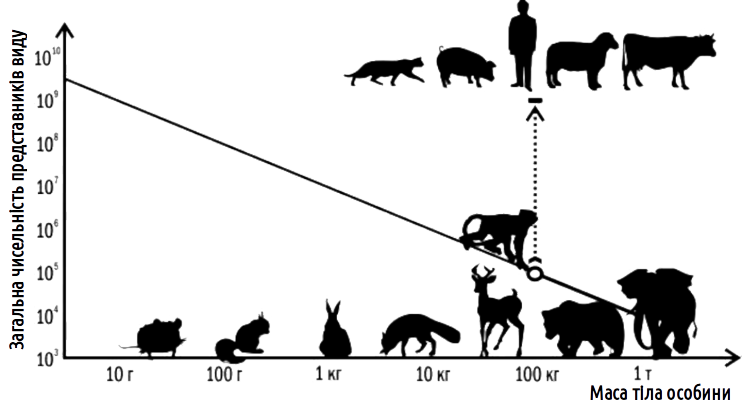
Fig. VI-1.1. For mammals, a rather rigid dependence is characteristic between body size of an individual and the number of species in the biosphere. Our species and closely related domestic animals "break out" of this dependence by several orders of magnitude
Recognizing the importance of quantitative differences, let us, however, turn to other, fundamental ones. In what way do humans differ fundamentally from other animals? From the experience of discussing this topic, some of the most frequently offered answers can be considered.
"Humans are intelligent." It is difficult for us to know what is happening in the psyche of our neighbor, let alone animals. One way or another, the psyche of highly developed animals and humans alike ensures their interaction with the surrounding environment and adaptation to it. What happens inside this "black box" is very difficult to describe and name. Perhaps this answer is correct, but we should not limit ourselves to it. In what externally manifested features are the unique properties of our species expressed?
"Humans use abstract symbols (the second signal system)." To inform other bees about the location of a food source, a scout bee performs a special dance, running in a "figure eight." The number of abdomen oscillations while running through the central part of the figure means the distance to the food source, and the angle of this part relative to the vertical indicates the direction of flight angle in relation to the Sun with correction for its daily movement! We see here too the use of abstract symbols.
"Humans create a model of the world in their psyche and are guided by it." From the inclination of the axis of bee dances, one can establish where, in their calculations, the Sun is. It turns out that in their model of the world, during the day the Sun gradually moves from east to west above the Earth, and at night — from west to east below the Earth (bees "use" a geocentric system). They differ in this, for example, from fish capable of orienting by the Sun, which demonstrate that in their model the Sun at night "moves" from west to east above the Earth, remaining invisible.
"Humans live in society." Countless species of animals live in society — from social insects to flocking and herding mammals. Human social behavior is connected by many similar traits with that of other primates.
"Humans are capable of learning." Have you seen how a trained dog differs from an untrained one? And doesn't an old hare surpass a young one in the ability to escape from predators?
"All animals change themselves, adapting to the environment, while humans change the environment." A marmot digging a hole changes the environment in the desired direction. Getting used to the cold in winter, we change ourselves — recall, at 0°C in autumn our face is cold, but in spring it is not.
"Humans are capable of working." And what do wasps do, obtaining sweet pieces for themselves and protein food for their larvae?
"Humans create artificial ecosystems." Beavers create dams up to a kilometer long, flooding attractive forest sections. They have two goals in this: to reach food plants and to protect themselves from predators. The dam's construction depends on local conditions, is constantly repaired and strengthened with branches and mud.
"Humans can destroy their habitat." Consider the sad story of yeast that settled in grape juice and processed sugar into alcohol until the alcohol-saturated environment became unsuitable for their life.
"Humans build cities and use other species." Leaf-cutter ants fill the underground chambers of their nests with chewed leaves, grow certain fungi there (fighting "weeds") and feed on parts of these fungi's bodies. Ants are also capable of "animal husbandry," growing aphids.
"Human actions are purposeful." Humans are capable of acting both purposefully and making astonishing mistakes and simply senseless actions. The same can be said about most animal species. Surely, each of us, turning to our own experience, will find countless confirmations of this opinion. During compulsory service in the Soviet Army, one of the authors of this manual saw two servicemen sawing a leaning tree with a two-handed saw from the side toward which the tree was leaning. The author's warning that the tree would jam their saw provoked verbal aggression from them. When the saw became stuck, they tried to chop it out with an axe and again chopped "at the incline." When the tree (quite predictably) jammed the axe as well, their commander ordered to pull the tree with a vehicle. The fallen tree damaged both the automobile and the driver. The actions of these people can hardly be considered purposeful.
"Humans are the only animals that are ashamed of nudity." Certainly, shame was the first acquisition of Adam and Eve after partaking of the fruits of the tree of knowledge of good and evil. However, in many primates, a male's display of his genitals is a challenge to other males, leading either to their submission or to conflict. A female, displaying her genitals to a "foreign" male, signals her sexual readiness and may provoke aggression from a dominant male. The mechanism for avoiding conflictive situations transformed into what we call shame. Other species also have behavioral mechanisms that allow them to avoid conflicts.
"Humans are capable of harming their own health." Beetles of the genus Lomechusa can live in ant nests, producing narcotic substances from which ants stop performing necessary work. Ants take every care of these beetles and may breed them in numbers leading to the ant colony's death.
"Humans feel friendly feelings toward their relatives." Tadpoles of frogs swim in schools. They choose schools that include their relatives (with full siblings more attractive than cousins). From schools formed by non-relatives, tadpoles choose "acquaintances" — those they had been in the company of before.
So, do humans not fundamentally differ from other animals? No, they differ, and very substantially.