
Ecology: biology of interaction. I-07. Properties of complex systems
The more integrated a system is, the harder its mosaic description becomes. A reductionist view is necessary but insufficient: emergent properties arise from interactions and cannot be fully inferred from isolated parts.
I-7. Properties of complex systems
“When I look at a cow grazing in a meadow, all I see is the crazy dance of electrons.”
Unknown author (quintessence of biological reductionism)
Can one study complex systems like those in biology using only a reductionist approach? Can one do without it?
“The task of defining the object of a science is to separate it from objects of other sciences. In biology, this was hindered by philosophical prejudices not yet fully overcome. I mean reduction of more complex forms to simpler ones, and the tendency to regard those simpler forms as more ‘true’ or ‘real’ than the complex forms from which they were abstracted. The first is a legitimate and necessary scientific method. The second is poor philosophy...”
...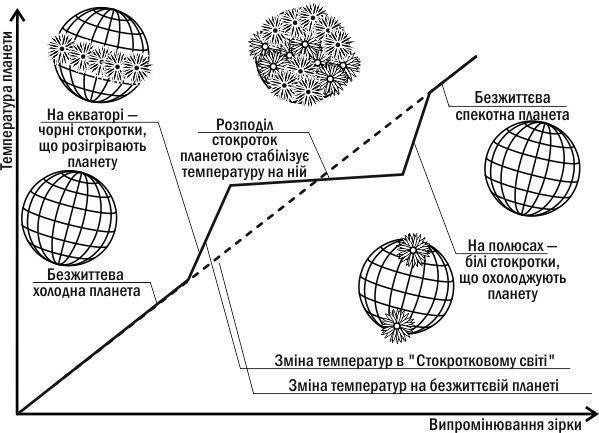
Thus, if components interact in certain ways, they can alter environment properties in directions favorable to themselves.
“Therefore, even such a super-primitive biosphere consisting of a single plant species that can only vary petal color can produce effects of cosmic scale — globally changing planetary surface temperature. But more important than temperature change itself is that the planet becomes a homeostat, maintaining temperature constant despite external changes (solar luminosity). Remarkable also is that the system as a whole operates with negative feedback while each element operates with positive feedback, a typical feature of living systems...” (K.Yu. Eskov, 1999).
Emergent properties of “Daisyworld” seem to arise from “nothing.” Consider: Earth’s biosphere is vastly more complex and has far more degrees of freedom!