
Ecology: Biology of Interactions. III-05. Ecological Balance
Since autotrophs and heterotrophs are inextricably linked, the most important characteristic of the biosphere is the ratio between their main functions: the creation and destruction of organic matter. This ratio is called the ecological balance. A fundamental property of the biosphere — a positive balance outcome...
III-5. Ecological Balance. The origin of life on Earth and its maintenance are the result of the transformation of a small part of solar energy. Living organisms can exist only by using the flow of energy that passes through them. What processes ensure this flow? The main group of organisms on Earth can be considered phototrophs - bacteria and plants capable of photosynthesis. They draw the energy they need directly from the Sun's radiation and convert it into a form accessible to other organisms. For heterotrophs (many bacteria, fungi, and animals), this form is various organic compounds. Our share of the energy flow from the Sun flows through us with our food. More complex mechanisms ensure the existence of chemotrophs. Let's consider, for example, the "black smoker" biocenosis - a place where hot water containing hydrogen sulfide emerges from the Earth's interior at the bottom of the ocean (Fig. III-5.1). Where the water from the interior, containing hydrogen sulfide, mixes with ocean water, which contains oxygen, chemosynthetic bacteria live. They obtain energy by oxidizing hydrogen sulfide and live not only in water but also in the bodies of large bivalve mollusks and worm-like animals of the pogonophore group - riftia (pogonophores were previously considered a separate phylum, and are now classified as annelid worms). These and other animals are fed by crustaceans and even fish. Can we conclude that such an ecosystem exists independently of the solar energy flow? Fig. III-5.1. General view of a "black smoker", as well as riftia ( Riftia pachyptila ) and associated fauna in close-up. Of course not. The "black smoker" ecosystem uses dissolved oxygen, which is a product of photosynthesis. Using solar energy, phototrophs created a difference in redox potentials between the oxygen atmosphere and the reducing interior. It is from this difference in chemical potentials that chemotrophs draw energy. It turns out that somehow phototrophs "feed" chemotrophs! As amazing as this relationship between two groups of organisms is, the most common relationships may seem even more surprising. Our planet is inhabited by two groups of living beings, for each of which the waste products or life activities of the other group are resources. This refers to autotrophs as a whole (including phototrophs) and heterotrophs, which correspond to each other like two halves of a broken plate. Naturally, such a correspondence cannot be accidental: it reflects an important regularity in the functioning of the biosphere. Since autotrophs and heterotrophs are inextricably linked, the most important characteristic of the biosphere is the ratio between their main functions: the creation and destruction of organic matter (Fig. III-5.2). This ratio is called ecological balance (Table III-5.1). Of course, the relationships shown in the figure are simplified. Organic substances are also created during chemosynthesis, and destroyed during glycolysis (anaerobic breakdown of carbohydrates in tissues; it is from its consequences that muscles ache after heavy exertion), fermentation, and combustion. Oxygen is not released, and sometimes is even absorbed in some bacterial types of chemosynthesis. In aerobic (oxygen) respiration, the rate of organic matter decomposition is much higher; the other two pathways of organic matter decomposition involve the work of a whole complex of functionally different converter organisms. Fig. III-5.2. Ecological balance in the biosphere is based on the equilibrium between photosynthesis and respiration. Table III-5.1. Components of ecological balance.
|
Fig. III-5.2. The ecological balance in the biosphere is based on the equilibrium between photosynthesis and respiration |
Table III-5.1. Components of the ecological balance |
||
|
Income of organic matter |
C3 |
Photosynthesis |
|
|
C4 |
Aerobic respiration (using oxygen) |
||
|
CAM |
Anaerobic respiration (using other oxidants) |
||
|
CAM |
Fermentation (restructuring of the substrate molecule) |
||
|
Bacterial |
|||
III-5. Ecological balance
Both the emergence of life on Earth and its maintenance are the result of the conversion of a small portion of solar energy. Living organisms can exist only by using the flow of energy passing through them. What processes ensure this flow?
The main group of Earth's organisms can be considered phototrophs — bacteria and plants capable of photosynthesis. They draw the energy they need directly from solar radiation and convert it into a form accessible to other organisms. For heterotrophs (many bacteria, fungi, and animals), this form consists of various organic compounds. Our share of the energy flow coming from the Sun passes through us with our food.
The mechanisms by which chemotrophs sustain their existence are more complex. Let us consider, for example, the biocenosis of a "black smoker" — a site where hot water containing hydrogen sulfide emerges from the depths at the bottom of the ocean (Fig. III-5.1). Where water from the depths containing hydrogen sulfide mixes with ocean water containing oxygen, chemotrophic bacteria live. They obtain energy through the oxidation of hydrogen sulfide and live not only in the water but also in the bodies of large bivalve molluscs and worm-like animals from the group of pogonophores — riftia (pogonophores were previously considered an independent phylum, but are now classified as annelid worms). These and other animals are fed upon by crustaceans and even fish. Can one conclude that such an ecosystem exists independently of the flow of solar energy?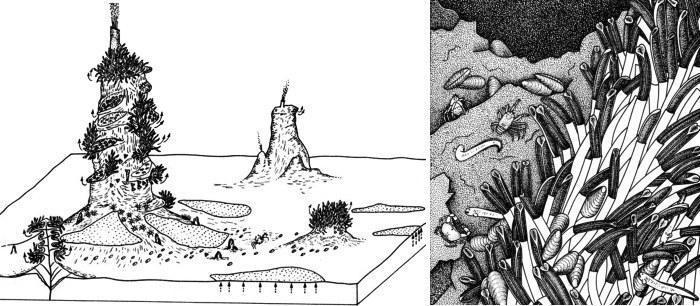
Fig. III-5.1. General view of a "black smoker", as well as riftia (Riftia pachyptila) and associated fauna in close-up
Of course not. The ecosystem of the "black smoker" uses dissolved oxygen in the water, which is the result of photosynthesis. Using solar energy, phototrophs created a difference in redox potentials between the oxygen-containing atmosphere and the reducing interior of the Earth. It is from this difference in chemical potentials that chemotrophs draw their energy. It turns out that phototrophs somehow "feed" chemotrophs!
However amazing such a relationship between two groups of organisms may be, the most ordinary relationships may seem even more remarkable. Our planet is inhabited by two groups of living beings, for each of which the resources are the waste products or metabolic outputs of the other group. These are autotrophs as a whole (including phototrophs) and heterotrophs, which correspond to each other like two halves of a broken plate. Naturally, such a correspondence cannot be coincidental: it reflects an important regularity in the functioning of the biosphere.
Since autotrophs and heterotrophs are inextricably linked, the most important characteristic of the biosphere is the ratio between their main functions: the creation and destruction of organic matter (Fig. III-5.2). This ratio is called the ecological balance (Table III-5.1). Of course, the relationships shown in the figure are simplified. Organic substances are also created during chemosynthesis, and are destroyed during glycolysis (anaerobic breakdown of carbohydrates in tissues; this is why muscles ache after heavy exertion), fermentation, and combustion. Oxygen is not released, and sometimes is even absorbed, in certain bacterial types of chemosynthesis. During aerobic (oxygen) respiration, the rate of organic matter decomposition is much higher; the other two pathways of organic substance breakdown involve the work of an entire complex of functionally different transformer organisms.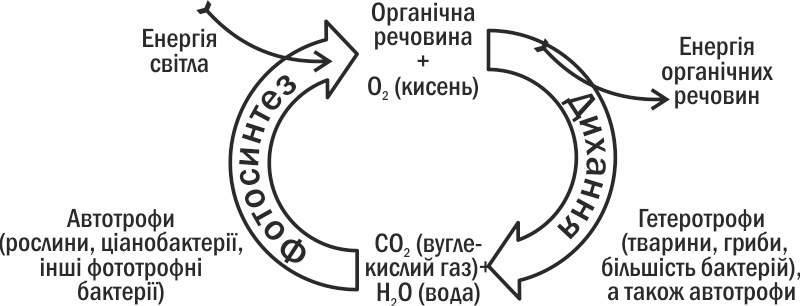
Fig. III-5.2. The ecological balance in the biosphere is based on the equilibrium between photosynthesis and respiration
Table III-5.1. Components of the ecological balance
Despite the diversity of phenomena affecting the creation and destruction of organic matter, the ecological balance in the biosphere can be expressed with sufficient accuracy through the balance of two most powerful processes that change the amount of organic matter — photosynthesis and respiration. Therefore, to some extent this balance can also be expressed through the equilibrium between oxygen and carbon dioxide in the atmosphere.
A fundamental property of the biosphere — a positive balance outcome. The oxygen-containing (i.e., oxidizing), rather than reducing, atmosphere on Earth is the result of a shift in the balance in favor of the predominance of photosynthesis. Some of the oxygen released during this process is spent on oxidizing reducing substances coming from the Earth's interior, and also dissipates into outer space. And what happens to the organic matter equivalent to this oxygen? It accumulates in the ecosystem in the form of detritus (from Latin deterere — to break apart) — organic matter in the process of decomposition. A component of detritus is humus — one of the decomposition products of organic matter. Its components, humic acids, are characterized by variable composition; they include aromatic rings, nitrogen-containing groups, and carbohydrate residues.
The fate of the formed detritus can vary. Some of it will be absorbed by detritivore organisms, which will oxidize it during their respiration. Another part of the detritus may end up in conditions where it becomes inaccessible to oxygen oxidation. Over time, such detritus will be transformed into fossil fuels: peat, shale, coal, and even gas and oil.
Thanks to the fact that in the ecological balance photosynthesis prevails over respiration, a significant amount of organic matter of biogenic origin has accumulated in the crust, and a corresponding amount of oxygen has entered the atmosphere. The oxygen equivalent to the accumulated organic matter has already been consumed in chemical reactions and dissipated into space. This implies that humanity fundamentally cannot burn all the reserves of organic substances accumulated in the Earth's crust — it simply will not have enough atmospheric oxygen for this.
The conditions for the burial of organic matter were different in different periods of Earth's history. For example, in the Carboniferous period, vast areas of the planet were occupied by swamps, on which large clubmosses and horsetails grew. Falling into swampy liquid, the trees found themselves in oxygen-free conditions and over time were transformed into coal (one of the resources upon which our civilization depends). Is it coincidental that during this time the largest terrestrial arthropods existed — dragonflies of the genus Meganeura with a wingspan of half a meter, as well as the myriapod Arthropleura, which reached two meters in length? One of the factors limiting the maximum size of arthropods is the decrease in the efficiency of tracheal respiration with increasing body size. The high oxygen content of the Carboniferous atmosphere mitigated the effect of this constraint.