
Ecology: Biology of Interaction. IV-09. Diversity of Forms of Exploitation
Holophages, true predators, kill prey immediately and consume many prey during their lifetime. Merophages, grazing predators, usually eat only parts of the prey, causing it certain but not necessarily fatal damage. Parasites are closely associated with their host,...
IV-09. Diversity of Forms of Exploitation
Lodyeynikov listened: furiously
A rustle of a thousand deaths flowed through the garden.
Nature, turned at once into hell,
Completed its everyday apogee.
The beetle ate the grass, the bird pecked the beetle,
The weasel drank the brain from the bird's head.
The faces of nocturnal creatures, fearfully and heavily,
Frightened, peered from the grass.
Nature's age-old spindle
United being and death as best it could,
Into one skein, but the mind was powerless
To unite these two mysteries.
Nikolai Zabolotsky, translated by Larysa Vyrovets
The concept of 'predator' seems familiar to everyone. Common consciousness considers 'predators' to be members of the order Carnivora among mammals, the orders Falconiformes and Accipitriformes among birds, and also, probably, sharks and crocodiles. All the more surprising it is to realize that from an ecological point of view, predators are also the ladybug hunting aphids, the water flea filtering algae from water, and even the sundew that gradually digests the mosquito that has settled on its leaf. For all these organisms, it is characteristic that they consume other living organisms, and that the condition for consuming them is depriving them of life. Naturally, the killing of a zebra by a lion is a much more dramatic and bloody event than the 'killing' of unicellular algae by a water flea, but there is no fundamental boundary between these events.
Without rejecting other classifications, in our course we will consider predation as part of a broader category of relationships — exploitation (see item IV-6) — and identify 4 forms of exploitation: true predation (holophogy), grazing predation (merophogy), parasitoidism, and parasitism (Fig. IV-9.1).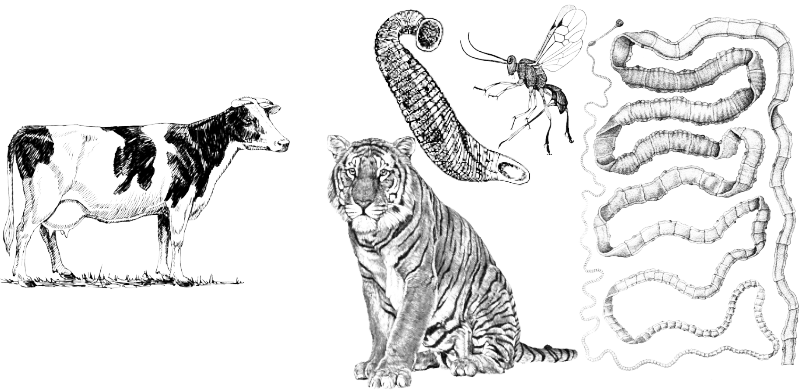
Fig. IV-9.1. A tiger, a medicinal leech, a parasitoid wasp, a tapeworm... Which of these animals belongs to the same group of exploiters as a cow?
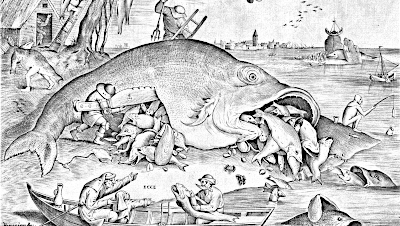
Holophages, true predators, kill prey immediately and consume many prey during their lifetime (a lion, a ladybug, a water flea, a sperm whale, a sundew).
Merophages, grazing predators (a cow, a horsefly, a medicinal leech, a flea) usually eat only parts of the prey, causing it certain but not necessarily fatal damage. During their lifetime, merophages exploit many victims with whom they have no particularly close bonds.
Parasites (tapeworm, HIV, mistletoe, aphid, louse) are closely associated with their host, take only part of its resources and do not necessarily cause death. Their connection with the host is very close; in the typical case, an individual parasite is associated with a single host individual throughout its entire life.
Parasitoids, which include many Hymenoptera (parasitoid wasps, digger wasps) and some Diptera, lead a free lifestyle but lay their eggs in, on, or near the victim. The larvae hatched from the egg consume the victim alive and then kill it: the death of the victim is inevitable, but deferred. Taking into account the number of insects in general and Hymenoptera in particular, such a strategy is by no means rare.
As you can see, the familiar concepts of 'predator' and 'parasite' have become blurred in this classification. Among grazing predators we have included both the cow and the medicinal leech. However, as soon as we turn away from emotional evaluations and, for example, try to model such relationships, we immediately see that the relationships of the cow and the leech with their victims are quite similar. Merophages move through space, finding their victims and taking part of their biomass. However, when a medicinal leech attacks not a cow that has come to drink water, but a toad's tadpole, it interacts with it as a true predator: it kills and eats a significant part of its body.
In everyday interpretation, the concept of 'parasites' includes internal and external parasites. In the sense used here, true parasites are almost exclusively internal parasites and only some external ones. For example, lice are closely associated with their hosts and relatively rarely transfer from one to another. Both their lives and their reproduction are closely linked to the host's body. Therefore, lice can be considered parasites.
Unlike lice, fleas or bedbugs reproduce not on the host's body, but in its 'lair' and easily transfer from one host to another. For their feeding, finding the host on which they will feed next time is important. This allows these insects to be considered merophages, grazing predators.
It is easy to understand that the categories of exploiters identified here are not sharply separated from each other and are connected by transitions.