
Ecology: Biology of Interaction. VI-22. (Supplement) Main Stages of Anthropogenesis
Appendices: Syllabus. Questions. References. Persons. Glossary. R Commands.
VI-22. (Supplement) Main Stages of Anthropogenesis
Say not, "Why were the former days better than these?" for it is not from wisdom that you ask this.
Ecclesiastes
Our family belongs to the order Primates, which includes more than 200 extant species. The earliest undisputed representatives of our order known to us lived 55 million years ago, but their history can be traced even further back. More than 30 million years ago, Aegyptopithecus inhabited North Africa — a possible common ancestor of African apes and humans. It was a small arboreal animal.
Hominoids (representatives of the superfamily Hominoidea, the great apes, which unites humans and gibbons) appeared approximately 23 million years ago; their earliest known representative is Proconsul, an African arboreal ape. The lineage leading to gibbons diverged from the family Hominidae 20 million years ago. The subsequent events of interest to us took place within our own family. The key events pertaining to the emergence of our genus and species occurred in Africa.
The lineage leading to orangutans diverged from ours approximately 14 million years ago, that leading to gorillas approximately 10 million years ago, and that leading to chimpanzees only 5–6 million years ago. Among the earliest representatives of our lineage after its split from the chimpanzee lineage were possibly Sahelanthropus and Orrorin, which lived approximately 6 million years ago. Of the known species, Ardipithecus, which lived 4.4 million years ago, is the best candidate for our ancestor. It was a small animal that apparently moved bipedally, although it inhabited forests rather than open spaces. Ardipithecus was the ancestor of the fairly numerous genus Australopithecus (meaning "southern ape"), which appeared more than 4 million years ago and inhabited the African savannahs, where the advantages of bipedal locomotion were fully realised (Fig. VI-22.1). Those australopithecines most likely to have been our ancestors had a cranial capacity (which allows inference about brain volume) of approximately 430–450 cm³ (chimpanzees have approximately 400 cm³, while modern humans average 1,300 cm³).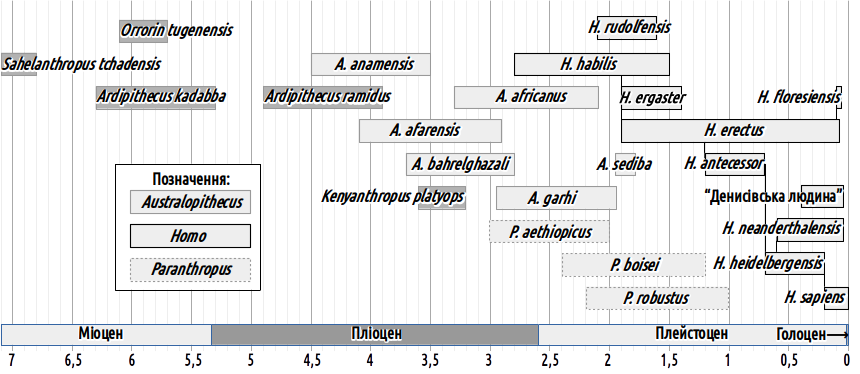
Fig. VI-22.1. Temporal ranges of certain hominin species. Note: not all species are shown here!
The larger descendants of the australopithecines, capable of consuming hard plant food owing to powerful jaws, are assigned to the genus Paranthropus (meaning "the one standing beside the human"), while the smaller ones, not specialised for any particular type of food or mode of obtaining it, are assigned to the genus Homo. For a certain period these two genera developed in parallel, which was manifested, among other things, in the enlargement of brain volume and in the increasing complexity of the tools employed. The distinguishing features of our genus are the manufacture of stone tools (Paranthropus probably used only bone) and a larger brain — generally, with some exceptions, exceeding 600 cm³. However, stone tools are not exclusive to humans: chimpanzees capable of using stone tools have recently been discovered in Africa!
Approximately 2.4 million years ago, the first representatives of the genus Homo appeared in Africa. They are assigned to the species H. habilis — Handy Man. These were small individuals, approximately one and a half metres in height, with a brain volume of 670 cm³, who used crude pebble tools. Contemporaneous with this species was a somewhat larger species (with a relatively flatter face), H. rudolfensis — Rudolph Man (approximately 2 million years ago, 770 cm³), whose remains were first discovered near Lake Rudolf. Homo habilis became extinct approximately 1.5 million years ago, leaving behind promising descendants. Chief among these was H. ergaster — Working Man (1.9–1.6 million years ago, 880 cm³). This species was substantially larger than its predecessors (roughly comparable to modern humans), manufactured sophisticated stone hand-axes, and markedly increased the proportion of meat in its diet (through hunting and scavenging). It was probably this species that first began using fire. The evolutionary leap brought about by the appearance of ergaster was so significant that some scholars consider it more appropriate to assign the two preceding species to the genus Australopithecus and to begin the history of our genus with H. ergaster.
It is from this stage that the dispersal of humans beyond Africa also begins. Remains of H. georgicus, dated to 1.8 million years ago and representing a developmental level intermediate between H. habilis and H. ergaster (brain 600–680 cm³, height 1.5 m, crude stone tools), have been found on the territory of Georgia. Meanwhile, 1.6 million years ago H. ergaster gave rise to another species, H. erectus — Upright Man. Having originated in Africa, this species colonised South Asia.
The representative of H. erectus from the island of Java was at one time described under the name "Pithecanthropus" — "ape-man." He was once imagined as a stooped, grotesque creature more ape-like than human. It is now clear that this species appeared entirely human, differing only in a low forehead (brain volume 900–1,100 cm³), pronounced supraorbital ridges, and a receding chin. This species existed for more than one and a half million years (from 1.6 million to 50 thousand years ago) and colonised vast territories. Moreover, as recent discoveries have demonstrated, Pithecanthropus even mastered seafaring. On the Indonesian island of Flores, remains of a dwarf hominin species, H. floresiensis, have been found; it was apparently a descendant of H. erectus and existed there in the period from 95 to 13 thousand years ago. To reach Indonesia, it or its ancestors had to cross considerable stretches of open sea. Homo floresiensis was very small in stature (approximately 1 m, like a three-year-old child), and it was probably H. erectus that first crossed the ocean. The small brain size (380 cm³) did not prevent the people of Flores from using fire, manufacturing stone tools, and hunting dwarf elephants.
Approximately 1 million years ago in Africa, H. antecessor — Pioneer Man (brain approximately 1,000 cm³) — arose from H. erectus. This species colonised Southern Europe and lived there approximately 800 thousand years ago. It was possibly from this species that H. heidelbergensis — Heidelberg Man — arose in Africa, subsequently spreading widely across Europe. One of the technological innovations of this species was thrown wooden spears with a sharpened tip. Outwardly these people strongly resembled us, differing only in a weak chin protrusion and a number of barely perceptible anatomical features. Approximately 200 thousand years ago, Neanderthal Man — H. neanderthalensis — arose from Heidelberg Man.
Neanderthals existed in Europe and Western Asia in the interval 200–28 thousand years ago, including during the glacial epochs. They were stocky, physically very strong and robust individuals with a brain volume equal to or even greater than that of our species. They made sophisticated tools, buried their dead, and possibly even had some rudiments of art. Analysis of genetic material (mitochondrial DNA) from Neanderthal remains has shown that this was not a subspecies of our species but a separate species that developed in parallel with ours (and coexisted with it for a considerable time). Neanderthal genes are present in the genomes of members of our species, with the exception of the indigenous inhabitants of sub-Saharan Africa. The lineages of our species and the Neanderthals diverged more than half a million years ago. The extinction of the Neanderthals is associated with the disappearance of the mammoth fauna at the end of the last glaciation, and may also have been the result of competitive exclusion by our species.
The earliest known specimen of H. sapiens — Wise Man — is 195 thousand years old. This is the so-called Omo I skull (whose age was previously considered somewhat younger). Our species arose in Africa approximately 200,000 years ago. Roughly three-quarters of our history was spent in Africa. Approximately 60 thousand years ago, as a result of certain events, our species nearly became extinct: all subsequent humans are descendants of a small group that may have numbered only a few dozen individuals. Having survived this crisis, our species began to disperse across Africa and Eurasia. Our species differs from other species of our genus in a more slender build, a higher reproductive rate, greater aggressiveness, and, of course, the most complex and flexible behaviour. The ancient African representatives of our species are assigned to the subspecies H. sapiens idaltu; the later ones, which arose in Africa and dispersed throughout the world, to H. s. sapiens. Members of the latter subspecies who inhabited Europe during the last 40 thousand years are conventionally called Cro-Magnons. After the emergence of the modern human subspecies, its evolution proceeded primarily through cultural rather than biological inheritance.
Throughout most of the history of our family, several species of humans inhabited the Earth simultaneously, and only recently has a single species — our own — remained. The development of our genus probably followed one pattern: new species form in small populations and subsequently disperse widely across the planet. Since humans occupy an exceptionally broad ecological niche, the cohabitation of two or more of their species in the same territory contradicts Gause's competitive exclusion principle. Under such conditions, only one species was inevitably destined to remain.
One might suppose that the only species capable of successfully sharing an ecological niche with H. sapiens would have been H. floresiensis. Island life rendered this species very small and its ecological niche sufficiently distinct from our own. Regrettably, the habitats of H. floresiensis were destroyed in the course of a volcanic eruption (narrow-range species are critically dependent on the preservation of their habitats).