
Ecology: the Biology of Interaction. VI-21. (Supplement) Fear of GM Products (and a Few Words about Democracy)
One of the topics that attracts significant attention from conservation organizations and amateur ecologists is the issue of transgenic or genetically modified (GM) organisms, as well as food products produced from them. So what, does a person have the right to know what they eat? Of course, yes. But they also have the right to proper...
VI-21. (supplementary) Fear of GM Products (and a Few Words About Democracy)
One of the topics that receives significant attention from environmental organizations and lay ecologists is the topic of transgenic or genetically modified (GM) organisms, as well as food products derived from them.
When introducing the category of GM organisms, we unite them not based on their general properties, but according to the characteristic of using a certain method for obtaining them — the transfer of genetic information from one species to another at the stage of obtaining the initial material for further breeding. Examples of GM organisms:
— tomatoes that can be stored for several months at a temperature of 12 degrees, and then ripen quickly if placed in warmth (optimal for ketchup production);
— so-called golden rice, enriched with carotenoids, intended to combat vitamin deficiency in poor countries;
— soy resistant to Roundup (a pesticide, treatment of fields with which is guaranteed to destroy weeds);
— soy, the amino acid composition of proteins (and their nutritional value) of which is close to animal products;
— potatoes that accumulate the toxin of soil bacteria that is lethal for the Colorado potato beetle but harmless for humans;
— crops resistant to diseases, droughts, frosts, and soil salinization (both food and technical, for example cotton).
Currently on sale are sausages, pâtés, chocolate, sauces, chips, carbonated drinks, and other products containing transgenic proteins and DNA. In some cases, the manufacturers themselves cannot know all the characteristics of the raw materials they use. However, the situation can be clarified through expertise that determines the presence in the product of DNA sequences characteristic of the means used in the GM procedure for transferring new information into the genome of the modified species.
The first transgenic plant was grown in 1993, and in 1992 the use of GM organisms in agriculture began (in China). The growth of the agricultural sector in the USA and attempts to supply cheap GM products to Europe gave rise to a powerful public movement directed against both American economic expansion and the technology itself (anti-globalist protests are partly related to the fact that transnational corporations are involved in creating GM organisms). Difficulties in selling GM products slowed the growth of their production, although the USA, Canada, Argentina, Brazil, India, and China continue to increase their volumes.
As of today, the area under GM crops is growing (Fig. VI-21.1, VI-21.2).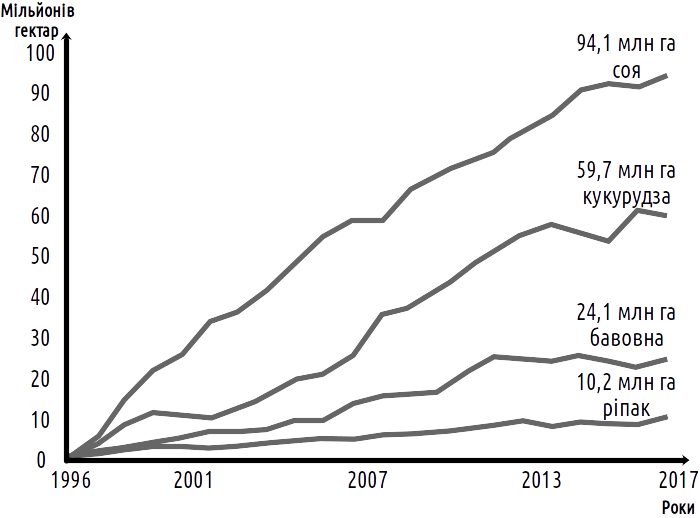
Fig. VI-21.1. Changes in the area under major GM crops; data for 2017 (data source — ISAAA: International Service for the Acquisition of Agri-biotech Applications)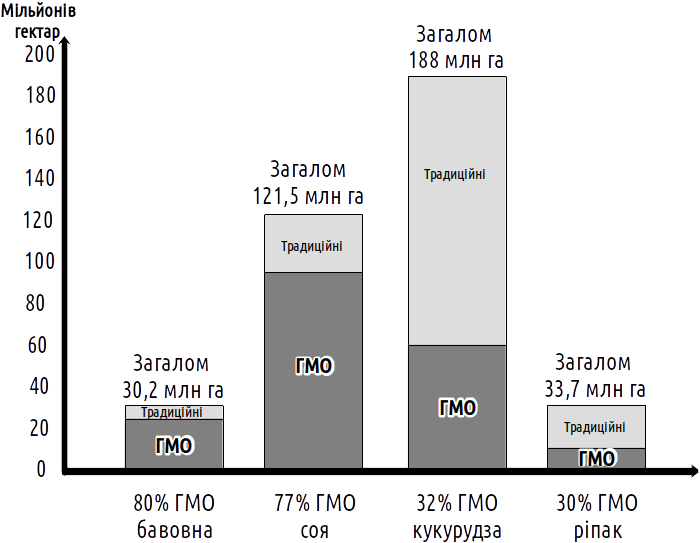
Fig. VI-21.2. Ratio of areas under GM and traditional varieties as of 2017 (data source — ISAAA: International Service for the Acquisition of Agri-biotech Applications)
Due to the acute tension of the disputes, it can be difficult to evaluate the arguments advanced by the parties. The typical tactic of GM product opponents is as follows: some unfavorable property of a certain food is investigated not on a natural sample, but on a transgenic one. For example, Brazil nut proteins can cause allergies. If these proteins are transferred to soy, the possibility of an allergic reaction to them will remain. One registered case of such a reaction is one of the arguments widely used for banning the GM procedure. However, the allergenic properties of these proteins will also be preserved when using natural nuts in salads, but somehow the demand to ban salad preparation does not meet with activist support. Probably the most famous experiments based on this dubious logic were conducted in 1998 by Arpad Pusztai (Arpad Pusztai), a researcher at the Rowett Institute in Aberdeen (Great Britain). He fed rats lectin (a toxin contained in both transgenic and ordinary potatoes) and registered adverse consequences for their health. Expertise showed that Pusztai's experiments did not allow comparison of natural and modified potatoes, because lectin from both natural and transgenic potatoes affects rats equally.
Phytohormones contained in GM soy provoke impotence? Phytohormones unfavorable for libido can also be contained in natural soy! However, for most of the population, premature sensations are probably quite sufficient to stop buying not only soy, but also any other GM products.
In any case, noticeable damage to health caused by consumption of GM products has not been registered so far. American citizens, who are adept at extracting astronomical compensation from firms that failed to warn that spilling hot coffee on oneself can lead to burns, have not found grounds to bring lawsuits against its manufacturers over decades of intense consumption of transgenic food.
The possibility of spread of genes from GM organisms as a result of natural processes seems not to be invented: it has been registered in several completely correct studies. However, in assessing this fact, opponents and supporters of GM products differ greatly. The first speak of ecological catastrophe. The others point out that horizontal transfer of genetic material (including thanks to viruses, which genetic engineers also use) has been going on in nature since time immemorial and has not caused any catastrophe.
What compels GM supporters to overcome stubborn resistance? On the one hand, of course, profits. But their opponents also do not forget about business. A paradox has become the fact that at many conferences calling for the banning of GM organisms, so-called "ecologists" ("greens") are neighbors with producers of pesticides. Unlike the hypothetical harm from transgenic organisms, the harm from pesticides has been proven many times and very convincingly. For example, when discussing the permissibility of distributing transgenic potatoes resistant to the Colorado potato beetle, one should consider, among other things, the damage from chemical pest control agents. On the other hand, besides immediate market conditions, there are weighty strategic considerations that compel transitioning to GM varieties. Their productivity is 15–25% higher than traditional ones, much less pesticides and fertilizers are required for their cultivation, and agro-technologies are less resource-intensive. UN experts do not see a way to satisfy the food needs of Earth's population. The development and use of GM technologies can feed ever new mouths until such time as population growth slows for natural reasons. One of the important technologies for hungry countries is the introduction into plant proteins of essential amino acids characteristic of animal food. This will not only save the lives of many hungry people, but also free them from alimentary marasmus (weakening of mental abilities caused by inadequate food).
So far, opposition to GMOs is limited to advertising campaigns and laws requiring labeling of GMO content in products. Ukraine is the world leader in this regard. According to the law "On Consumer Rights Protection" in Ukraine, the label "GMO-free" must be placed on any products (such as rock salt). Such warnings create the impression that the issue is about something truly horrible.
Humanity stands before a sad fact. Its numbers are much higher than those whose existence can be ensured by "natural" technologies. The call "back to the lifestyle of our great-grandfathers" must be supplemented with specific recommendations about what to do with those who will not have enough resources. Until such recommendations exist, dreams of a simple and natural life remain utopia.
As public opinion polls show, a significant part of the population does not know what genetically modified organisms are, but considers GM products dangerous — if only because they contain genes foreign to humans. But all food contains genes foreign to humans. Like other animals, we can feed only on other organisms or their remains, which practically inevitably contain DNA. For example, bread is a product of processing plant seeds (containing DNA) by single-celled fungi (cells containing their own DNA). Dough is kneaded on water containing live or killed microorganisms, and thus their DNA. Other DNA-containing products can be added to bread (eggs, spices), it can be buttered, which contains DNA fragments from a cow, and caviar, which contains its own DNA, can be placed on it...
The cell is not an environment in which any foreign genetic information can be launched. The method of obtaining dinosaurs played out in "Jurassic Park" as a result of transferring its DNA into a frog egg cell is completely implausible. As a result of such a procedure, only a frog egg cell with destroyed hereditary apparatus will be obtained. During genetic modification of organisms or treatment of genetic diseases, two difficult problems have to be solved: how to deliver the necessary DNA into the nucleus and how to make it work there.
So then, does a person have the right to know what they are eating? Of course, yes. But they also have the right to proper understanding of this knowledge. What does an ordinary person know about modified organisms? That they are dangerous in some way. That there are protests against them. That their content is particularly warned about (harmful, probably). That scientists, as always, say something incomprehensible. No, it's still scary!
The first democracies, in which it became the form of society management, now recognized as optimal, had serious electoral qualifications. For example, in them only free adult men who owned certain property had the right to vote. Besides the understandable reasons related to the desire of dominant groups of people to retain their power, a quite healthy idea was also manifested here. Only those people from whom one could expect the presence of their own opinion could influence decisions on issues submitted to the democratic procedure. The opinion of an illiterate slave or a girl who never left the women's half of the house was not taken into account. Note: the matter is not in the gender of the hypothetical slave and girl we mentioned, nor in their property, but in the absence in them (under the social conditions in which they were formed) of experience in making independent decisions. Counting can be done according to the principle "each vote equals any other" only for comparable and independent voices!
We live during a time of total literacy and the potential possibility of internal freedom extending to all members of society. Any electoral qualification is now meaningless and impossible. But how to account for the difference in the degree of independence of points of view of different people? A person possessing sufficient culture will not impose their opinion in an area in which they are not an expert, but are all people like that? Technologies of advertising, public relations, agitation, propaganda, public campaigns, and other forms of brainwashing, rapidly improving, only reduce the proportion of opinions that can be considered independent. On the one hand, the question of what should be consumed is the most democratic, requiring consideration of the opinion of all members of society. On the other hand, what is the value of the opinion of a person who does not not know what genetically modified organisms are, but considers them harmful in advance?