Ecology: Biology of Interaction. VI-23. (Supplement) Mechanisms of Behaviour in Humans and Other Animals
A remarkable feature of the model of reality constructed by the human mind is that this model includes an image of the person themselves (a phenomenon called reflection, or self-mirroring). A person identifies with the image of the «self» that they themselves construct. It should be noted that the adequacy of this image in the typical case leaves much to be desired...
VI-23. (Supplement) Mechanisms of Behaviour in Humans and Other Animals
From our shaggy relatives we still
wander by roundabout ways.
Our feelings are still four-legged,
some of them even have fins.
Igor Guberman, translated by Larysa Vyrovets
Contemporary biology regards the complex adaptations of organisms (i.e., the correspondences between the properties of organisms, their environment, and their way of life) as the product of evolution. The mechanisms governing human behaviour emerge as a result of the evolution of behavioural mechanisms in other animals. Unfortunately, the study of human behaviour has in our time been ceded to the humanities (the “human scientists”), who most commonly not only fail to understand biology but are on principle unwilling to do so. The humanities habitually treat human behaviour as something fundamentally distinct from the behaviour of other animals. Incidentally, the very formulation “other animals” is a powerful negative stimulus for typical humanities scholars... Comparing the behaviour of humans and other animals — drawing attention to their similar features — is labelled “biologism” in humanistic discourse. Unfortunately, the examination of innate forms of human behaviour is all too often perceived, without any justification, as an attack on human dignity. The discussion of the continuity of human behavioural mechanisms with respect to our relatives is needed, of course, not merely to enlighten the humanities. As we have noted (section 1.14), understanding the properties of biosystems requires taking their prehistory into account. To understand the distinctive features of humankind, it is necessary to examine the evolution of behaviour in other animals.
Behaviour is one of the mechanisms by which an animal adapts to its environment. Since behaviour is a means of adaptation to the environment, we can with full justification examine it from the perspective of ecology, as the science of interaction with the environment. The external (morphological) and internal (anatomical) structure characteristic of a species, its functions (physiology), and its behaviour form a unified adaptive system, in which behaviour is the most labile element. Let us offer three different definitions of the concept of “behaviour,” progressing from the concrete (used for short-term description of an individual) to the general (used for description of a species):
— actions of an organism directed at the environment, constituting a response to external and internal stimuli;
— the characteristic mode of interaction between an organism and its environment, which changes in response to external and internal stimuli;
— the mode, characteristic of representatives of a species, of responding to external and internal stimuli through particular actions.
Behaviour is shaped by the psyche, i.e., the system of internal processes within an organism that ensure control of its behaviour in response to external stimuli (arriving from the environment) and internal stimuli (generated within the psyche itself). In animals, psychic processes take place in the nervous system. Does a psyche exist in organisms other than animals? For example, paramecia demonstrate fairly complex behaviour but lack a nervous system. Can one speak, at least hypothetically, of the “psyche” of a paramecium? This is more a matter of taste (see Fig. 2.1.1). Direct study of the psyche is impossible, and it is therefore studied indirectly, by observing behaviour or the state of the nervous system. The nervous system provides rapid control of behaviour, and the endocrine system influences the character of its functioning.
The mechanisms governing behaviour, in terms of their complexity, can be arranged in a certain sequence. Using superscript indices, we will indicate three groups into which we distribute the elements of this sequence:
Simple reflexesI — Instincts (control of FAPs, fixed action patterns)I —
— Associations (conditioned reflexes)II — ImprintingII — Retention and use of individual experienceII —
— Elementary cognitive processesIII — Cognition (reason)III
Group I comprises innate mechanisms of behaviour. Group II comprises acquired mechanisms. The mechanisms of group III, cognitive mechanisms, are naturally also acquired, but by virtue of the unusual nature of their mechanism (the use of a model of reality constructed within the psyche) they merit special status. In this sequence, each successive element requires an increasingly complex neurological substrate. It is probable that, in the course of evolution, the forms of behaviour standing at the beginning of the sequence appeared earlier than those that follow. In advanced species, however, both “lower” and “higher” forms of behaviour may be retained. Acquired and cognitive mechanisms develop on an innate foundation (at minimum, on the basis of the innate structure of the nervous system).
Simple reflexes may be controlled by a reflex arc consisting of only two neurons: sensory and motor (although usually between the input and output of the reflex arc there exists a more or less complex system of interneurons). Simple reflexes are widespread among various animals, including humans. The classic example of a simple reflex in humans is the patellar reflex.
Instincts form the basis of behaviour in many animals. The concept of “instinct” is a very ancient one. As early as the third century BCE the Stoic philosopher Chrysippus applied it to describe animal behaviour. When speaking of instincts, one generally implied the innate tendencies of animals that determine their behaviour. The classical ethologists Konrad Lorenz and Niko Tinbergen (who together with Karl von Frisch received the Nobel Prize in 1973 for founding this science) regarded instinct as a species-specific sequence of actions that is triggered under certain conditions and directed towards the satisfaction of a particular need.
“Instinct is a temporal morphostructure of an animal that regularly appears in the stream of an animal’s actions in a social situation specific to it.” K. Lorenz.
Instinct is “a hierarchically organised nervous mechanism that responds to certain predisposing and releasing stimuli (external and internal) with fully coordinated, life-significant movements characteristic of the species.” N. Tinbergen.
An important characteristic of instinct, according to Lorenz and Tinbergen, is its automatism. In the typical case, instinct consists of a certain sequence of actions that is carried out as a single whole. Lorenz called this sequence of actions “hereditary coordination,” and Tinbergen called it a “fixed action pattern,” FAP (the term “fixed action complex,” FAC, which we will use hereafter, is also widely employed). Instinctive behaviour satisfies a particular need. In a specific situation, external or internal stimuli (or releasers — signals that liberate the specific energy of an instinctive action) cause the corresponding need to be actualised and produce motivation that controls the animal’s behaviour. Motivation triggers the corresponding FAC (fixed action complex). Thus, an instinct is a system for controlling FACs, consisting of a mechanism for their triggering and execution. It can be represented as the following chain:
(Need + Stimulus) —> Motivation —> FAC
Many dog owners who keep dogs in apartments will have observed how the animals “bury” a treat (for example, a bone) in a corner of the room for later. The dog chooses a sheltered corner, places what it wants to conceal on the floor... and begins to act like a robot. The dog pushes soil — which is not there — over the treat it is hiding, using its muzzle. Its movements are entirely adept; it is obvious that if it were working with loose earth or leaves, it would effectively conceal its cache. Having mechanically executed these actions, the dog walks away and behaves as if its “treasure” is safely hidden (although it remains in plain sight). Against the background of the normally appropriate behaviour of a domestic animal, such actions appear ominously automatic, somehow inanimate; in general, an observer often perceives instinctive actions as mechanical. The fact is that the situation of food-concealment triggers in the dog a FAC honed through many generations of wolves that masked the remains of their prey. Once the FAC was triggered, it executes as a single whole.
Instinctive behaviour is a refined mechanism for reproducing the mode of action that brought success to the ancestors of a given individual. However, the behaviour of most animals also requires other mechanisms that would permit account to be taken of the specific features of the environment in which the individual finds itself. These are the various mechanisms of acquired behaviour.
For example, the behaviour of a hydra is governed by reflexes (such as contraction in response to touch) and instincts (catching prey, locomotion by “somersaulting,” etc.). However, if a water current were to repeatedly touch the hydra’s body with a fragment of aquatic vegetation, the contraction reflex would prove to be suppressed. This is a form of accounting for individual experience.
Conditioned reflexes (associations) were discovered by the 1904 Nobel laureate Ivan Petrovich Pavlov. Simple conditioned reflexes are the establishment of an association (connection) between an unconditional and a neutral stimulus. Thus, in Pavlov’s classic experiment, dogs formed an association between food and an auditory signal. Complex complexes of associations provide dynamic stereotypes, or motor patterns. Dynamic stereotypes differ from FACs in that they develop on the basis of learning and, owing to this, demonstrate incomparably greater flexibility.
Imprinting was discovered by K. Lorenz. It is the lawful memorisation of a key image that occurs at a specific stage of ontogeny. For example, a newborn chick or mammalian infant needs to memorise the characteristic features of its mother. It is born ready to receive the corresponding image and retain it for life. In infancy this image facilitates correct interaction with the parents; later it facilitates recognition of relatives and potential mates.
As the mechanism of individual memory becomes more complex, its potential significance increases. Let us provide two more examples.
The spider wasp Pompilus hunts spiders, including tarantulas. The female wasp paralyses the tarantula by delivering precise stings to the nervous centres of the spider. The female then excavates a burrow, places the spider inside, and lays an egg on it. The larva consumes the spider alive, pupates, and in due course emerges from the burrow, setting out to find a mate for reproduction, while females also seek new spiders. The wasp’s behaviour during the encounter with the spider is governed by instincts. Training it through trial and error is impossible — any mistake would result in the wasp’s death, since the tarantula is a very dangerous adversary. Transmitting experience through learning is also impossible, if only because the wasp never sees its parents. The programme for fighting the spider is an instinct refined over countless generations of wasps. Note that all mother wasps are victors in their encounters with spiders; all of them succeeded in immobilising their prey and laying eggs upon them, from which their offspring successfully hatched. But the wasp’s behaviour also includes acquired elements. Having killed the spider, the wasp hides it in a sheltered spot and excavates a burrow. It then returns for the spider (it remembers where it was hidden) and drags it to the burrow (it remembers where it was excavated).
Let us represent this in a diagram that explains the mechanisms governing behaviour in the majority of animals (Fig. VI-23.1). The foundation of behaviour is the chain explained above: (Need + Stimulus) -> Motivation -> FAC. Adjustment of behaviour to account for local environmental features is provided by acquired behaviour — associations. It is shown that the behaviour of an organism is a means of acting upon the environment and is governed by environmental influences and internal connections.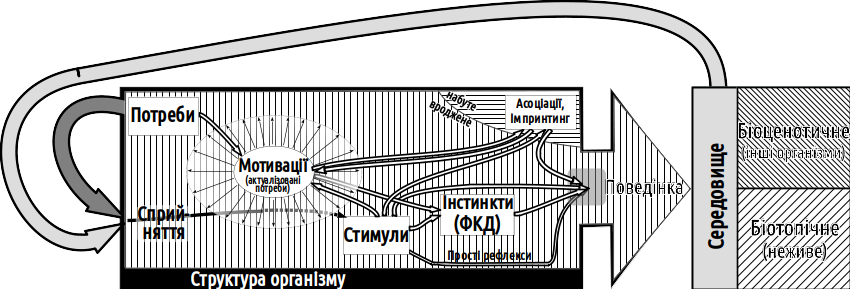
Fig. VI-23.1. Mechanisms underlying the behaviour of the majority of animals (relatively simple behaviour, governed primarily by innate mechanisms)
The refinement of mechanisms for incorporating individual experience opens the way towards the construction within the psyche of a more or less complete model of the aspects of reality that are significant to the animal. As in the case of imprinting, the memory of the spider wasp retains certain images for which it is prepared. However, there may be several such images (in the typical case the wasp paralyses and places several spiders in burrows in sequence). As the memory mechanism becomes more sophisticated, the number of images held within it increases and their diversity grows. Interacting with the biotopic sub-environment (section 5.04), the animal constructs within the psyche a “map” of the locality; for successful adaptation in the biocenotic sub-environment, the memorisation of a multitude of characteristics of representatives of other species, their habits, and their typical manifestations is necessary. Success in the population sub-environment may be linked to the memorisation of the individual characteristics of relatives and the history of interactions with them.
Although acquired behaviour is more “costly” (requiring a more developed nervous system and greater expenditure of energy for its development and functioning), it proves to be more flexible and complex. In certain modes of life, the development of a complex nervous system as a means of enabling flexible acquired behaviour proves to be justified. Note: for the development of acquired behaviour, an innate foundation is required — above all the nervous system that supports it! Selection refining the capacity for developing acquired forms of behaviour will operate in a complex and variable environment. Highly specialised species will, in all likelihood, refine the optimal behaviour of individuals on an innate (more reliable and economical) basis. The complexity of behaviour is particularly promoted by an opportunistic mode of life (from Latin opportunus — convenient, advantageous), i.e., a mode of life of species whose individuals are capable of realising various forms of behaviour depending on the possibilities that open up for them in a diverse environment. The refinement of the behaviour of individuals of such species leads to the construction in their psyche of initially fragmentary and then increasingly developed models of the environment.
For example, animals that colonise a particular territory memorise the positions of landmarks within it and navigate far more confidently than in unfamiliar terrain. Depending on the complexity of their psyche, the colonisation of territory may be associated with different mechanisms. The elephant shrew (order Macroscelidea) constructs a complex system of dynamic stereotypes that allows it to move at high speed from landmark to landmark on its home range. In a group of elephants, a female leader, on the basis of the experience accumulated over her long life, builds up a representation of the features of her home region and guides the group’s migrations in response to weather and the needs of the group. Presumably, in the latter case, memory of a multitude of landmarks is associated with a kind of internal analogue of a “map” (or GPS, a geo-positioning system). The latter case is transitional to the third group of behavioural mechanisms: cognitive ones.
Animals with complex behaviour, such as corvids, parrots, or mammals of the order Carnivora, demonstrate the capacity for what L. V. Krushinsky termed elementary cognitive (or intellectual) processes. The fact is that as the model of reality formed within the animal’s psyche becomes more complex, the possibility of predicting future events on the basis of this model emerges. An animal capable of such prediction will respond not to stimuli from events that have already occurred, but to anticipations derived from the model of reality constructed in its psyche. Let us consider a fairly simple example: the capacity for extrapolation.
An animal is shown bait (food characteristic of it) through a slit in a screen. The slit must be of such a size that it is impossible to seize the bait through it. After the animal has seen the attractive object, the bait is displaced to the right or to the left. If the animal is capable of extrapolating the movement of this object, it will go around the screen from the side towards which the bait has moved. If the subject is incapable of extrapolation, it will go around the screen from one particular side (the more convenient one, or the one from which it once succeeded in obtaining food). It turns out, for example, that hedgehogs are incapable of extrapolating the movement of their prey, while tortoises (including herbivorous ones, whose food cannot run away) are capable. What does the capacity for extrapolation signify? The presence in the psyche of a model that allows prediction of the outcome of movement of an object that has become invisible to the animal.
There is nothing extraordinary about the appearance in animals of the capacity for modelling; such capacity is a logical result of the evolutionary refinement of innate forms of behaviour and the development of acquired forms on their basis. The modelling of reality by means of the psyche opens up potential possibilities for further complexification of behaviour. Figure VI-23.2 shows the mechanism of behavioural control in animals capable of elementary cognitive functions. This diagram is the result of complexification of the mechanism shown in Fig. VI-23.1. Comparing these diagrams, one can see that an additional “level” has been added to the mechanisms of behavioural control.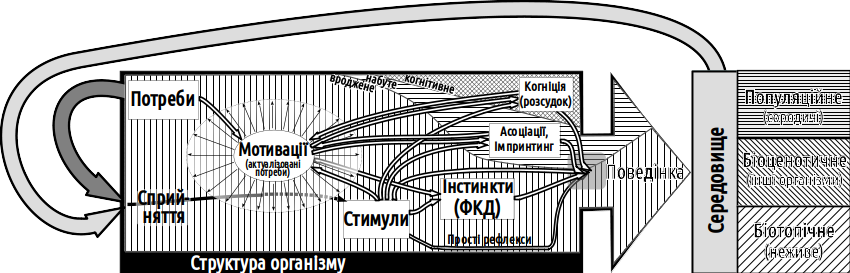
Fig. VI-23.2. Mechanisms underlying the behaviour of highly developed animals capable of elementary cognitive functions
The time has come to discuss the distinctive features of human behaviour. Which of the mechanisms listed above manifest themselves in human behaviour?
Simple reflexes are present in humans, but on the whole they determine a relatively small proportion of its external manifestations.
Instincts, as mechanisms of FAC control, are absent or nearly absent in humans. However, the scientific tradition (including even the humanities) employs the concept of “instinct” in describing human behaviour. The fact is that the classical interpretation of instinctive behaviour by Lorenz and Tinbergen is not the only possible one.
“Instincts are not by nature something vague and undefined, but represent specifically organised motivating forces which, long before they enter consciousness and subsequently, regardless of the degree of awareness, pursue their inherited goals. They are thus very close analogues of archetypes — in fact so close that there are serious grounds for supposing that archetypes are the unconscious images of the instincts, in other words, that they represent the patterns of instinctive behaviour.” C. G. Jung.
Instincts as innate motivations, of the kind described by Carl Gustav Jung, are present in humans (whereas as mechanisms of FACs, in the sense of Lorenz and Tinbergen, they are, we repeat, practically absent). But what distinguishes instincts in Jung’s understanding from instincts in the understanding of Lorenz and Tinbergen? The absence of the final stage of their realisation: the FAC. Why does the last link disappear from the chain (Need + Stimulus) -> Motivation -> FAC? This final stage of instinctive behaviour was reduced in humans in order to yield its role to another, more powerful and flexible mechanism — cognition, reason. In representatives of our species, cognition attains a complexity unreachable for all other species. We form and maintain in our psyche a complex model of reality. The formation of human cognitive mechanisms also proves to be altogether extraordinary. Innate mechanisms of the psyche are formed under the influence of the hereditary programme (naturally, provided that development occurs in the environment normal for the given species; as the experience of “Mowgli” children demonstrates, in an inappropriate environment these programmes cannot be realised). Acquired behavioural mechanisms are formed on the basis of innate structures, which begin to function correctly as a result of certain environmental influences. For example, imprinting is provided by the presence of hereditarily determined structures in the nervous system, which at a certain moment in time are capable of isolating from the stream of external signals that stimulus which will acquire exceptional significance for many instinctive programmes, and retaining this stimulus for life. Reason is formed under the influence of culture, maintained by a particular community. The very emergence of complex culture is a consequence of our capacity for cultural inheritance (see the preceding section). The cultural environment (see section 5.04) powerfully influences the formation of the individual’s psyche.
Thus, typical instincts (in the sense of Lorenz and Tinbergen) in humans are reduced, losing their final (key, for other species) element, and transform into what Jung called instincts. In our view, it would be more accurate to speak of innate motivations or, better still, an innate system of behavioural motivation (ISBM).
How do human reason and its motivations relate to each other? Reason is an instrument of adaptation, serving to solve problems defined by motivations. Many of us have observed situations in which a particular person directs their powerful intellect towards solving problems that appear quite strange to an outside observer. Very often these problems prove to be linked to reproductive or hierarchical behaviour, i.e., they belong to domains where humans have powerful innate behavioural mechanisms. This is how the ISBM manifests itself, setting reason tasks that it will then solve. Fairness requires acknowledging that in a number of cases we can also observe the opposite situation, where entirely rational motivations manifest themselves in a person’s behaviour. The connection between motivations and reason is thus bidirectional.
In the typical case, cognitive control does not generate new motivations but modifies the operation of existing, innate ones. The behaviour of one person is subordinated to an irresistible desire to become a manager; of another, to a manic striving to raise their Hirsch index; of a third, to an acute dream of owning a large red sports car. One might discuss the power-hunger of the first, the “Hirsch-mania” of the second, and the acquisitiveness of the third. A more attentive observer will understand that the energy behind all these desires is supplied by an innate motivation to raise hierarchical status. This motivation is neither bad nor good in itself. However, for those around such a person it is better when this motivation for raising hierarchical status is channelled into, for example, creative endeavour.
It is useful to pay attention to the manifestations of innate motivations in our own behaviour. The chief sign of this for an outside observer is the irrationality of behaviour. The irrationality of a person’s own actions is not apparent to the subject (their reason rationalises all strange acts and provides them with entirely logical explanations). However, the person themselves may also notice several characteristic markers in their own behaviour. These are:
— emotionality (especially poorly controlled emotionality);
— certainty about something that admits of no doubt (outwardly this manifests as dogmatism and bias);
— attribution of special significance to particular details (symbols, etc.);
— earnest seriousness that excludes irony and self-irony;
— a discrepancy between one’s own account of the reasons for one’s behaviour and the assessments of outside observers.
A remarkable feature of the model of reality constructed by the human mind is that this model includes an image of the person themselves (a phenomenon called reflection, or self-mirroring). A person identifies with the image of the “self” that they themselves construct. It should be noted that the adequacy of this image in the typical case leaves much to be desired. The mind in the typical case “does not see” the innate mechanisms that govern it. The idea that innate motivations influence human behaviour provokes protest and accusations of unjustified “biologism”...
This third stage in the complexification of the mechanism of behavioural control is shown in Fig. VI-23.3. The mechanism of FAC control has disappeared; innate motivations have remained (although the motivational system is subject to influence by reason). Reason, which has grown to cyclopean proportions, forms a model of reality, part of which is the image of the “self.” The goals towards the achievement of which reason is employed are determined to a considerable degree by the largely unconscious ISBM.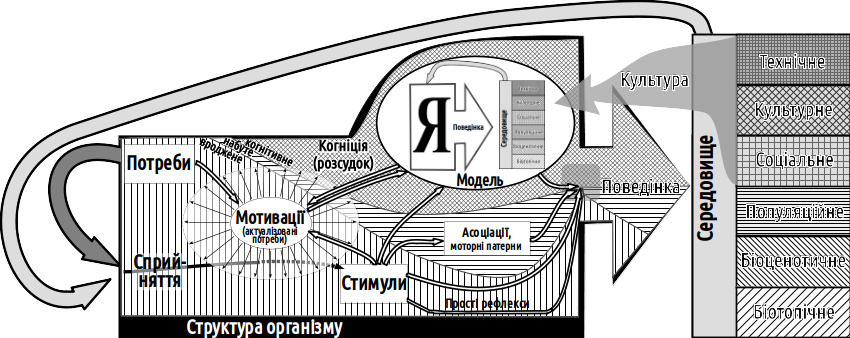
Fig. VI-23.3. Mechanisms underlying human behaviour
The reduction of the final link in the chain of realisation of instinctive behaviour is connected not at all with the fact that “lower” mechanisms of behaviour are incompatible with “higher” ones. In many cases, “lower” mechanisms allow routine behavioural problems to be solved more rapidly and economically. However, the evolution directed towards increasing the flexibility of behaviour was poorly compatible with the rigidity of the FAC. To make the execution of instinctive behaviour flexible is a very difficult problem; it proved simpler to disconnect the FAC and transfer to reason the management of behaviour conditioned by motivations (including those that remained from the partially reduced instincts).
Using the approach described, we can advance in the understanding of several topical problems.
Why do human instincts, unlike those of other animals, permit cognitive control of their realisation? Abraham Maslow, the renowned researcher of the structure of human needs, on this basis denied the presence of instincts in humans... In the light of the foregoing, the reason is clear. In our species the final element of typical instinctive behaviour has been reduced — the very one that ensured the strikingly automatic execution of instinctive behaviour. Human “instincts” (innate motivations) manifest themselves differently: as feelings arising from nowhere, unexpected desires, and goals invisible to reason itself. For their realisation, the full intellectual power of the person is engaged. Naturally, it is precisely these innate motivations that form the foundation of the “unconscious” in Freud’s sense (within a contemporary understanding it is better to speak not of the “subconscious” but of the “unconscious” or of “unconscious psychic processes”).
The fundamental discrepancy between the actual mechanisms of control of human behaviour and the person’s own ideas about their “self” generates a mass of inconsistencies from which one is obliged to defend oneself using mechanisms of rationalisation, repression, and aggressive denial. Actions based on an inadequate assessment of human nature lead time and again to failures. Naturally, most people tend to blame these failures not on the inadequacy of their own models but on the machinations of evil forces or enemies.
A consequence of the defensive mechanisms that prevent reason from perceiving the motivations that govern it is that thoughtful people understand the motives of other people’s behaviour considerably better than their own.
“And why beholdest thou the mote that is in thy brother’s eye, but considerest not the beam that is in thine own eye?
Or how wilt thou say to thy brother, Let me pull out the mote out of thine eye; and, behold, a beam is in thine own eye?
Thou hypocrite, first cast out the beam out of thine own eye; and then shalt thou see clearly to cast out the mote out of thy brother’s eye.”
Gospel of Matthew 7:3–5
The cited passage gives hope for the possibility of “finding the beam in one’s own eye,” i.e., of acknowledging the presence in one’s own psyche of an ISBM that is “invisible” to one’s own reason, and of beginning the fascinating process of tracking and understanding it. Ultimately, such understanding may lead to an expansion of the person’s own freedom through the control (and, when necessary, modification of the action) of previously unconscious psychic mechanisms. The necessary conditions for such self-knowledge are: renouncing the identification of oneself exclusively with the conscious part of one’s psyche, understanding the conditionality of the image of the “Self,” and overcoming the fear of “biologism.” An impartial analysis of our behaviour will reveal not only its evolutionary conditionality and continuity with respect to the behaviour of other animals, but also its uniqueness. Not understanding ourselves, we combine the blind realisation of our biological programmes with the denial of their existence. If we advance in the understanding of ourselves, we will be better able to realise our values.
Additional materials:
Materials for the course “Evolutionary-biological foundations of human behaviour,” where these questions are examined in greater detail
Lecture on irrationality, 10 June 2014
Column: Strategies we are not aware of
Column: The miracle of self-reflection
Column: An integral model of being
Column: Orientation by internal map
Column: Reflex and self
Column: What governs our behaviour?
Column: The roots of personality
Column: Unreliable instincts, or Why there are bad mothers among humans
Column: The creed of a zoologist, or What we can learn from our own animal nature