
Ecology: Biology of Interactions. III-11. Trophic Links and Levels
Autotrophs obtain biogenic elements and the necessary energy from the environment and create organic substances. The organic substances of autotrophs are consumed by some heterotrophs, these heterotrophs -- by others, and so on until the organic matter synthesized by autotrophs is decomposed almost without remainder. These relatio...
III-11. Trophic Links and Levels
The transfer of matter and transformation of energy in ecosystems occurs through the nutrition of organisms. The global processes that support the functioning of the biosphere and make human existence possible are associated with the feeding of countless individual living beings.
Autotrophs obtain biogenic elements and the necessary energy from the environment and create organic substances. The organic substances of autotrophs are consumed by some heterotrophs, these heterotrophs by others, and so on until the organic matter synthesized by autotrophs is decomposed almost without remainder. These relationships, based on nutrition, are called trophic (feeding) links. Their sequences form trophic chains.
A trophic chain is the path of transfer of organic matter and the energy contained in it, from its initial recipients (autotrophs) through a series of organisms that eat one another. Two types of trophic chains are distinguished. Grazing chains lead from green plants to herbivorous animals and on to predators. Detrital chains lead from dead organic matter (detritus) to microorganisms, detritivores, and their predators (Fig. III-11.1).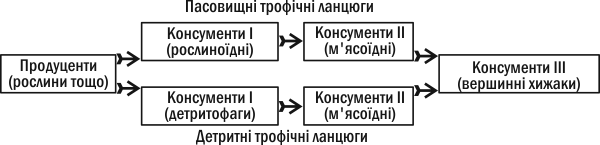
Fig. III-11.1. Grazing and detrital trophic chains are interconnected.
Examining where and how the elements of grazing and detrital chains are arranged, we will see that most biogeocenoses are divided into two layers: an autotrophic layer, well-lit and dominated by production, and a heterotrophic layer, deprived of light and dominated by respiration. In terrestrial biogeocenoses the autotrophic layer lies above the soil, while the heterotrophic layer lies below its surface. In aquatic ecosystems the autotrophic layer is the sunlit water column, while the heterotrophic layer is the dark depths and bottom sediments. Grazing chains extend through the autotrophic layer of ecosystems, while detrital chains extend through the heterotrophic layer. However, these sequences are not independent. Some animals can obtain energy from different chains. A toad going out for an evening walk may eat a leaf beetle that has just been feeding on some garden plant (and thus belongs to one of the grazing chains), or it may catch a ground beetle -- a predatory beetle that fed on subterranean invertebrates from detrital food chains. Thus, we can say that all trophic chains operating within a given ecosystem form its trophic web.
We have one more concept to introduce, related to the trophic structure of communities, and it is precisely this concept that we will use most often hereafter. A trophic level is the totality of organisms in a community that receive solar energy after the same number of transformations. Naturally, the first trophic level is the level of producers. Producers are eaten by first-level consumers, who are in turn eaten by second-level consumers, and so on.
Some species may, in different aspects of their behavior, occupy different levels. Thus, the concept of a trophic level characterizes not a species as such, but the features of its lifestyle in a specific ecological situation. A person may eat potatoes, pork, or even a delicacy frog. In these situations they function as a first-level consumer, then a second-level consumer, and even as a third- or fourth-level consumer. However, setting aside exotic and delicacy foods, we can establish that humans belong to consumer levels I-II, receiving solar energy that has been processed once (by plants) or twice (first by plants, then by herbivorous animals).
An energy flow passes through each trophic level, and the output from one level is the input to the next.
Energy flows through the trophic levels at different speeds. A useful characteristic for describing its flow is turnover time: (turnover) = biomass / net productivity. For algae, turnover time is about a few days; for steppe -- 3 years; for forest -- 25 years.
In forest litter, turnover time ranges from 3 months in a humid tropical forest to 100 years in a montane coniferous forest. Experiments involving the introduction of radioactive tracers into an ecosystem, whose transfer through trophic webs can be tracked, allow us to observe the pattern of matter movement through the ecosystem over time.
The cycling of matter in an individual ecosystem is connected with the cycling of matter in the biosphere as a whole. Sometimes one speaks of the minor and major cycles of matter exchange.