
Ecology: Biology of Interactions. III-10. Nature and Characteristics of Assemblages
{ "title": "", "summary": "", "body": "Probably, the group still represents a real ecological unit. The functioning of the group consists of the activity of its constituent individuals, but it is more than its sum. The efficiency of the group and its stability increase in proportion to how harmoniously, evolutionarily &l..." }
III-10. Nature and Characteristics of Communities
Naturally, the most striking and interesting part of ecosystems are communities — collections of their living components. Interactions between individuals of different species and populations occur within communities. Some of these relationships form quite interesting chains. Let's give just one example that has long become a classic.
"Darwin found that bumblebees with their long proboscis — the only insects capable of pollinating the deep tubular flowers of red clover. From this, he concluded that the spread of red clover in England is explained by the large number of bumblebees. At the same time, referring to one of the entomological works, he points out that most often bumblebee nests are found near cities and villages, where they are less destroyed by voles that eat larvae and pupae. Why are there few voles near cities and villages? It's because there are many cats that significantly reduce the population of voles. A German scientist continued this reasoning as follows: if it is proven, he said, that cats are responsible for the prevalence of clover in England — the main food for cattle, and clover is ecologically linked to the British naval fleet, since beef is the main food for sailors, then, therefore, cats deserve the main credit for Britain being a great naval power. Thomas Huxley took the next step: he argued — partly in jest — that since cats in England are mainly kept by old maids, British power can be logically — and ecologically — derived from the "cat-love" of numerous English grandmothers" (P. Farb, 1971).
As a result of co-evolution, different parts of the community adapt to each other. As a result, many types of communities have a characteristic species composition and a quite definite ratio of organisms belonging to different ecological groups.
Are communities separate objects that are clearly distinguished? Rarely — yes, often — no. At the beginning of the 20th century, a discussion about the nature of communities among American ecologists flared up. F. Clements and other supporters of the organismic concept of ecosystems considered communities as superorganisms. On the contrary, H. Gleason and other supporters of the individualistic concept considered communities as conglomerates of species with similar environmental requirements.
The dispute has not been resolved yet. On the one hand, gradient analysis (i.e., the study of the distribution of species along gradients of change in any significant, primarily climatic, factors) showed that the boundaries of the distribution of individual species do not necessarily coincide with the boundaries of communities (Fig. III-10.1 and III-10.2). The steeper the gradients of conditions, the clearer the boundaries of the distribution of species. The boundaries of the distribution of dominant species are more characteristic than the boundaries of the distribution of random species. On the other hand, since communities have the ability to self-regulate, their boundaries are located quite complexly and cannot be entirely accurately determined using gradient analysis.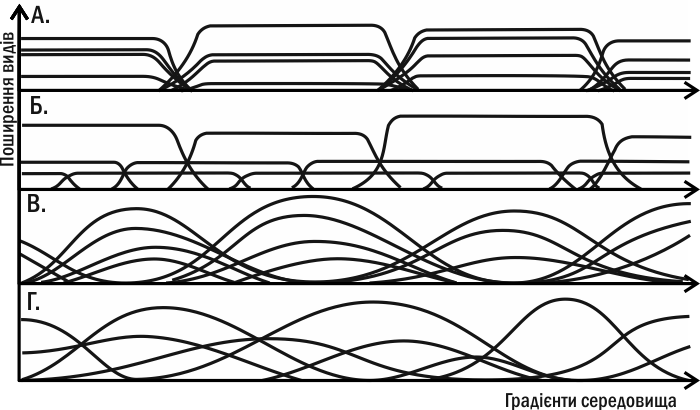
Fig. III-10.1. Theoretical curves showing possible options for changing the occurrence of species along a gradient (smooth change) of some essential factor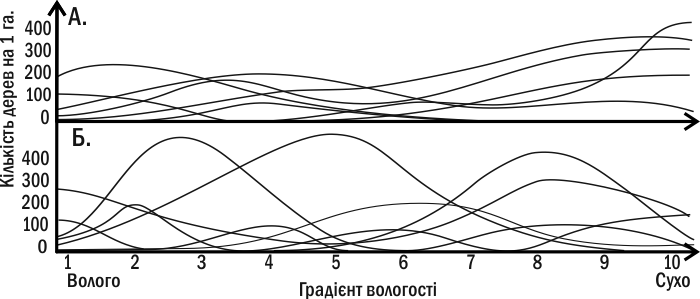
Fig. III-10.2. Real curves of the occurrence of different tree species depending on the gradient of humidity. The recorded curves do not correspond to any of the theoretical options shown in Fig. III-10.1
"On the nesting territory of a pair of great spotted woodpeckers (Dendrocopos major L.) in a suburban oak forest, hundreds of tree trunks of several species, thousands, if not tens of thousands of herbaceous plant stems of dozens of species (strictly speaking, one or more plant associations can be distinguished on this territory); each trunk is a habitat for dozens and hundreds of individuals of several species of xylophagous insects and thousands of individuals of phytophagous insects that feed on green mass, flowers, and fruits; herbaceous plants form habitats for tens of thousands of phytophagous insects and thousands of individuals of their predators; in the forest litter and upper soil horizons, there are thousands and tens of thousands of individuals of dozens of species of insects (predators, saprophages, coprophages), myriapods, arachnids, terrestrial crustaceans, worms, and the number of species of microorganisms (bacteria, fungi, protozoa) living in the soil is calculated in tens, if not hundreds of millions. In addition, in addition to a pair of woodpeckers, one or two pairs of nuthatches (Sitta europaea L.), several pairs of great tits (Parus major L.), pied flycatchers (Ficedula albicolllis (Temm.)), robins (Erithacus rubecula L.), chaffinches (Fringilla coelebs L.), and warblers (Phylloscopus sibilatrix Vieill.) can nest on this territory, and for a predator like the goshawk (Accipiter gentilis L.), this territory may be only a small part (from 1/25 to 1/10) of its nesting and hunting territory. The same territory is occupied by a dozen individuals of shrews (Soricidae) and mouse-like rodents (Muridae), one squirrel (Sciuris vulgaris L.) can feed, and for a weasel (Mustela erminea L.) or a stoat (M. nivalis L.), as well as for a goshawk, this territory is approximately 1/10-1/5 of their foraging territory, not to mention large ungulate mammals (moose (Alces alces L.), roe deer (Capreolus capreolus L.), wild boar (Sus scrofa L.)), for each individual of which a territory of hundreds of times more is required and which can also be detected on this territory if the area of the forest array is large enough or it is connected to neighboring arrays" (Yu.I. Vergeles, 2000).
Probably, the community is still a real ecological unit. The functioning of the community consists of the activities of individuals in its composition, but is something more than its sum. The efficiency of the community and its stability increase in proportion to how harmoniously, evolutionarily "fitted" populations, in its composition. An example of the importance of the "fitting" of species in a community to each other is the reactions of communities to introducents (invaders). Most often, introducents cannot enter the composition of integral communities and die out, but sometimes they give outbreaks of numbers, changing the functioning of communities.
Communities can be complete (including producers, consumers, and reducers) and incomplete.
Communities can be characterized by a number of features, considering their emergent properties that are not present at the level of parts of a holistic system. Some of them are:
The composition of the community (species structure) — the species that make up the community. Most often, the appearance of the community is determined by any basic (or several basic) species. Such species are called edificators. Usually, around individual individuals of edificator species, a complex of species closely associated with it develops — a consortion. Consortia are structural units of communities.
Abundance — the number of individuals per unit area or volume.
Frequency of species — the proportion of individuals of a certain species in relation to the total number of individuals.
Diversity — species richness. It is higher the more species, and lower the more individuals of each species are caught in a separate sample.
Spatial structure — features of the arrangement of individuals relative to each other. Distinguish vertical structure, or stratification, and horizontal — mosaicism. Stratification is characteristic of phytocenoses, consisting of plants that differ in height. An example of stratification in a forest: I — trees of the first magnitude (spruce, pine, oak, birch, aspen); II — trees of the second magnitude (rowan, cherry); III — undergrowth of shrubs (hazel, euonymus, cherry); IV — undergrowth of high shrubs and large herbs (marsh, blueberry, heather, aconite, Ivan-tea); V — low shrubs and small herbs (lingonberry, cranberry, sorrel); VI — mosses, ground lichens, liverworts.
Ecological structure — the ratio of the main ecological groups of organisms, as well as different life forms.
Periodicity — daily, seasonal, long-term, age-related.