VII. Class Mammalia-01. Characteristics of Mammals
What exactly made mammals such a successful group of animals?
Дмитро Шабанов
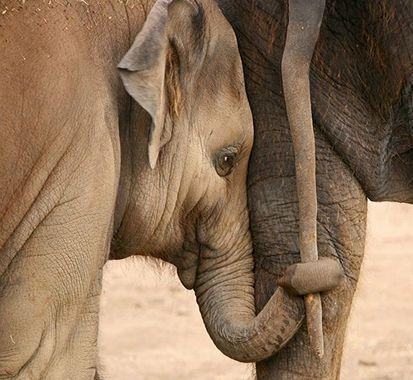
Mammals are “our,” the most understandable to us group of animals. Is the preceding photograph colored for you by some emotion? That is no accident. We are relatives, and even some features of the facial expressions and postures of other species prove understandable to us.
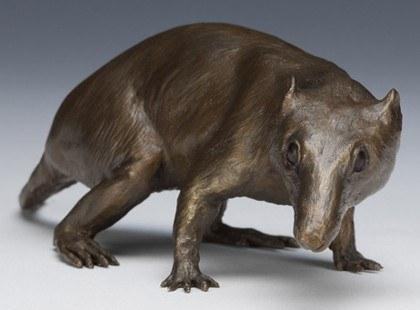
The first mammals were small creatures remotely resembling insectivores, approximately like the Morganucodon shown below. It is the best-studied Triassic mammal known today.
Let us list the main features of mammals. Here they are:
— hair covering;
— homeothermy;
— feeding the young with milk;
— skin with hair and cutaneous glands;
— lower jaw consisting of a single paired bone;
— three auditory ossicles;
— double occipital condyle;
— secondary bony palate;
— heterodont dentition (incisors — canines — molars);
— four-chambered heart, with only the left aortic arch retained;
— body cavity divided by the diaphragm into thoracic and abdominal compartments;
— complex behavior ensured by the cerebral cortex.
Probably many of these features were already characteristic of theromorphs, especially the late ones.
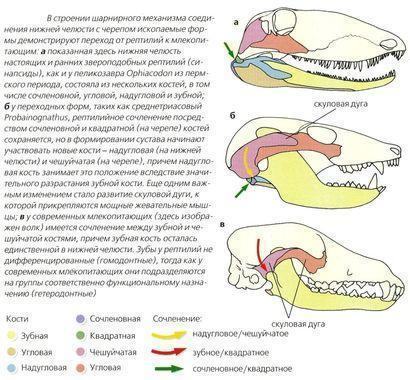
Some of these features require comment. Perhaps one of the principal inventions of mammals is the sturdy lower jaw consisting of the dentary bone. The angular and articular bones, now freed, entered into the composition of the middle ear, as shown in the scheme below.
(clickable)
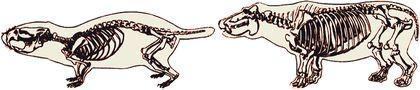
Mammals are an extraordinarily diverse class in terms of size. Small and large mammals live, in essence, in different worlds—they differ very greatly in the relative importance of gravity for them. As an animal grows, its weight increases proportionally to the cube of its size, whereas the strength of the skeleton and muscles increases only proportionally to the square of its size. This leads to the locomotor system of large animals being strengthened disproportionately.
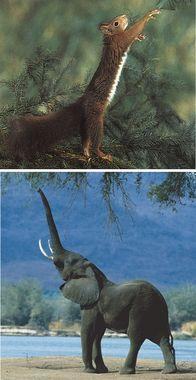
And even so: this squirrel finds it much easier to lift its body than an elephant does, although the locomotor system occupies a greater part of the elephant’s body than of the squirrel’s.
Adaptation to increasingly rapid running and the associated lengthening of the limbs led many mammals to rest not on the whole foot, but only on the toes (or even on their tips, protected by a hoof).
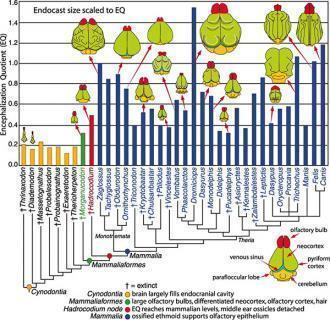
One of the essential features of mammals is the complexity of their behavior, achieved, among other things, through enlargement of the brain. Their encephalization quotient increased substantially in the transition from theromorphs (shown in the diagram by yellow columns). Already Morganucodon (shown by the green column) had a much larger brain; subsequently, the tendency toward brain enlargement only intensified.
(clickable)
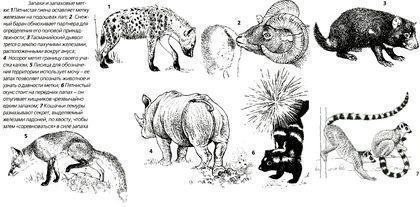
For mammals, as a group descended from nocturnal animals, well-developed olfaction and hearing are characteristic. Vision is not the best developed sense in most mammals. An exception is formed by a few groups, such as primates, in which the role of vision increased many times because of their life in trees.
(clickable)