
Ecology: Biology of Interactions. III-03. Examples of Ecosystems
III-3. Examples of ecosystems
Examples of ecosystems include a pond, a meadow, a city, a forest, a field, etc. Comparison of pond and meadow biomass is shown in Table III-3.1, and comparison of relative energy-flow magnitudes for a freshwater site and a forest is shown in Fig. III-3.1.
In all cases, living organisms and their environment are inseparable. A large fraction of organic matter is in soil or in solid-phase forms.
Table III-3.1 compares two ecosystems (after Odum, 1986):
- Producers: phytoplankton (pond), grasses (meadow)
- Consumers of autotrophic tier: zooplankton (pond), insects (meadow)
- Consumers of heterotrophic tier: benthos (pond), soil invertebrates (meadow)
- Permaneants (large mobile consumers): fish (pond), tetrapods (meadow)
- Decomposers: bacteria and fungi (both systems)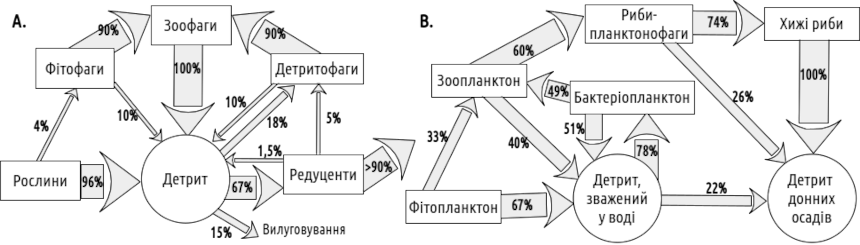
Fig. III-3.1. Comparison of relative energy flows in forest and freshwater ecosystems
A major difference between aquatic and terrestrial ecosystems is that microproducers dominate in water, whereas macroproducers dominate on land. Organic remains decompose more slowly on land; thus more detritus accumulates.
Urban ecosystems are characterized by very intensive energy exchange, high demand for diverse matter and energy inputs, and powerful, heterogeneous waste streams.
Field ecosystems belong to agroecosystems, which occupy a significant part of Earth’s area. They are highly unstable states maintained by muscular labor or fossil-fuel energy inputs. Key differences from natural ecosystems are reduced diversity and predominance of artificially created components. Since agroecosystems are designed for biomass extraction, sustaining their stability requires replenishment of consumed biogenic elements (from fertilizers or imported biomass).
|
Ecological groups |
Pond |
Meadow |
||
|
Composition |
Weight, g/m2 |
Composition |
Weight, g/m2 |
|
|
Producers |
Phytoplankton |
5 |
Grasses |
500 |
|
Consumers of the autotrophic layer |
Zooplankton |
0,5 |
Insects |
1 |
|
Consumers of the heterotrophic layer |
Benthos |
4 |
Soil invertebrates |
4 |
|
4 |
Lower |
15 |
Tetrapods |
15 |
|
15 |
1-10 |
1-10 |
1-10 |
10-100 |
Fig. III-3.1. Comparison of relative energy flows in forest (A.) and freshwater (B.) ecosystems, after Mirkina and Naumova, 2011. Note: Fig. III-3.1 shows not absolute values of energy flows, but approximate ratios of output from each pool. For example, in the case analyzed in the diagram, phytophages take 4% of the plants' energy, and 90% of the phytophages' energy is obtained by zoophages. Leaching is the transfer of substances from the solid phase into solution. Of course, these diagrams are conditional and very simplified (for example, neither aquatic plants nor detritus are shown in the diagram of energy flows in the reservoir), but they still give an idea that energy flows in different systems differ significantly. An important difference between aquatic and terrestrial ecosystems is that microproducers dominate in water, while macroproducers (a large part of whose body consists of transport and support tissues) dominate on land. Organic residues on land are destroyed with more difficulty, and therefore more detritus accumulates there. Features of the urban ecosystem include very intensive energy exchange, a large demand for the influx of diverse substances and energy, and a powerful and diverse waste flow. For example, the annual energy costs to maintain a square meter of lawn in front of a building in a necessary condition are the same as for maintaining a square meter of cornfield. The area providing food for the city must exceed the area of the city itself by 30-100 times or more, and the water catchment basins exploited by the city must be even larger. The field ecosystem belongs to agroecosystems, which occupy a significant part of the planet's area. They are characterized by extremely unstable states, maintained by the input of muscle energy or fossil fuel energy. Important differences between agricultural systems and natural ecosystems are reduced diversity and the prevalence of artificially created components. Since agricultural systems are created to harvest the biomass obtained in them, the condition for maintaining a stable state of agricultural systems is the replenishment of the spent reserve of biogens. Such replenishment can be carried out in various ways - from the use of fertilizers to the use of biomass produced in other ecosystems.