
Ecology: The Biology of Interactions. III-14. (Supplement) School Problems on Ecological Pyramids
Did you know that hippopotamuses come ashore at night to graze? Apparently, in the imagination of the problem-book author and Wikipedia editors, frog tadpoles do something similar. Otherwise, these predominantly herbivorous aquatic larvae of tailless amphibians would be unable to use their scraping mouthparts to hunt terrestrial insects...
Appendices: Syllabus. Questions. References. Persons. Glossary. R commands.
III-14. (Supplement) School Problems on Ecological Pyramids
Teaching any subject is closely linked to assessing student achievement. Things are straightforward when the object of study is formalised. Students who have learned to solve differential equations can be required to solve such equations. That is precisely why nothing is more convenient for a teacher than a good problem book. But sciences differ, and biology has few problems: problems from molecular biology ("given an RNA strand of length...") and problems on the "rule of the ecological pyramid." No test or test-preparation session is complete without these problems. In our ecology textbook we, too, cannot pass over them without comment.
As an example, let us consider a question and answer available on one educational website. A naive schoolgirl asks how to solve the following problem:
"Using the rule of the ecological pyramid, determine and explain how many algae and bacteria are needed for one dolphin weighing 400 kg to grow and survive in the Black Sea."
The question is answered by a teacher with the status of "guru":
"We construct a food chain (approximate): phytoplankton (algae and bacteria) — zooplankton — fish — dolphin. The rule of the ecological pyramid states that only 10 percent of the mass or energy of each previous link in the food chain passes to the next. We calculate starting from the dolphin. If it weighs 400 kg, then the mass of the previous link — fish — was 4,000 kg, i.e., 4 tonnes; the mass of zooplankton will be 40 tonnes; and the mass of algae will accordingly be 400 tonnes."
The guru's answer is impeccable from the standpoint that the schoolgirl who reproduces it will receive the highest mark. But is this answer correct? The issue is not merely that the term "phytoplankton" should not be decoded as "algae and bacteria." Major questions are associated with the so-called "rule of the ecological pyramid" itself. At the time of writing this section, the Ukrainian Wikipedia formulates it as follows: "The rule of the ecological pyramid — the production of organisms at each successive trophic level is always lower, on average by up to 10 times, than the production of the preceding level." This is sometimes called Lindeman's rule, or the ten-percent rule. It is recommended for use both in calculating the ratio of the number of first-order consumers to the number of producers, and in calculating ratios between all subsequent consumer levels.
For example, M. Begon et al. (1989) indicate that herbivorous animals consume a relatively small fraction of plant production. In water this fraction (exploitation efficiency) does not exceed 25 percent; on land it is 15 percent (and usually much less). Plant food — at least green biomass — is a product that is difficult to assimilate. Cell walls of cellulose complicate its digestion, and it contains less energy than meat. Not all the energy contained in leaves is assimilated by herbivorous organisms. The fraction of energy extracted from food is indicated by assimilation efficiency; for leaf-feeding it is close to 50 percent. Finally, not all energy obtained from food will be stored in the consumer's biomass. The ratio of energy stored in production to the amount assimilated is called net production efficiency. For herbivorous insects it is approximately 40 percent, while for mammals it is an order of magnitude lower (1–3 percent).
It is now possible to calculate the ratio of herbivore production to plant production. This quantity is called overall ecological efficiency, or Lindeman efficiency. To compute it, one must multiply (in fractions, not percentages) the efficiencies of exploitation, assimilation, and net production. In the case of locusts feeding on leaves, Lindeman efficiency is 0.15 × 0.5 × 0.4 = 0.03. Note: 3 percent is the upper limit of overall ecological efficiency for terrestrial ecosystems! This limit is calculated for herbaceous plants, for which we assumed that they consist entirely of leaves. If we were to carry out the calculation for trees, we would need to account for the substantial quantity of wood, which is largely inaccessible to herbivorous animals. And the overall ecological efficiency for mammals is less than 1 percent!
Thus, a realistic estimate of the ratio of herbivorous animals to plants is not a tenfold difference but a hundredfold one, and the production of leaf- and grass-eating animals cannot even approach 10 percent of plant production. If we also take into account that one kilogram of animal flesh contains more energy than one kilogram of leaves, the maximum disparity in biomass quantities only increases. Of course, not all plant biomass is equal. Assimilation efficiency when feeding on wood is 15 percent, while when feeding on fruits and seeds it can reach 80 percent; but of course the "quantity of plant matter" must not be calculated exclusively on the basis of fruits and seeds.
Very well, but are calculations based on the "ten-percent rule" valid for subsequent trophic levels? No, and they make no more sense than calculating the average temperature across a hospital including the morgue and the fever ward. A great tit eats a kilogram of insects. A python eats a kilogram-weight guinea pig. How much weight will they each gain? A star pupil and a "guru" teacher would confidently answer: 100 grams each! Not at all — and not only because there are no 100-gram great tits. As shown in the preceding section, the great tit will gain approximately 6 grams, and the python two-thirds of a kilogram.
But even that is not sufficient. The dolphin problem asked how much phytoplankton is needed for a dolphin to "grow and survive." In dolphins, as in most mammals, growth slows sharply and virtually stops some time after sexual maturity is reached. How much phytoplankton is needed to sustain a dolphin that has grown to its 400 kg and is no longer growing? According to the logic of the problems under discussion — none at all. The increment of "dolphin flesh" equals zero, hence the fish required for it is zero, the zooplankton is zero, and the phytoplankton is zero. Really?
When one of the authors of this textbook was still a Soviet schoolboy, he participated in the All-Ukrainian Biology Olympiad. To advance to the national round, the winners of the regional olympiad had to go through preparation supervised by the best teaching specialist. This preparation included problems of the kind exemplified by the dolphin problem. When that schoolboy suggested that calculations based on the "rule of the ecological pyramid" were inapplicable to the case of adult mammals, the only reply he received was: "Can't you read? You must calculate as written!" His attempt to argue led to his being removed from the regional team as incapable of learning. The future ecologist reached the olympiad (and won it) only because the student who asked no unnecessary questions fell ill.
What must be done so that present-day schoolchildren who think of such questions receive more substantive answers? Regrettably, they must be taught to solve problems on the "rule of the ecological pyramid" so that they are not outcompeted by those trained according to the canons of school biology! A fiction that distorts genuine understanding reinforces itself and thereby becomes hopelessly insurmountable...
And finally — a bonus: a brilliant example of a problem on the "rule of the ecological pyramid" that combines a non-existent regularity with biological illiteracy and wishful fantasy. Many years ago this problem appeared in the relevant article of the Russian Wikipedia. At the time of writing this section of our textbook the problem was still in place (Fig. III-14.1). On the same page there is a link to a text by an author of this textbook who once attempted to argue with Wikipedia administrators. The authors of the Ukrainian Wikipedia copied this problem from the Russian one but were, of course, not interested in the criticism. What follows is a quotation.
"An example of an ecological pyramid. Suppose that one person can be fed for a year by 300 trout. To feed them, 90,000 frog tadpoles are needed. To feed these tadpoles, 27,000,000 insects are needed. These insects require 1,000 tonnes of grass for food. If a person were to switch to an exclusively plant-based diet, the intermediate pyramid levels could be bypassed, and then 1,000 tonnes of plant biomass would be sufficient to feed approximately 1,000 times more people."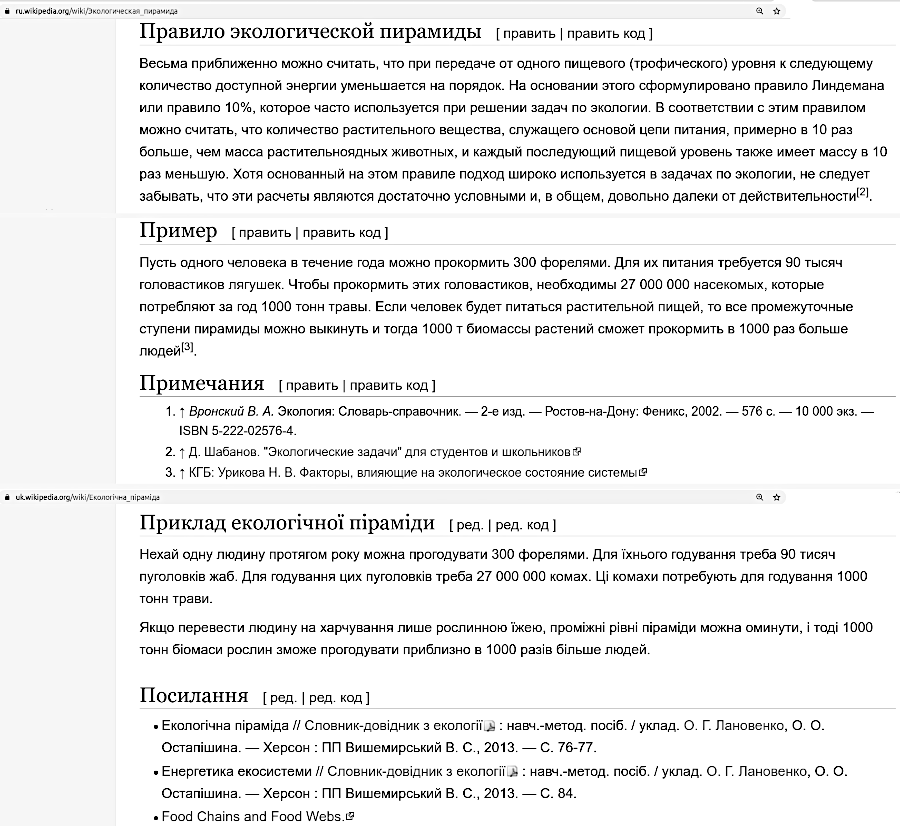
Fig. III-14.1. The point of this screenshot from the Russian and Ukrainian Wikipedia is not an attempt to discredit the world's greatest encyclopaedia. The content of Wikipedia reflects the understanding of its authors, which has been distorted by school education.
Did you know that hippopotamuses come ashore at night to graze? Apparently, in the imagination of the problem-book author and Wikipedia editors, frog tadpoles do something similar. Otherwise, these predominantly herbivorous aquatic larvae of tailless amphibians would be unable to use their scraping mouthparts to hunt terrestrial insects. Just imagine: night falls, somewhere in the distance trout are splashing. Across the floodplain meadow advances a wave of ninety thousand tadpoles devouring insects. Moving towards them under cover of darkness march a thousand "ecologists" grazing on grass that will no longer be available to the hapless victims of the tadpoles...